Advertisements
Advertisements
प्रश्न
Two resistors A and B of 4 Ω and 6 Ω, respectively are connected in parallel. The combination is connected across a 6 volt battery of negligible resistance. Calculate the power dissipated in each resistor.
Advertisements
उत्तर
The effective resistance of 4 Ω and 6 Ω in parallel
The power dissipated in 4 Ω
P = `(6 xx 6)/4`
= 9 W
Power dissipated in 6 Ω
P = `(6 xx 6)/6`
= 6 W
B = 6 W
APPEARS IN
संबंधित प्रश्न
Which particles are responsible for current in conductors?
An electric toaster draws 8 A current in a 220 V circuit. It is used for 2 h. Find the cost of
operating the toaster if the cost of electrical energy is Rs. 4.50 per kWh.
An immersion heater rated 1000 W, 220 V is used to heat 0.01 m3 of water. Assuming that the power is supplied at 220 V and 60% of the power supplied is used to heat the water, how long will it take to increase the temperature of the water from 15°C to 40°C?
What is the current in the circuit shown (Fig. )
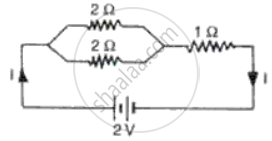
An electric iron rated 750 W is operated for 2 hours/day. How much energy is consumed by the electric iron for 30 days?
What are the two main systems of wiring commonly used in houses? Which of these systems mentioned by you is better and why?
Three 250 W heaters are connected in parallel to a 100 V supply, Calculate total current taken from the supply.
How can electric energy consumed by an electric appliance be calculated in kilowatt hour (kWh)?
A room has AC run for 5 hours a day at a voltage of 220V. The wiring of the room consists of Cu of 1 mm radius and a length of 10 m. Power consumption per day is 10 commercial units. What fraction of it goes in the joule heating in wires? What would happen if the wiring is made of aluminium of the same dimensions?
`[ρ_(Cu) = 1.7 xx 10_(Ωm)^-8, ρ_(Al) = 2.7 xx 10^-8 Ωm]`
