Advertisements
Advertisements
प्रश्न
Two charges q and – 3q are placed fixed on x-axis separated by distance ‘d’. Where should a third charge 2q be placed such that it will not experience any force?
Advertisements
उत्तर
At P: on 2q, Force due to q is to the left and that due to –3q is to the right.
∴ `(2q^2)/(4 piε_0 x^2) = (6q^2)/(4 piε_0 (d + x)^2`
∴ `(d + x)^2 = 3x^2`
∴ `2x^2 - 2dx - d^2` = 0
`x = d/2 + (sqrt(3)d)/2`
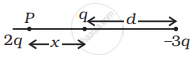
(–ve sign would be between q and – 3q and hence is unacceptable.)
`x = d/2 + (sqrt(3)d)/2 = d/2 (1 + sqrt(3))` to the left of q.
APPEARS IN
संबंधित प्रश्न
The electrostatic force on a small sphere of charge 0.4 μC due to another small sphere of charge − 0.8 μC in air is 0.2 N.
- What is the distance between the two spheres?
- What is the force on the second sphere due to the first?
Three-point charges q, – 4q and 2q are placed at the vertices of an equilateral triangle ABC of side 'l' as shown in the figure. Obtain the expression for the magnitude of the resultant electric force acting on the charge q

(b) Find out the amount of the work done to separate the charges at infinite distance.
Find the dimensional formula of ε0.
Estimate the number of electrons in 100 g of water. How much is the total negative charge on these electrons?
Two small spheres, each with a mass of 20 g, are suspended from a common point by two insulating strings of length 40 cm each. The spheres are identically charged and the separation between the balls at equilibrium is found to be 4 cm. Find the charge on each sphere.
Two identically-charged particles are fastened to the two ends of a spring of spring constant 100 N m−1 and natural length 10 cm. The system rests on a smooth horizontal table. If the charge on each particle is 2.0 × 10⁻⁸ C, find the extension in the length of the spring. Assume that the extension is small as compared to the natural length. Justify this assumption after you solve the problem.
Two particles A and B, each carrying a charge Q, are held fixed with a separation dbetween them. A particle C of mass m and charge q is kept at the middle point of the line AB. If it is displaced through a distance x perpendicular to AB, what would be the electric force experienced by it?
Two particles A and B possessing charges of +2.00 × 10⁻⁶ C and of −4.00 × 10⁻⁶ C, respectively, are held fixed at a separation of 20.0 cm. Locate the points (s) on the line AB, where (a) the electric field is zero (b) the electric potential is zero.
A point charge produces an electric field of magnitude 5.0 NC−1 at a distance of 40 cm from it. What is the magnitude of the charge?
Two equal charges, 2.0 × 10⁻⁷ C each, are held fixed at a separation of 20 cm. A third charge of equal magnitude is placed midway between the two charges. It is now moved to a point 20 cm from both the charges. How much work is done by the electric field during the process?
Two identical particles, each with a charge of 2.0 × 10⁻⁴ C and mass of 10 g, are kept at a separation of 10 cm and then released. What would be the speed of the particles when the separation becomes large?
Write down Coulomb’s law in vector form and mention what each term represents.
The force between two charges 0.06 m apart is 5 N. If each charge is moved towards the other by 0.01 m, then the force between them will become ______.
Polarised dielectric is equivalent to ______.
A spring of spring constant 5 × 10³ N/m is stretched initially by 5 cm from the unstretched position. Then the work required to stretch it further by another 5 cm is:
The capacity of an isolate conducting sphere of radius R is proportional to
The S.I unit of electric permittivity is
