हिंदी
कर्नाटक बोर्ड पी.यू.सी.पीयूसी विज्ञान 2nd PUC Class 12

Two charges q and – 3q are placed fixed on x-axis separated by distance ‘d’. Where should a third charge 2q be placed such that it will not experience any force? - Physics

Advertisements
Advertisements

प्रश्न

Two charges q and – 3q are placed fixed on x-axis separated by distance ‘d’. Where should a third charge 2q be placed such that it will not experience any force?

टिप्पणी लिखिए
Advertisements

उत्तर

At P: on 2q, Force due to q is to the left and that due to –3q is to the right.

∴ `(2q^2)/(4 piε_0 x^2) = (6q^2)/(4 piε_0 (d + x)^2`

∴ `(d + x)^2 = 3x^2`

∴ `2x^2 - 2dx - d^2` = 0

`x = d/2 + (sqrt(3)d)/2`
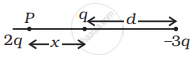
(–ve sign would be between q and – 3q and hence is unacceptable.)

`x = d/2 + (sqrt(3)d)/2 = d/2 (1 + sqrt(3))` to the left of q.

shaalaa.com
  क्या इस प्रश्न या उत्तर में कोई त्रुटि है?
अध्याय 1: Electric Charges And Fields - MCQ I [पृष्ठ ६]

APPEARS IN

एनसीईआरटी एक्झांप्लर Physics [English] Class 12
अध्याय 1 Electric Charges And Fields
MCQ I | Q 1.23 | पृष्ठ ६

संबंधित प्रश्न

A particle of mass m and charge (−q) enters the region between the two charged plates initially moving along x-axis with speed vx (like particle 1 in the fig.). The length of plate is L and an uniform electric field E is maintained between the plates. Show that the vertical deflection of the particle at the far edge of the plate is qEL2/(2m`"v"_"x"^2`).


Four charges +q, −q, +q and −q are to be arranged respectively at the four corners of a square ABCD of side 'a'.
(a) Find the work required to put together this arrangement.
(b) A charge q0 is brought to the centre of the square, the four charges being held fixed. How much extra work is needed to do this ?


A charge of 1.0 C is placed at the top of your college building and another equal charge at the top of your house. Take the separation between the two charges to be 2.0 km. Find the force exerted by the charges on each other. How many times your weight is this force?


Find the electric force between two protons separated by a distance of 1 fermi (1 fermi = 10−15 m). The protons in a nucleus remain at a separation of this order. 


Two charged particles are placed 1.0 cm apart. What is the minimum possible magnitude of the electric force acting on each charge?


Consider a gold nucleus to be a sphere of radius 6.9 fermi in which protons and neutrons are distributed. Find the force of repulsion between two protons situated at largest separation. Why do these protons not fly apart under this repulsion?


Two insulating small spheres are rubbed against each other and placed 1 cm apart. If they attract each other with a force of 0.1 N, how many electrons were transferred from one sphere to the other during rubbing?


Find the ratio of the electrical and gravitational forces between two protons.


Suppose an attractive nuclear force acts between two protons which may be written as F=Ce−kr/r2. Write down the dimensional formulae and appropriate SI units of C and k.   


Two identical balls, each with a charge of 2.00 × 10⁻⁷ C and a mass of 100 g, are suspended from a common point by two insulating strings, each 50 cm long. The balls are held at a separation 5.0 cm apart and then released. Find. 

(a) the electric force on one of the charged balls

(b) the components of the resultant force on it along and perpendicular to the string

(c) the tension in the string

(d) the acceleration of one of the balls. Answers are to be obtained only for the instant just after the release.


Two identical pith balls, each carrying a charge q, are suspended from a common point by two strings of equal length l. Find the mass of each ball if the angle between the strings is 2θ in equilibrium. 


A particle A with a charge of 2.0 × 10⁻⁶ C is held fixed on a horizontal table. A second charged particle of mass 80 g stays in equilibrium on the table at a distance of 10 cm from the first charge. The coefficient of friction between the table and this second particle is μ = 0.2. Find the range within which the charge of this second particle may lie.


A point charge produces an  electric field of magnitude 5.0 NC−1 at a distance of 40 cm from it. What is the magnitude of the charge?


Two identical particles, each with a charge of 2.0 × 10⁻⁴ C and mass of 10 g, are kept at a separation of 10 cm and then released. What would be the speed of the particles when the separation becomes large?


A force F acts between sodium and chlorine ions of salt (sodium chloride) when put 1 cm apart in air. The permittivity of air and dielectric constant of water are `epsilon_0` and K respectively. When a piece of salt is put in water, electrical force acting between sodium and chlorine ions 1 cm apart is ____________.


SI unit of permittivity of free space is ______.


A spring of spring constant 5 × 10³ N/m is stretched initially by 5 cm from the unstretched position. Then the work required to stretch it further by another 5 cm is:


Coulomb's law is given by F = k q1q2 rn where n is 


Electric charge of any system is ______.


Share
Notifications

Englishहिंदीमराठी


      Forgot password?
Use app×