Advertisements
Advertisements
प्रश्न
Two charges 5 μC and -4μC are kept 5.0 m apart at points A and B respectively. How much work will have to be done to move the charge at A through a distance of 5.0 m further away from point B along the line BA?
Advertisements
उत्तर
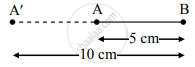
Given: q1 = 5 µC = 5 × 10⁻⁶ C, q2 = 4 μC = −4 × 10⁻⁶ C, r1 = 5 m
To find: Work done (W)
∴ V = `1/(4πε_0)"q"_1/"r"`
= 9 × 10⁹ × `(5xx10^-6)/5`
∴ V = 9 × 10³ V
∴ V = `"W"/"q"_1`
∴ W = V × q1
W = 9 × 103 × 5 × 10-6
W = 45 × 10-3
W = 4.5 × 10⁻² J
APPEARS IN
संबंधित प्रश्न
A hollow charged conductor has a tiny hole cut into its surface. Show that the electric field in the hole is `(sigma/(2in_0)) hat"n"`. where `hat"n"` is the unit vector in the outward normal direction, and `sigma` is the surface charge density near the hole.
The number of electrons in an insulator is of the same order as the number of electrons in a conductor. What is then the basic difference between a conductor and an insulator ?
Answer the following question.
State the units of linear charge density.
In a region where intensity of electric field is 5 NC-1, 40 lines of electric force are crossing per square metre. The number of lines crossing per square metre where intensity of electric field is 10 NC-1 will be ______
Which of the following is three-dimensional continuous charge distribution?
Two large, thin metal plates are parallel and close to each other. On their inner faces, the plates have surface charge densities of opposite signs and of magnitude 17.7 × 10⁻²² C/m2. What is electric field intensity E:
- in the outer region of the first plate, and
- between the plates?
An infinite line charge produces a field of 9 × 10⁴ N/C at a distance of 2 cm. Calculate the linear charge density.
At the atomic level, charge exists in discrete units. What is the fundamental charge unit called, and what is its value?
Under what condition is a charge distribution treated as continuous rather than discrete?
Which of the following best defines linear charge density?
What is the SI unit of surface charge density?
For a linear charge distribution, if the linear charge density is λ and a small element has length dl, what is the charge element dq?
For a volume charge distribution, if the volume charge density is ρ and a small volume element is dV, what is the charge element dq?
A metal plate is an example of which type of charge distribution?
For a linear charge distribution, what is the integral form of the electric field?
For a surface charge distribution, what is the integral form of the electric field?
For a volume charge distribution, what is the integral form of the electric field?
What is the defining characteristic of a uniform charge distribution?
For a uniform charge distribution, what is the mathematical representation of charge density?
What is the defining characteristic of a non-uniform charge distribution?
