Advertisements
Advertisements
प्रश्न
Thinking about Language
Match the words/phrases in Column A with their meanings in Column B.
| A | B |
| 1. slaving | (i) a quarrel or an argument |
| 2. cgaos | (ii) remove something from inside another thing using a sharp tool |
| 3. rummage | (iii) strange, mysterious. Difficult to explain |
| 4. scrape out | (iv) finish successfully, achieve |
| 5. stumble over, tumble into |
(v) search for something by moving things around hurriedly or carelessly |
| 6. accomplish | (vi) completer confusion and disorder |
| 7. uncanny | (vii) fall, or step awkwardly while waking |
| 8. (to have or get into) a | (viii) working hard |
Advertisements
उत्तर
| A | B |
| 1. slaving | (viii) working hard |
| 2. cgaos | (vi) completer confusion and disorder |
| 3. rummage | (v) search for something by moving things around hurriedly or carelessly |
| 4. scrape out | (ii) remove something from inside another thing using a sharp tool |
| 5. stumble over, tumble into |
(vii) fall, or step awkwardly while waking |
| 6. accomplish | (iv) finish successfully, achieve |
| 7. uncanny | (iii) strange, mysterious. Difficult to explain |
| 8. (to have or get into) a | (i) a quarrel or an argument |
संबंधित प्रश्न
Who is the real culprit according to the king? Why does he escape punishment?
Based on your reading of the story, answer the following question by choosing the correct option:
“The very naming of Harold had caused a sacrifice on his part.” The writer’s tone here is
Now, it is your turn. Write and produce your own radio programme. You will need to select your own content. The following are some ideas. You are free, of course, to add your own ideas. Remember, the programme must be in English.
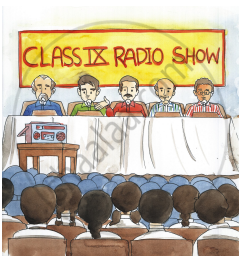
- News stories: about people in your class, about school, about sports (school and local), about the local community
- Comedy: jokes, short plays
- Interviews: with teachers, with exstudents of your school, with a Class IX student who has recently done something very interesting
- Games: general knowledge quiz, panel game, word game
- Advertisements: for shops/industries in the local community, things ‘for sale’ and ‘wanted’ by students
- Local sites: monuments/sites of historical importance and of tourist interest
- Special reports: e.g. safety at school, examination results, school uniform, school assemblies
- Interesting people: role-play interviews with film stars, sports personalities, TV personalities, etc.
- Entertainment reviews: music, films, videos, books, etc.
- Plays
- Songs with lyrics
- Speeches on important personalities
- Tele conference video conference with students, teachers, experts
But even as he approached the boy, Mr. Oliver sensed that something was wrong. The boy appeared to be crying. His head hung down, he held his face in his hands, and his body shook convulsively. It was a strange, soundless weeping, and Mr. Oliver felt distinctly uneasy.
Well, what’s the matter, he asked, his anger giving way to concern. What are you crying for? The boy would not answer or look up. His body continued to be wracked with silent sobbing.
Oh, come on, boy. You shouldn’t be out here at this hour. Tell me the trouble. Look up.
Read the extract given below and answer the question that follow.
Describe the posture of the boy.
After washing from his hands and face the dust and soil of work, Joe left the kitchen, and went to the little bedroom. A pair of large bright eyes looked up at him from the snowy bed; looked at him tenderly, gratefully, pleadingly. How his heart swelled in his bosom! With what a quicker motion came the heart-beats! Joe sat down, and now, for the first time, examining the thin free carefully under the lamp light, saw that it was an attractive face, and full of a childish sweetness which suffering had not been able to obliterate.
“Your name is Maggie?” he said, as he sat down and took her soft little hand in his.
“Yes, sir.” Her voice struck a chord that quivered in a low strain of music.
“Have you been sick long?”
“Yes, sir.” What a sweet patience was in her tone!
“Has the doctor been to see you?”
“He used to come”
“But not lately?”
“No, sir.”
Read the extract given below and answer the questions that follow.
What does Maggie tell Joe?
Lights were shining from every window, and there was a savoury smell of roast goose, for it was New-year’s eve—yes, she remembered that. In a corner, between two houses, one of which projected beyond the other, she sank down and huddled herself together. She had drawn her little feet under her, but she could not keep off the cold; and
she dared not go home, for she had sold no matches, and could not take home even a penny of money. Her father would certainly beat her; besides, it was almost as cold at home as here, for they had only the roof to cover them, through which the wind howled, although the largest holes had been stopped up with straw and rags. Her little hands were almost frozen with the cold. Ah! perhaps a burning match might be some good, if she could draw it from the bundle and strike it against the wall, just to warm her fingers. She drew one out—“scratch!” how it sputtered as it burnt! It gave a warm, bright light, like a little candle, as she held her hand over it. It was really a wonderful light. It seemed to the little girl that she was sitting by a large iron stove, with polished brass feet and a brass ornament. How the fire burned! and seemed so beautifully warm that the child stretched out her feet as if to warm them, when, lo! the flame of the match went out, the stove vanished, and she had only the remains of the half-burnt match in her hand.
Read the extract given below and answer the question that follow.
What did she imagine when she lighted the first match?
The women came out on the shore, and made for the stepping—?stones. They had plenty to laugh and bicker about, as they approached the river in a noisy crowd. They girded up their skirts, so as to jump from stone to stone, and they clanked their sickles and forks together over their shoulders to have ease of movement. They shouted their quarrels above the gush of the river. Noise frightens crocodiles. The big mugger did not move, and all the women crossed in safety to the other bank. Here they had to climb a steep hillside to get at the grass, but all fell to with a will, and sliced away at it wherever there was foothold to be had. Down below them ran the broad river, pouring powerfully out from its deep narrow pools among the cold cliffs and shadows, spreading into warm shallows, lit by kingfishers. Great turtles lived there, and mahseer weighing more than a hundred pounds. Crocodiles too. Sometimes you could see them lying out on those slabs of clay over there, but there were none to be seen at the moment.
Read the extract given below and answer the question that follow.
Why did they shout louder than the sound of the water?
Suddenly all the tension seemed to ebb out of my body as the truth of what he said hit me. Confidently, I drew a line a full foot in back of the board and proceeded to jump from there. I qualified with almost a foot to spare.
That night I walked over to Luz Long’s room in the Olympic village to thank him. I knew that if it hadn’t been for him I probably wouldn’t be jumping in the finals the following day. We sat in his quarters and talked for two hours—about track and field, ourselves, the world situation, a dozen other things.
When I finally got up to leave, we both knew that a real friendship had been formed. Luz would go out to the field the next day trying to beat me if he could. But I knew that he wanted me to do my best—even if that meant my winning.
Read the extract given below and answer the question that follow.
How did Luz Long help Jesse Owens?
The king got angry when he was shown to be wrong ______.
Why was Ravi upset with the elders?
How the discovery of fire has helped the mankind?
There are four pairs of rhyming words in the poem. Say them aloud.
How did Vijay Singh outwit the ghost with his wit and wisdom?
Discuss the question in pairs before you write the answer.
Who did he first choose as his master? Why did he leave that master?
What made Patrick believe that he was lucky?
The words given against the sentences below can be used both as nouns and verbs. Use them appropriately to fill in the blanks.
(i) You deserve a ________________________ on the back for your good performance. (pat)
(ii) The teacher _________________________ the child on the cheek to encourage her.
Do you think it is good to be a rebel?
Can there be a good reason behind speaking when everybody else is silent?
Read the lines given below and answer the following question:
| “But my darling, if you love me,” thought Miss Meadows, “I don’t Mind how much it is. Love me as little as you like.” |
Where was Miss Meadows as she thought these thoughts?
In what ways does power corrupt in the play Macbeth? Discuss any one character who is corrupted by power in the play. Incorporate the following details and answer in 100-150 words.
- The character’s traits before coming to power
- The character’s degeneration after coming into power
