Advertisements
Advertisements
प्रश्न
The torque of a force \[\overrightarrow F \] about a point is defined as \[\overrightarrow\Gamma = \overrightarrow r \times \overrightarrow F.\] Suppose \[\overrightarrow r, \overrightarrow F\] and \[\overrightarrow \Gamma\] are all nonzero. Is \[r \times \overrightarrow\Gamma || \overrightarrow F\] always true? Is it ever true?
Advertisements
उत्तर
\[\text{No, }\overrightarrow r \times \overrightarrow \tau || \overrightarrow \Gamma\text{ is not true.} \]
In fact, it is never true.This is because:
\[ \overrightarrow r \times \overrightarrow \tau \]
\[ = \overrightarrow r \times \left( \overrightarrow r \times \overrightarrow F \right)\]
Applying vector triple product, we get:
\[\overrightarrow r \times \left( \overrightarrow r \times \overrightarrow F \right)\]
\[ = \left(\overrightarrow r . \overrightarrow F \right) \overrightarrow r - \left( \overrightarrow r . \overrightarrow r \right) \overrightarrow F \]
\[ \because \overrightarrow r . \overrightarrow r = r^2 \]
\[ = \left( \overrightarrow r . \overrightarrow F \right) \overrightarrow r {}^{-r^2} \overrightarrow F \]
\[\text{If }\overrightarrow r . \overrightarrow F = 0; \text{ that is, }\overrightarrow r {}^{\perp}\overrightarrow F,\text{ then} \]
\[\overrightarrow r \times \overrightarrow \Gamma = {}^{-r^2}\overrightarrow F \]
\[\text{We know that }r^2\text{ is never negative and }\overrightarrow r \times \overrightarrow \Gamma = -r^2 \overrightarrow F \]
This implies that both vectors may be antiparallel to each other but not parallel.
APPEARS IN
संबंधित प्रश्न
Find the components along the x, y, z axes of the angular momentum l of a particle, whose position vector is r with components x, y, z and momentum is p with components px, py and 'p_z`. Show that if the particle moves only in the x-y plane the angular momentum has only a z-component.
Two particles, each of mass m and speed v, travel in opposite directions along parallel lines separated by a distance d. Show that the angular momentum vector of the two particle system is the same whatever be the point about which the angular momentum is taken.
A solid cylinder of mass 20 kg rotates about its axis with angular speed 100 rad s–1. The radius of the cylinder is 0.25 m. What is the kinetic energy associated with the rotation of the cylinder? What is the magnitude of the angular momentum of the cylinder about its axis?
The density of a rod gradually decreases from one end to the other. It is pivoted at an end so that it can move about a vertical axis though the pivot. A horizontal force F is applied on the free end in a direction perpendicular to the rod. The quantities, that do not depend on which end of the rod is pivoted, are ________________ .
A particle of mass m is projected with a speed u at an angle θ with the horizontal. Find the torque of the weight of the particle about the point of projection when the particle is at the highest point.
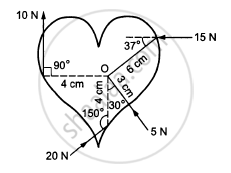
Calculate the total torque acting on the body shown in the following figure about the point O.
A 6⋅5 m long ladder rests against a vertical wall reaching a height of 6⋅0 m. A 60 kg man stands half way up the ladder.
- Find the torque of the force exerted by the man on the ladder about the upper end of the ladder.
- Assuming the weight of the ladder to be negligible as compared to the man and assuming the wall to be smooth, find the force exerted by the ground on the ladder.
The ratio of the acceleration for a solid sphere (mass m and radius R) rolling down an incline of angle θ without slipping and slipping down the incline without rolling is, ______
Define torque and mention its unit.
What are the conditions in which force can not produce torque?
State conservation of angular momentum.
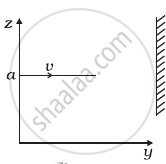
A particle of mass m is moving in yz-plane with a uniform velocity v with its trajectory running parallel to + ve y-axis and intersecting z-axis at z = a (Figure). The change in its angular momentum about the origin as it bounces elastically from a wall at y = constant is ______.
A Merry-go-round, made of a ring-like platform of radius R and mass M, is revolving with angular speed ω. A person of mass M is standing on it. At one instant, the person jumps off the round, radially away from the centre of the round (as seen from the round). The speed of the round afterwards is ______.
Figure shows two identical particles 1 and 2, each of mass m, moving in opposite directions with same speed v along parallel lines. At a particular instant, r1 and r2 are their respective position vectors drawn from point A which is in the plane of the parallel lines. Choose the correct options:
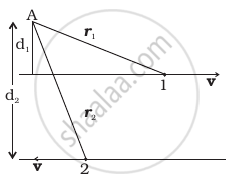
- Angular momentum l1 of particle 1 about A is l1 = mvd1
- Angular momentum l2 of particle 2 about A is l2 = mvr2
- Total angular momentum of the system about A is l = mv(r1 + r2)
- Total angular momentum of the system about A is l = mv (d2 − d1)
⊗ represents a unit vector coming out of the page.
⊗ represents a unit vector going into the page.
Two discs of moments of inertia I1 and I2 about their respective axes (normal to the disc and passing through the centre), and rotating with angular speed ω2 and ω2 are brought into contact face to face with their axes of rotation coincident.
- Does the law of conservation of angular momentum apply to the situation? why?
- Find the angular speed of the two-disc system.
- Calculate the loss in kinetic energy of the system in the process.
- Account for this loss.
A spherical shell of 1 kg mass and radius R is rolling with angular speed ω on horizontal plane (as shown in figure). The magnitude of angular momentum of the shell about the origin O is `a/3 R^2` ω. The value of a will be:

The position vector of 1 kg object is `vecr = (3hati - hatj)` m and its velocity `vecv = (3hati + hatk)` ms−1. The magnitude of its angular momentum is `sqrtx` Nm where x is ______.
Angular momentum of a single particle moving with constant speed along the circular path ______.
