Advertisements
Advertisements
प्रश्न
A flywheel of moment of inertia 5⋅0 kg-m2 is rotated at a speed of 60 rad/s. Because of the friction at the axle it comes to rest in 5⋅0 minutes. Find (a) the average torque of the friction (b) the total work done by the friction and (c) the angular momentum of the wheel 1 minute before it stops rotating.
Advertisements
उत्तर
Let the angular deceleration produced due to frictional force be α.
Initial angular acceleration,
\[\omega_0 = 60 rad/s\]
Final angular velocity,
\[\omega = 0\]
t = 5 min =300 s
We know that
\[\omega = \omega_0 + \alpha t\]
\[\Rightarrow \alpha = - \frac{\omega_0}{t}\]
\[ \Rightarrow \alpha = - \left( \frac{60}{300} \right) = - \frac{1}{5} rad/ s^2\]
(a) Torque produced by the frictional force (R),
\[\tau = I\alpha = 5 \times $\left( \frac{- 1}{5}
right)\]
= 1 N - m opposite to the rotation of wheel
(b) By conservation of energy,
Total work done in stopping the wheel by frictional force = Change in energy
\[W = \frac{1}{2}I \omega^2 \]
\[ = \frac{1}{2} \times 5 \times \left( 60 \times 60 \right)\]
\[ = 9000 \text{ joule }= 9 kJ\]
(c) Angular velocity after 4 minutes,
\[\omega = \omega_0 + \alpha t\]
\[ = 60 - \frac{4 \times 60}{5}\]
\[ = \frac{60}{5} = 12 rad/s\]
So, angular momentum about the centre,
\[L = I\omega\]
\[ = 5 \times 12 = 60 kg - m^2 /s\]
APPEARS IN
संबंधित प्रश्न
Find the components along the x, y, z axes of the angular momentum l of a particle, whose position vector is r with components x, y, z and momentum is p with components px, py and 'p_z`. Show that if the particle moves only in the x-y plane the angular momentum has only a z-component.
The torque of the weight of any body about any vertical axis is zero. If it always correct?
The torque of a force \[\overrightarrow F \] about a point is defined as \[\overrightarrow\Gamma = \overrightarrow r \times \overrightarrow F.\] Suppose \[\overrightarrow r, \overrightarrow F\] and \[\overrightarrow \Gamma\] are all nonzero. Is \[r \times \overrightarrow\Gamma || \overrightarrow F\] always true? Is it ever true?
If the resultant torque of all the forces acting on a body is zero about a point, is it necessary that it will be zero about any other point?
A particle of mass m is projected with a speed u at an angle θ with the horizontal. Find the torque of the weight of the particle about the point of projection when the particle is at the highest point.
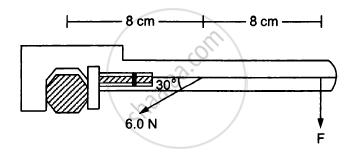
When a force of 6⋅0 N is exerted at 30° to a wrench at a distance of 8 cm from the nut it is just able to loosen the nut. What force F would be sufficient to loosen it if it acts perpendicularly to the wrench at 16 cm from the nut?
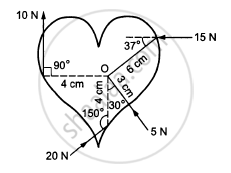
Calculate the total torque acting on the body shown in the following figure about the point O.
A cubical block of mass m and edge a slides down a rough inclined plane of inclination θ with a uniform speed. Find the torque of the normal force acting on the block about its centre.
A rope is wound around a hollow cylinder of mass 3 kg and radius 40 cm. What is the angular acceleration of the cylinder if the rope is pulled with a force of 30 N?
A Merry-go-round, made of a ring-like platform of radius R and mass M, is revolving with angular speed ω. A person of mass M is standing on it. At one instant, the person jumps off the round, radially away from the centre of the round (as seen from the round). The speed of the round afterwards is ______.
The net external torque on a system of particles about an axis is zero. Which of the following are compatible with it?
- The forces may be acting radially from a point on the axis.
- The forces may be acting on the axis of rotation.
- The forces may be acting parallel to the axis of rotation.
- The torque caused by some forces may be equal and opposite to that caused by other forces.
A spherical shell of 1 kg mass and radius R is rolling with angular speed ω on horizontal plane (as shown in figure). The magnitude of angular momentum of the shell about the origin O is `a/3 R^2` ω. The value of a will be:

A rod of mass 'm' hinged at one end is free to rotate in a horizontal plane. A small bullet of mass m/4 travelling with speed 'u' hits the rod and attaches to it at its centre. Find the angular speed of rotation of rod just after the bullet hits the rod 3. [take length of the rod as 'l']
The position vector of 1 kg object is `vecr = (3hati - hatj)` m and its velocity `vecv = (3hati + hatk)` ms−1. The magnitude of its angular momentum is `sqrtx` Nm where x is ______.
The magnitude of the torque on a particle of mass 1 kg is 2.5 Nm about the origin. If the force acting on it is 1 N, and the distance of the particle from the origin is 5 m, the angle between the force and the position vector is (in radians) ______.
A solid sphere is rotating in free space. If the radius of the sphere is increased while keeping the mass the same, which one of the following will not be affected?
