Advertisements
Advertisements
प्रश्न
The table shows the mass of the planets, the sun and the moon in our solar system.
| Celestial Body |
Mass (kg) | Mass (kg) Standard Notation |
| Sun | 1,990,000,000,000,000,000,000,000,000,000 | 1.99 × 1030 |
| Mercury | 330,000,000,000,000,000,000,000 | |
| Venus | 4,870,000,000,000,000,000,000,000 | |
| Earth | 5,970,000,000,000,000,000,000,000 | |
| Mars | 642,000,000,000,000,000,000,000,000,000 | |
| Jupiter | 1,900,000,000,000,000,000,000,000,000 | |
| Saturn | 568,000,000,000,000,000,000,000,000 | |
| Uranus | 86,800,000,000,000,000,000,000,000 | |
| Neptune | 102,000,000,000,000,000,000,000,000 | |
| Pluto | 12,700,000,000,000,000,000,000 | |
| Moon | 73,500,000,000,000,000,000,000 |
- Write the mass of each planet and the Moon in scientific notation.
- Order the planets and the moon by mass, from least to greatest.
- Which planet has about the same mass as earth?
Advertisements
उत्तर
a. Mass of each planet and Moon in scientific notation is given below:
Using law of exponents,
am × an = am + n
Sun = 199 × 1028
= 1.99 × 1028 × 102
= 1.99 × 1030
Mercury = 33 × 1022
= 3.3 × 1022 × 10
= 3.3 × 10²³
Venus = 487 × 1022
= 4.87 × 1022 × 102
= 4.87 × 1024
Earth = 597 × 1022
= 5.97 × 1022 × 102
= 5.97 × 1024
Mars = 642 × 1027
= 6.42 × 1027 × 102
= 6.42 × 1029
Jupiter = 19 × 1026
= 1.9 × 1026 × 10
= 1.9 × 1027
Saturn = 568 × 1024
= 5.68 × 1024 × 102
= 5.68 × 1026
Uranus = 868 × 1023
= 8.68 × 1023 × 102
= 8.68 × 1025
Neptune = 102 × 1024
= 1.02 × 1024 × 102
= 1.02 × 1026
Pluto = 127 × 1020
= 1.27 × 1020 × 102
= 1.27 × 10²²
Moon = 795 × 1020
= 7.95 × 1020 × 102
= 7.95 × 10²²
b. Order of mass of all planets and Moon from least to greatest
Pluto < Moon < Mercury < Venus < Earth < Uranus < Neptune < Saturn < Jupiter < Mars
c. Venus has about the same mass as Earth.
APPEARS IN
संबंधित प्रश्न
Suppose you have a stretching machine which could stretch almost anything. For example, if you put a 5 metre stick into a (× 4) stretching machine (as shown below), you get a 20 metre stick. Now if you put 10 cm carrot into a (× 4) machine, how long will it be when it comes out?
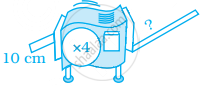
Two machines can be hooked together. When something is sent through this hook up, the output from the first machine becomes the input for the second. Which stretching machine does the same work as two (× 2) machines hooked together?
  |
Find three repeater machines that will do the same work as a (× 64) machine. Draw them, or describe them using exponents.
Ajay had a 1 cm piece of gum. He put it through repeater machine given below and it came out `1/(100,000)` cm long. What is the missing value?

Neha needs to stretch some sticks to 252 times their original lengths, but her (× 25) machine is broken. Find a hook-up of two repeater machines that will do the same work as a (× 252) machine. To get started, think about the hookup you could use to replace the (× 25) machine.

Find two repeater machines that will do the same work as a (× 81) machine.
Find three machines that can be replaced with hook-ups of (× 5) machines.
The left column of the chart lists the lengths of input pieces of ribbon. Stretching machines are listed across the top. The other entries are the outputs for sending the input ribbon from that row through the machine from that column. Copy and complete the chart.
| Input Length | Machine | |||
| × 2 | ||||
| 1 | 5 | |||
| 3 | 15 | |||
| 14 | 7 | |||
The distance between the Sun and the Earth is 1.496 × 10⁸ km and distance between the Earth and the Moon is 3.84 × 10⁸ m. During solar eclipse the Moon comes in between the Earth and the Sun. What is distance between the Moon and the Sun at that particular time?
A particular star is at a distance of about 8.1 × 10¹³ km from the Earth. Assuring that light travels at 3 × 10⁸ m per second, find how long does light takes from that star to reach the Earth.
