Advertisements
Advertisements
प्रश्न
The radius of a spherical balloon increases from 7 cm to 14 cm as air is being pumped into it. Find the ratio of surface areas of the balloon in the two cases.
Advertisements
उत्तर
Radius (r1) of spherical balloon = 7 cm
Radius (r2) of the spherical balloon, when air is pumped into it = 14 cm
Required ratio = `"Initial surface area"/"Surface area after pumping air into a balloon"`
= `(4pir_1^2)/(4pir_2^2)` = `(r_1/r_2)^2`
= `(7/14)^2` = `1/4`
Therefore, the ratio between the surface areas in these two cases is 1 : 4.
APPEARS IN
संबंधित प्रश्न
A certain number of metallic cones, each of radius 2 cm and height 3 cm are melted and recast into a solid sphere of radius 6 cm. Find the number of cones.
Two solid spheres of radii 2 cm and 4 cm are melted and recast into a cone of height 8 cm. Find the radius of the cone so formed.
A solid cone of radius 5 cm and height 8 cm is melted and made into small spheres of radius 0.5 cm. Find the number of spheres formed.
Find the surface area of a sphere of diameter 21 cm.
Find the surface area of a sphere of diameter 3.5 cm.
Find the total surface area of a hemisphere and a solid hemisphere each of radius 10 cm.
(Use 𝜋 = 3.14)
The surface area of a sphere is 5544 `cm^2`, find its diameter.
Eight metallic spheres; each of radius 2 mm, are melted and cast into a single sphere. Calculate the radius of the new sphere.
A solid rectangular block of metal 49 cm by 44 cm by 18 cm is melted and formed into a solid sphere. Calculate the radius of the sphere.
Find the maximum volume of a cone that can be carved out of a solid hemisphere of radius r cm.
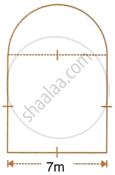
The cross-section of a tunnel is a square of side 7 m surmounted by a semi-circle as shown in the adjoining figure. The tunnel is 80 m long.
Calculate:
- its volume,
- the surface area of the tunnel (excluding the floor) and
- its floor area.
The hollow sphere, in which the circus motor cyclist performs his stunts, has a diameter of 7 m. Find the area available to the motorcyclist for riding.
The largest sphere is cut off from a cube of side 6 cm. The volume of the sphere will be
Find the surface area and volume of sphere of the following radius. (π = 3.14 )
9 cm
Find the radius of a sphere whose surface area is equal to the area of the circle of diameter 2.8 cm
There is surface area and volume of a sphere equal, find the radius of sphere.
There is a ratio 1: 4 between the surface area of two spheres, find the ratio between their radius.
A sphere cut out from a side of 7 cm cubes. Find the volume of this sphere?
The cylinder of radius 12 cm have filled the 20 cm with water. One piece of iron drop in the stands of water goes up 6.75 cm. Find the radius of sphere piece.
A solid sphere is cut into two identical hemispheres.
Statement 1: The total volume of two hemispheres is equal to the volume of the original sphere.
Statement 2: The total surface area of two hemispheres together is equal to the surface area of the original sphere.
Which of the following is valid?
