Advertisements
Advertisements
प्रश्न
The potential energy of your body is least when you are ______.
पर्याय
sitting on a chair
Sitting on the ground
sleeping on the ground
standing on the ground
Advertisements
उत्तर
The potential energy of your body is least when you are sleeping on the ground.
Explanation:
Based on its position, any object can store energy. Potential energy is the stored energy in that position. For example, a drawn bow stores energy due to its position. When the bow is in its usual posture, that is, when it is not drawn, no energy is stored in it. However, if its position is altered from its typical equilibrium state, it can store energy as a result of its position.
When it comes to gravitational potential energy. A relationship between an object's height and gravitational potential energy is observed. The gravitational potential energy of an object increases with its elevation.
A person seated in a chair is the most elevated of the possibilities shown. As a result, it possesses the most potential energy. When sleeping or lying down on the ground, a person's height from the ground is at its lowest. As a result, when a person sleeps on the ground, his or her potential energy is limited.
APPEARS IN
संबंधित प्रश्न
A mass of 10 kg is at a point A on a table. It is moved to a point B. If the line joining A and B is horizontal, what is the work done on the object by the gravitational force? Explain your answer.
The potential energy of a freely falling object decreases progressively. Does this violate the law of conservation of energy? Why?
State two factors on which the potential energy of a body at a certain height above the ground depends.
Two bodies A and B of masses 10 kg and 20 kg respectively are at the same height above the ground. Which of the two has greater potential energy?
Write the expression for the gravitational potential energy explaining the meaning of the symbols used.
A body of mass m is moved from ground to a height h. If the force of gravity on mass of 1 kg is g newton, find the force needed to lift the body.
The gravitational potential energy stored in a box of weight 150 kgf is 1.5 × 10⁴ J. Find the height of the box. Take 1 kgf = 10 N.
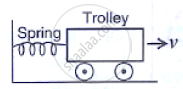
A spring is kept compressed by a small trolley of mass 0.5 kg lying on a smooth horizontal surface as shown in the adjacent fig. When the trolley is released, it is found to move at a speed v = 2 m s-1. What potential energy did the spring possess when compressed?
A ball of mass m is thrown vertically up with an initial velocity so as to reach a height h. The correct statement is:
State whether the following statement is true or false :
The potential energy of a body of mass 1 kg kept at a height of 1 m is 1 J.
A boy weighing 50 kg climbs up a vertical height of 100 m. Calculate the amount of work done by him. How much potential energy does he gain? (g = 9.8 m/s2)
A body of mass 2 kg is thrown vertically upwards with an initial velocity of 20 m/s. What will be its potential energy at the end of 2 s? (Assume g = 10 m/s2).
What is the difference between gravitational potential energy and elastic potential energy? Give one example of a body having gravitational potential energy and another having elastic potential energy.
Prove that the kinetic energy of a freely falling object on reaching the ground is nothing but the transformation of its initial potential energy.
If we increase the velocity of a car moving on a flat surface to four times its original speed, its potential energy ______.
Which of the following is the example potential energy?
