Advertisements
Advertisements
प्रश्न
The mean speed of the molecules of a hydrogen sample equals the mean speed of the molecules of a helium sample. Calculate the ratio of the temperature of the hydrogen sample to the temperature of the helium sample.
Use R = 8.314 JK-1 mol-1
Advertisements
उत्तर
Mean velocity is given by \[V_{avg} = \sqrt{\frac{8RT}{\pi M}}\]
Let temperature for H and He respectively be T1 and T2, respectively.
For hydrogen:
MH = 2g = 2 \[\times\] 10-3 kg
For helium:
MHe= 4 g = 4 \[\times\] 10-3 kg
Now,
A/q \[\sqrt{\frac{8R T_1}{\pi M_H}} = \sqrt{\frac{8R T_2}{\pi M_{He}}}\]
\[ \Rightarrow \sqrt{\frac{8R T_1}{2 \times {10}^{- 3} \pi}} = \sqrt{\frac{8R T_2}{\pi \times 4 \times {10}^{- 3}}}\]
\[ \Rightarrow \sqrt{\frac{T_1}{2}} = \sqrt{\frac{T_2}{4}}\]
\[ \Rightarrow \frac{T_1}{T_2} = \frac{1}{2}\]
\[ \Rightarrow T_1 : T_2 = 1: 2\]
APPEARS IN
संबंधित प्रश्न
When you come out of a river after a dip, you feel cold. Explain.
The mean square speed of the molecules of a gas at absolute temperature T is proportional to
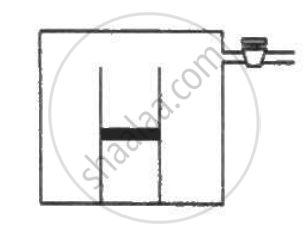
An ideal gas is kept in a long cylindrical vessel fitted with a frictionless piston of cross-sectional area 10 cm2 and weight 1 kg in figure. The vessel itself is kept in a big chamber containing air at atmospheric pressure 100 kPa. The length of the gas column is 20 cm. If the chamber is now completely evacuated by an exhaust pump, what will be the length of the gas column? Assume the temperature to remain constant throughout the process.
An adiabatic cylindrical tube of cross-sectional area 1 cm2 is closed at one end and fitted with a piston at the other end. The tube contains 0.03 g of an ideal gas. At 1 atm pressure and at the temperature of the surrounding, the length of the gas column is 40 cm. The piston is suddenly pulled out to double the length of the column. The pressure of the gas falls to 0.355 atm. Find the speed of sound in the gas at atmospheric temperature.
Answer in brief:
Show that rms velocity of an oxygen molecule is `sqrt2` times that of a sulfur dioxide molecule at S.T.P.
Explain, on the basis of the kinetic theory of gases, how the pressure of a gas changes if its volume is reduced at a constant temperature.
Calculate the ratio of the mean square speeds of molecules of a gas at 30 K and 120 K.
Energy is emitted from a hole in an electric furnace at the rate of 20 W when the temperature of the furnace is 727°C. What is the area of the hole? (Take Stefan’s constant σ to be 5.7 × 10⁻⁸ Js-1 m-2K-4.)
The power radiated by a perfect blackbody depends only on its ______
On what, the values of absorption coefficient, reflection coefficient, and transmission coefficient depend, in addition to the material of the object on which the radiation is an incident?
Why the temperature of all bodies remains constant at room temperature?
An ideal gas in a container of volume 500 cc is at a pressure of 2 × 10⁵ N/m2. The average kinetic energy of each molecule is 6 × 10⁻²¹ J. The number of gas molecules in the container is ______.
Volume versus temperature graphs for a given mass of an ideal gas are shown in figure at two different values of constant pressure. What can be inferred about relation between P1 and P2?

Consider a rectangular block of wood moving with a velocity v0 in a gas at temperature T and mass density ρ. Assume the velocity is along x-axis and the area of cross-section of the block perpendicular to v0 is A. Show that the drag force on the block is `4ρAv_0 sqrt((KT)/m)`, where m is the mass of the gas molecule.
Two gases A and B are at absolute temperatures of 360 K and 420 K, respectively. The ratio of the average kinetic energy of the molecules of gas B to that of gas A is ______.
If a = 0. 72 and r = 0.24, then the value of t is ______.
Which of the following materials is diathermanous?
Show that the average energy per molecule is directly proportional to the absolute temperature ‘T’ of the gas.
2000 calories of radiant heat is incident on a body. If the body absorbs 550 calories of heat, find the coefficient of emmission of the body.
