Advertisements
Advertisements
प्रश्न
The length and breadth of the rectangular piece of land area in the ratio of 5 : 3. If the total cost of fencing it at the rate of ₹48 per metre is ₹19,200, find its length and breadth.
Advertisements
उत्तर
Ratio in length and breadth of a rectangular piece of land = 5:3
Cost of fencing = ₹19,200
and rate = ₹48 per m
∴ Perimeter =`19200/48` = 400 m
Let length = 5x.
Then breadth = 3x
∴ Perimeter = 2(l + b)
400 = 2(5x + 3x)
400 = 2 × 8x = 16x
∴ 16x = 400
⇒ x = `400/16` = 25
∴ Length of the land = 5x = 5 × 25 = 125 m and breadth = 3x = 3 × 25 = 75 m.
APPEARS IN
संबंधित प्रश्न
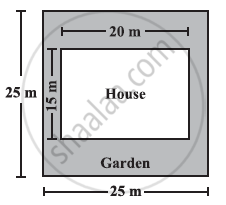
Mrs. Kaushik has a square plot with the measurement as shown in the following figure. She wants to construct a house in the middle of the plot. A garden is developed around the house. Find the total cost of developing a garden around the house at the rate of Rs 55 per m2.
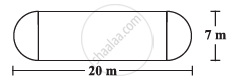
The shape of a garden is rectangular in the middle and semi circular at the ends as shown in the diagram. Find the area and the perimeter of the garden [Length of rectangle is 20 − (3.5 + 3.5) metres]
A flooring tile has the shape of a parallelogram whose base is 24 cm and the corresponding height is 10 cm. How many such tiles are required to cover a floor of area 1080 m2? (If required you can split the tiles in whatever way you want to fill up the corners).
A playground has the shape of a rectangle, with two semi-circles on its smaller sides as diameters, added to its outside. If the sides of the rectangle are 36 m and 24.5 m, find the area of the playground. (Take π = 22/7).
A rectangular piece is 20 m long and 15 m wide. From its four corners, quadrants of radii 3.5 m have been cut. Find the area of the remaining part.
The length and breadth of a rectangular field are in the ratio 7 : 4. If its perimeter is 440 m, find its length and breadth. Also, find the cost of fencing it @ ₹150 per m.
The perimeter of a rectangle becomes ______ times its original perimeter, if its length and breadth are doubled.
Mukesh walks around a circular track of radius 14 m with a speed of 4 km/hr. If he takes 20 rounds of the track, for how long does he walk?
What defines a closed figure?
The interior of the rectangle, along with its boundary, is called the:
