Advertisements
Advertisements
प्रश्न
A flooring tile has the shape of a parallelogram whose base is 24 cm and the corresponding height is 10 cm. How many such tiles are required to cover a floor of area 1080 m2? (If required you can split the tiles in whatever way you want to fill up the corners).
Advertisements
उत्तर
Area of parallelogram = Base × Height
Hence, area of one tile = 24 cm × 10 cm = 240 cm2
Required number of tiles = `"Area of Floor"/"Area of each tile"`
= `(1080 m^2)/(240 cm^2) = ((1080 xx 10000) cm^2)/(240 cm^2)` (∵ 1m = 100 cm)= 45000 tiles.
Thus, 45000 tiles are required to cover a floor of area 1080 m2.
संबंधित प्रश्न
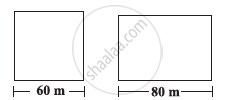
A square and a rectangular field with measurements as given in the figure have the same perimeter. Which field has a larger area?
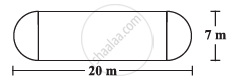
The shape of a garden is rectangular in the middle and semi circular at the ends as shown in the diagram. Find the area and the perimeter of the garden [Length of rectangle is 20 − (3.5 + 3.5) metres]
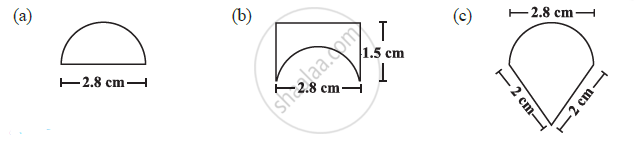
An ant is moving around a few food pieces of different shapes scattered on the floor. For which food − piece would the ant have to take a longer round? Remember, circumference of a circle can be obtained by using the expression c = 2πr, where r is the radius of the circle.
Find the area of Fig. 20.25, in square cm, correct to one place of decimal. (Take π = 22/7)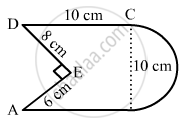
The diameter of a wheel of a bus is 90 cm which makes 315 revolutions per minute. Determine its speed in kilometres per hour. [Use π = 22/7]
The length and the breadth of a rectangular plot are 135 m and 65 m. Find, its perimeter and the cost of fencing it at the rate of ₹60 per m.
The area of a parallelogram is 60 cm2 and one of its altitudes is 5 cm. The length of its corresponding side is ______.
The perimeter of a rectangle becomes ______ times its original perimeter, if its length and breadth are doubled.
Mukesh walks around a circular track of radius 14 m with a speed of 4 km/hr. If he takes 20 rounds of the track, for how long does he walk?
What is the part of the plane enclosed by a closed figure known as?
