Advertisements
Advertisements
प्रश्न
The height of a right circular cone is 20 cm. A small cone is cut off at the top by a plane parallel to the base. If its volume be `1/8` of the volume of the given cone, then at what height above the base is the section made?
Advertisements
उत्तर
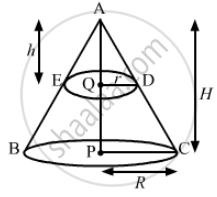
We have,
Height of the given cone, H = 20 cm
Let the radius of the given cone be h and
the height of the smaller cone be r.
Now, in ΔAQD and ΔAPC,
∠QAD = ∠PAC (Common angle)
∠AQD = ∠APC = 90°
So, by AA criteria
∠AQD ˜∠APC
`rArr ("AQ")/"AP"=("QD")/("PC")`
`rArr "h"/"H" = "r"/"R" .......(i)`
Volume of smaller cone `= 1/8xx "Volume of the given cone"`
`rArr "Volume of smaller cone"/"Volume of the given one" = 1/8`
`rArr ((1/3pi"r"^2"h"))/((1/3pi"R"^2"H"))=1/8`
`rArr ("r"/"R")^2xx("h"/"H") = 1/8`
`rArr ("h"/"H")^2xx("h"/"H")=1/8` [Using (i)]
`rArr ("h"/"H")^3 = 1/8`
`rArr "h"/"H"=root(3)(1/8)`
`rArr "h"/"20" = 1/2`
`rArr "h" = 20/2`
`rArr "h" = 10 "cm"`
∴ PQ = H - h = 20 - 10 cm
So, the section is made at the height of 10 cm above the base.
