Advertisements
Advertisements
प्रश्न
A solid metallic right circular cone 20 cm high and whose vertical angle is 60°, is cut into two parts at the middle of its height by a plane parallel to its base. If the frustum so obtained be drawn into a wire of diameter `1/12` cm, then find the length of the wire.
Advertisements
उत्तर
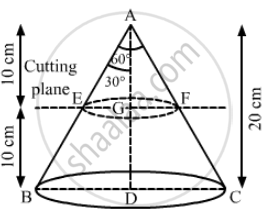
We have,
Height of the metallic cone, H = 20 cm,
Height of the frustum, `"h" = 20/2 = 10 "cm"` and
Radius of the wire `= 1/24 "cm"`
Let the length of the wire be l, EG = r and BD = R
In ΔAEG,
`"tan"30° = "EG"/"AG"`
`rArr 1/sqrt(3) = r/("H"-"h")`
`rArr 1/sqrt(3)="r"/(20-10)`
`rArr r = 10/sqrt(3) "cm"`
Also, in Δ ABD,
`tan 30° = "BD"/"AD"`
`rArr 1/sqrt(3) = "R"/"H"`
`rArr 1/sqrt(3) = "R"/20`
`rArr "R" = 20/sqrt(3) "cm"`
Now,
Volume of the wire = Volume of the frustum
`rArr pi(1/24)^2l = 1/3pih (R^2 + r^2 +"Rr")`
`= "l"/576 = 1/3xx10xx[(20/sqrt(3))^2 + (10/sqrt(3))^2 + (20/sqrt(3))(10/sqrt(3))]`
`rArr "l" = 576/3xx10xx[400/3+100/3+200/3]`
`= "l" = 576/3xx10xx700/3`
⇒ l = 448000 cm
∴ l = 4480 m
So, the length of the wire is 4480 m.
