मराठी

The Following Figure Shows a Closed Victory-stand Whose Dimensions Are Given in Cm Find the Volume and the Surface Area of the Victory Stand. - Mathematics

Advertisements
Advertisements

प्रश्न

The following figure shows a closed victory-stand whose dimensions are given in cm.
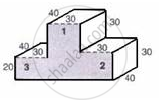
Find the volume and the surface area of the victory stand. 

बेरीज
Advertisements

उत्तर

Consider the box 1

Thus, the dimensions of box 1 are 60 cm, 40 cm, and 30 cm. 

Therefore, the volume of box 1 = 60 x 40 x 30 = 72000 cm
Surface area of box 1 = 2 ( lb + bh + lh )
Since the box is open at the bottom and from the given figure, we have,
Surface area of box 1 = 40 x 40 + 40 x 30 + 40 x 30 + 2 ( 60 x 30 )
                                  = 1600 + 1200 + 1200 + 3600
                                 = 7600 cm2   

Consider the box 2 

Thus, the dimensions of box 2 are 40 cm, 30 cm, and 30 cm.

Therefore, the volume of box 2 = 40 x 30 x 30 = 36000 cm
Surface area of box 2 = 2 ( lb + bh + lh )
Since the box is open at the bottom and from the given figure, we have,
Surface area of box 2 = 40 x 30 + 40 x 30  + 2 ( 30 x 30 )
                                  = 1200 + 1200 + 1800 
                                 = 4200 cm2   

Consider the box 3

Thus, the dimensions of the box 3 are 40 cm, 30 cm, and 20 cm.

Therefore, the volume of box 3 = 40 x 30 x 20 = 24000 cm
Surface area of box 3 = 2 ( lb + bh + lh )
Since the box is open at the bottom and from the given figure, we have,
Surface area of box 3 = 40 x 30 + 40 x 20  + 2 ( 30 x 20 )
                                  = 1200 + 800 + 1200 
                                 = 3200 cm2   

Total volume of the box
= volume of box 1 + volume of box 2 + volume of box 3
= 72000 + 36000 + 24000
= 132000 cm

Similarly, total surface area of the box
= surface area of box 1 + surface area  of box 2 + surface area of box 3
= 7600 + 4200 + 3200
= 15000 cm

shaalaa.com
Cross Section of Solid Shapes
  या प्रश्नात किंवा उत्तरात काही त्रुटी आहे का?
पाठ 21: Solids [Surface Area and Volume of 3-D Solids] - Exercise 21 (B) [पृष्ठ २७३]

APPEARS IN

सेलिना Concise Mathematics [English] Class 9 ICSE
पाठ 21 Solids [Surface Area and Volume of 3-D Solids]
Exercise 21 (B) | Q 10 | पृष्ठ २७३

संबंधित प्रश्‍न

A swimming pool is 40 m long and 15 m wide. Its shallow and deep ends are 1.5 m and 3 m deep respectively. If the bottom of the pool slopes uniformly, find the amount of water in liters required to fill the pool.


A swimming pool is 18 m long and 8 m wide. Its deep and shallow ends are 2 m and 1.2 m respectively. Find the capacity of the pool, assuming that the bottom of the pool slopes uniformly. 


The cross-section of a piece of metal 4 m in length is shown below. Calculate :


(i) The area of the cross-section;
(ii) The volume of the piece of metal in cubic centimeters.

If 1 cubic centimeter of the metal weighs 6.6 g, calculate the weight of the piece of metal to the nearest kg.


The given figure is a cross -section of a victory stand used in sports. All measurements are in centimetres. Assume all angles in the figure are right angles. If the width of the stand is 60 cm, find The space it occupies in cm3.


The given figure is a cross -section of a victory stand used in sports. All measurements are in centimetres. Assume all angles in the figure are right angles. If the width of the stand is 60 cm, find The total surface area in m2.


A swimming pool is 50 m long and 15 m wide. Its shallow and deep ends are 1.5 m and 4.5 m respectively. If the bottom of the pool slopes uniformly, find the amount of water in kilolitres required to fill the pool (1 m3 = 1000 liters).


The figure shows the cross section of 0.2 m a concrete wall to be constructed. It is 0.2 m wide at the top, 2.0 m wide at the bottom and its height is 4.0 m, and its length is 40 m. Calculate the volume of the concrete in the wall


The figure shows the cross section of 0.2 m a concrete wall to be constructed. It is 0.2 m wide at the top, 2.0 m wide at the bottom and its height is 4.0 m, and its length is 40 m. If the whole wall is to be painted, find the cost of painting it at 2.50 per sq m.


The cross section of a tunnel perpendicular to its length is a trapezium ABCD as shown in the figure. AM = BN; AB = 4.4 m, CD = 3 m The height of a tunnel is 2.4 m. The tunnel is 5.4 m long. Calculate the cost of painting the internal surface of the tunnel (excluding the floor) at the rate of Rs. 5 per m2.


The cross section of a canal is a trapezium with the base length of 3 m and the top length of 5 m. It is 2 m deep and 400 m long. Calculate the volume of water it holds.


Share
Notifications

Englishहिंदीमराठी


      Forgot password?
Use app×