Advertisements
Advertisements
प्रश्न
The following figure shows a closed victory-stand whose dimensions are given in cm.
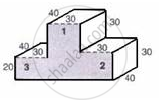
Find the volume and the surface area of the victory stand.
Advertisements
उत्तर
Consider the box 1
Thus, the dimensions of box 1 are 60 cm, 40 cm, and 30 cm.
Therefore, the volume of box 1 = 60 x 40 x 30 = 72000 cm3
Surface area of box 1 = 2 ( lb + bh + lh )
Since the box is open at the bottom and from the given figure, we have,
Surface area of box 1 = 40 x 40 + 40 x 30 + 40 x 30 + 2 ( 60 x 30 )
= 1600 + 1200 + 1200 + 3600
= 7600 cm2
Consider the box 2 
Thus, the dimensions of box 2 are 40 cm, 30 cm, and 30 cm.
Therefore, the volume of box 2 = 40 x 30 x 30 = 36000 cm3
Surface area of box 2 = 2 ( lb + bh + lh )
Since the box is open at the bottom and from the given figure, we have,
Surface area of box 2 = 40 x 30 + 40 x 30 + 2 ( 30 x 30 )
= 1200 + 1200 + 1800
= 4200 cm2
Consider the box 3
Thus, the dimensions of the box 3 are 40 cm, 30 cm, and 20 cm.
Therefore, the volume of box 3 = 40 x 30 x 20 = 24000 cm3
Surface area of box 3 = 2 ( lb + bh + lh )
Since the box is open at the bottom and from the given figure, we have,
Surface area of box 3 = 40 x 30 + 40 x 20 + 2 ( 30 x 20 )
= 1200 + 800 + 1200
= 3200 cm2
Total volume of the box
= volume of box 1 + volume of box 2 + volume of box 3
= 72000 + 36000 + 24000
= 132000 cm3
Similarly, total surface area of the box
= surface area of box 1 + surface area of box 2 + surface area of box 3
= 7600 + 4200 + 3200
= 15000 cm2
APPEARS IN
संबंधित प्रश्न
The following figure shows a solid of uniform cross-section. Find the volume of the solid. All measurements are in centimeters.
Assume that all angles in the figures are right angles.
The following figure shows a solid of uniform cross-section. Find the volume of the solid. All measurements are in centimeters.
Assume that all angles in the figures are right angles.
A school auditorium is 40 m long, 30 m broad and 12 m high. If each student requires 1.2 m2 of the floor area; find the maximum number of students that can be accommodated in this auditorium. Also, find the volume of air available in the auditorium, for each student.
The cross section of a piece of metal 2 m in length
is shown. Calculate the volume of the piece of metal.
A swimming pool is 50 m long and 15 m wide. Its shallow and deep ends are 1.5 m and 4.5 m respectively. If the bottom of the pool slopes uniformly, find the amount of water in kilolitres required to fill the pool (1 m3 = 1000 liters).
The figure shows the cross section of 0.2 m a concrete wall to be constructed. It is 0.2 m wide at the top, 2.0 m wide at the bottom and its height is 4.0 m, and its length is 40 m. Calculate the volume of the concrete in the wall

The figure shows the cross section of 0.2 m a concrete wall to be constructed. It is 0.2 m wide at the top, 2.0 m wide at the bottom and its height is 4.0 m, and its length is 40 m. If the whole wall is to be painted, find the cost of painting it at 2.50 per sq m.
The cross section of a tunnel perpendicular to its length is a trapezium ABCD as shown in the figure. AM = BN; AB = 4.4 m, CD = 3 m The height of a tunnel is 2.4 m. The tunnel is 5.4 m long. Calculate the cost of painting the internal surface of the tunnel (excluding the floor) at the rate of Rs. 5 per m2.
The cross section of a swimming pool is a trapezium whose shallow and deep ends are 1 m and 3 m respectively. If the length of the pool is 50 m and its width is 1.5 m, calculate the volume of water it holds.
A hose-pipe of cross section area 3 cm2 delivers 1800 liters of water in 10 minutes. Find the speed of water in km/h through the pipe.
