Advertisements
Advertisements
प्रश्न
Answer the following question
The enclosure in which Kari lived had a thatched roof that lay on thick tree stumps. Examine the illustration of Kari’s pavilion on page 8 and say why it was built that way.
Advertisements
उत्तर
Kari’s pavilion was built under a thatched roof having its support on a thick tree trunk. The support was necessary to save the roof from falling down when he moved about and bumped against the bamboo poles.
संबंधित प्रश्न
Thinking about the Text
Answer these question.
This is your big surprise.”
(i) Where has this been said in the play?
(ii) What is the surprise?
Do you like rain? What do you do when it rains steadily or heavily as described in the poem?
Thinking about the Poem
Do you think that the old lady would have been so ungenerous if she had known who Saint Peter really was? What would she have done then?
Answer following question in short.
Write the central theme of the poem.
Read the comic strip based on. H.G. Wells' novells.


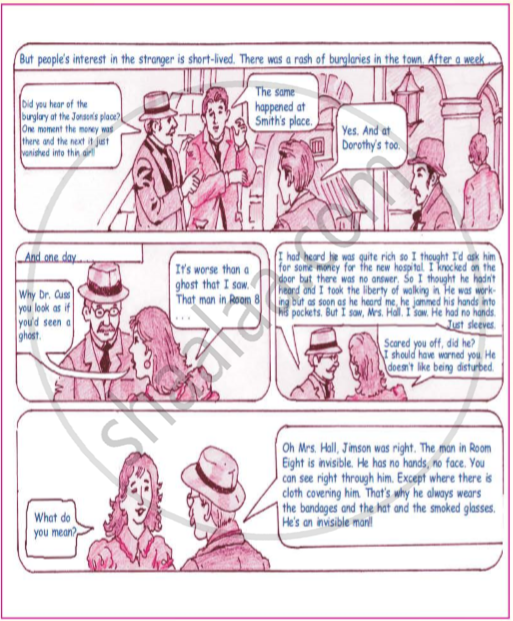
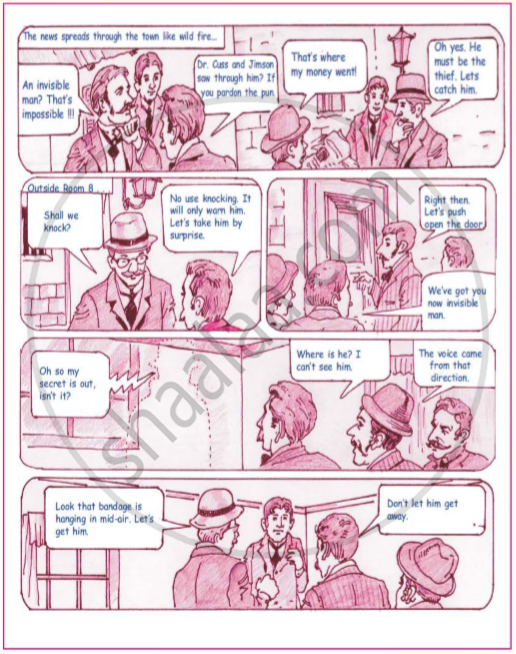
Answer the questions by ticking the correct option.
(a) The strange-looking man wanted ....
(i) the best room at the inn.
(ii} a room with a fire and a good lock.
(iii} a room with a good view.
(iv) a room where he could work quietly.
(b) Jimson was suspicious of the stranger because ...
(i} he did not answer Jimson's questions.
(ii} he did not want to talk about the weather.
(iii} he kept his back turned towards Jimson at all times.
(iv) he shouted atJimson when he entered his room.
(c) The people of the town gossiped about the stranger as ...
(i} he did not go out or talk to anyone in the town.
(ii} he had met with an accident and his face was bandaged.
(iii} he was new to the town and behaved rudely.
(iv) he stayed in his room and did not show his face to anyone.
(d) 'There was a rush of burglaries in the town. This means that ________
(i} there were many robberies in the town.
(ii) a few people in the town had seen a rob her.
(iii} the burglaries in the town were done in a rush.
(iv) the burglar was a rash and careless man.
(e) Although Jimson and Dr Cuss are suspicious of the strange guest, Mrs Hall tolerates him because ....
(i} she is not superstitious or ignorant.
(ii) she is sorry for the stranger who is bandaged.
(iii} the stranger is paying her a good amount of money for the room.
(iv} the stranger is polite and kind to Mrs Hall at all times.
(f) The stranger who was staying at the inn can be described as being ....
(I} violent
(ii} upright
(iii} dishonest
(iv) sensible
Read the following passage on New Zealand.
New Zealand is a Mecca for nature lovers. Throughout most of New Zealand's geological history, it was a bird's paradise. The islands were once part of the southern super - continent Gondwana from which they broke off around 80 million years ago before mammals had evolved and spread.
(courtesy: Terra Green Sept 2008 issue 06)
The underlined words express a relationship usually of space or time between the words with which they stand. Such 'Positional' words which are used before nouns (pre-position) are called prepositions.

What does he plant who plants a tree? a
He plants a friend of sun and sky;b
He plants the flag of breezes free;
The shaft of beauty, towering high;
He plants a home to heaven anigh;
For song and mother-croon of bird
In hushed and happy twilight heard____
The treble of heaven's harmony_____
These things he plants who plants a tree.
Read the lines given above and answer the question that follow:
So please, oh please, we beg, we pray,
Go throw your TV set away,
And in its place you can install
A lovely bookshelf on the wall.
Then fill the shelves with lots of books,
Ignoring all the dirty looks,
The Screams and yells,the bites and kicks,
And children hitting you with sticks-
Fear not, because we promise you
That, in about a week ot two
Of having nothing else to do,
They'll now begin to feel the need
Of having something to read.
And once they start - oh boy, oh boy!
You watch the slowly growing joy
That fills their hearts. They'll grow so keen
They'll wonder what they'd ever seen
In that ridiculous machine,
That nauseating, foul, unclean,
Repulsive television screen!
And later, each and every kid
Will love you more for what you did.
Read the lines given above and answer the question given below.
What does Dahl ask the parents to do?
Mr. Oliver, an Anglo-Indian teacher, was returning to his school late one night on the outskirts of the hill station of Shimla. The school was conducted on English public school lines and the boys – most of them from well-to-do Indian families – wore blazers, caps and ties. “Life” magazine, in a feature on India, had once called this school the Eton of the East.
Mr. Oliver had been teaching in this school for several years. He’s no longer there. The Shimla Bazaar, with its cinemas and restaurants, was about two miles from the school; and Mr. Oliver, a bachelor, usually strolled into the town in the evening returning after dark, when he would take short cut through a pine forest.
Read the extract given below and answer the question that follow.
When did Mr Oliver return from the town?
This woman had been despised, scoffed at, and angrily denounced by nearly every man, woman, and child in the village; but now, as the fact of, her death was passed from lip to lip, in subdued tones, pity took the place of anger, and sorrow of denunciation.
Neighbours went hastily to the old tumble-down hut, in which she had secured little more than a place of shelter from summer heats and winter cold: some with grave-clothes for a decent interment of the body; and some with food for the half-starving children, three in number. Of these, John, the oldest, a boy of twelve, was a stout lad, able to earn his living with any farmer. Kate, between ten and eleven, was bright, active girl, out of whom something clever might be made, if in good hands; but poor little Maggie, the youngest, was hopelessly diseased. Two years before a fall from a window had injured her spine, and she had not been able to leave her bed since, except when lifted in the arms of her mother.
“What is to be done with the children?” That was the chief question now. The dead mother would go underground, and be forever beyond all care or concern of the villagers. But the children must not be left to starve.
Read the extract given below and answer the question that follow.
What was a matter of concern now that the woman was dead?
Mr Wonka collected whose toe-nail?
Why was the crocodile unwilling to invite his friend home?
What is a dream?
What is one thing that dreams can never tell?
Where did father bring the ladder from?
Fill in the blank in the sentence below with the words or phrases from the box. (You may not know the meaning of all the words. Look such words up in a dictionary, or ask your teacher.)
I started early to be on time, but I was ______. There was a traffic jam!
Multiple Choice Question:
When is beauty heard?
Answer the following question.
When Jumman’s aunt realised that she was not welcome in his house, what arrangement did she suggest?
What does the poem say about the poet’s choice of subject?
Referring closely, to Act III Scene III, relate the stern warning of Ariel to the "three men of sin". What impact does his warning have on the three sinners?
