Advertisements
Advertisements
प्रश्न
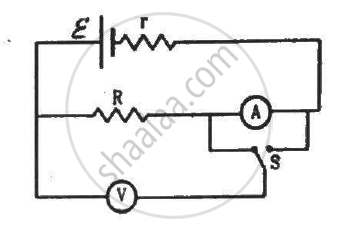
The emf ε and the internal resistance r of the battery, shown in the figure, are 4.3 V and 1.0 Ω respectively. The external resistance R is 50 Ω. The resistances of the ammeter and voltmeter are 2.0 Ω and 200 Ω respectively. (a) Find the readings of the two meters. (b) The switch is thrown to the other side. What will be the readings of the two meters now?
Advertisements
उत्तर
(a)
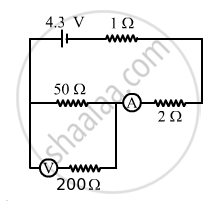
The 50 Ω and 200 Ω resistances are in parallel. Their equivalent resistance,
\[R_{eqv} = \frac{50 \times 200}{50 + 200} = 40 \Omega\]
This equivalent resistance and the 2 Ω and 1 Ω resistances are connected in series. The effective resistance of the circuit,
\[R_{eff} = \left( 40 + 2 + 1 \right) = 43 \Omega\]
In this case, the ammeter will read the total current of the circuit. The current through the ammeter,
\[i = \frac{4 . 3}{43} = 0 . 1 A\]
This current will be distributed in the inverse ratio of resistance between the resistances 50 Ω and 200 Ω. The current through the voltmeter,
\[i' = \frac{50}{\left( 50 + 200 \right)}i\]
\[ \Rightarrow i' = 0 . 02 A\]
Reading of the voltmeter = 0.02 × 200 = 4 V
(b)
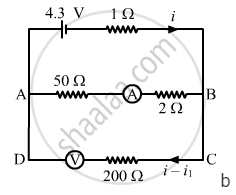
The two branches AB and CD are in parallel. Their equivalent resistance,
\[R_{eqv} = \frac{52 \times 200}{52 + 200} = 41 . 27 A\]
This equivalent resistance is in series with the 1 Ω resistance. The effective resistance of the circuit,
\[R_{eff} = \left( 41 . 27 + 1 \right) \Omega = 42 . 27 \Omega\]
The total current through the circuit,
\[i = \frac{4 . 3}{42 . 27} = 0 . 1 A\]
In this case, the ammeter will read the current flowing through the 50 Ω resistance, which is i1, as shown. The currents in the two parallel branches will distribute in the inverse ratio of the resistances.
\[\therefore i_1 = \left( \frac{200}{200 + 52} \right)i\]
\[ \Rightarrow i_i = 0 . 08 A\]
The current through the voltmeter = i - i1 = 0.02 A
The reading of the voltmeter = 0.02 × 200 = 4 V
