मराठी

The Distance Between Parallel Sides of a Trapezium is 15 Cm and the Length of the Line Segment Joining the Mid-points of Its Non-parallel Sides is 26 Cm. Find the Area of the Trapezium. - Mathematics

Advertisements
Advertisements

प्रश्न

The distance between parallel sides of a trapezium is 15 cm and the length of the line segment joining the mid-points of its non-parallel sides is 26 cm. Find the area of the trapezium.

बेरीज
Advertisements

उत्तर
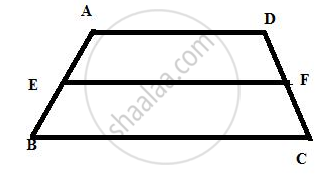

EF = `1/2` x ( AD + BC ) = 26 cm

Area of the trapezium
= `1/2` x ( AD + BC ) x h

= 26 x 15
= 390 cm2.              

shaalaa.com
  या प्रश्नात किंवा उत्तरात काही त्रुटी आहे का?
पाठ 20: Area and Perimeter of Plane Figures - Exercise 20 (B) [पृष्ठ २५७]

APPEARS IN

सेलिना Concise Mathematics [English] Class 9 ICSE
पाठ 20 Area and Perimeter of Plane Figures
Exercise 20 (B) | Q 35 | पृष्ठ २५७

संबंधित प्रश्‍न

The diagonal of a quadrilateral shaped field is 24 m and the perpendiculars dropped on it from the remaining opposite vertices are 8 m and 13 m. Find the area of the field.


Find the area of a quadrilateral one of whose diagonals is 30 cm long and the perpendiculars from the other two vertices are 19 cm and 11 cm respectively. 


The diagonals of a quadrilateral are 16 cm and 13 cm. If they intersect each other at right angles; find the area of the quadrilateral.


The area of a rectangular is 640 m2. Taking its length as x cm; find in terms of x, the width of the rectangle. If the perimeter of the rectangle is 104 m; find its dimensions.


A footpath of uniform width runs all around the outside of a rectangular field 30 m long and 24 m wide. If the path occupies an area of 360 m2, find its width.


How many tiles, each of area 400 cm2, will be needed to pave a footpath which is 2 m wide and surrounds a grass plot 25 m long and 13 m wide? 


Vertices of given triangles are taken in order and their areas are provided aside. Find the value of ‘p’.

Vertices Area (sq.units)
(p, p), (5, 6), (5, –2) 32

Find the area of the quadrilateral whose vertices are at (– 9, – 2), (– 8, – 4), (2, 2) and (1, – 3)


Find the area of the quadrilateral whose vertices are at (– 9, 0), (– 8, 6), (– 1, – 2) and (– 6, – 3)


If vertices of a quadrilateral are at A(– 5, 7), B(– 4, k), C(– 1, – 6) and D(4, 5) and its area is 72 sq. units. Find the value of k.


Share
Notifications

Englishहिंदीमराठी


      Forgot password?
Use app×