Advertisements
Advertisements
प्रश्न
The diameter of the wheel of a car is 70 cm. How many revolutions will it make to travel one kilometer?
Advertisements
उत्तर
The circumference of a circle is given by:
Circumference = π × Diameter.
Here, the diameter of the wheel is 70 cm. Substituting the value of π ≈ 3.1416
Circumference = 3.1416 × 70 = 219.91 cm
Since 1 km = 1000 m = 1000 × 100 = 100,000 cm, the total distance to be traveled is:
1 km = 100,000 cm.
The number of revolutions is the total distance divided by the circumference of the wheel:
Number of revolutions = `("Total distance")/("Circumference") = 100000/219.91`
Number of revolutions ≈ 454.74.
The wheel will make approximately 455 revolutions to travel 1 km.
APPEARS IN
संबंधित प्रश्न
Find the area of the square whose perimeter is 56 cm.
In the figure given below, find the area of shaded region: (All measurements are in cm)
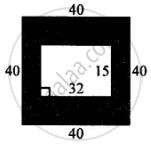
Find the area of the rhombus, if its diagonals are 30 cm and 24 cm.
One side of a parallelogram is 18 cm and its area is 153 cm2. Find the distance of the given side from its opposite side.
The adjacent sides of a parallelogram are 15 cm and 10 cm. If the distance between the longer sides is 6 cm, find the distance between the shorter sides.
The area of a right-angled triangle is 160 cm2. If its one leg is 16 cm long, find the length of the other leg.
Find the area of a right-angled triangle whose hypotenuse is 13 cm long and one of its legs is 12 cm long.
The legs of a right-angled triangle are in the ratio 4 : 3 and its area is 4056 cm2. Find the length of its legs.
The diameter of every wheel of a car is 63 cm. How much distance will the car move during the 2000 revolutions of its wheel.
A metal wire, when bent in the form of a square of largest area, encloses an area of 484 cm2. Find the length of the wire. If the same wire is bent to the largest circle, find:
(i) radius of the circle formed.
(ii) area of the circle.
