Advertisements
Advertisements
प्रश्न
The diagram shows the use of a lever.

- State the principle of moments as applied to the above lever.
- Which class of lever is this? Give an example of this class of lever.
- If FA = 100 cm, AB = 90 cm, calculate the minimum effort required to lift the load.
Advertisements
उत्तर
(i) Sum of the clockwise moments about the fulcrum is equal to the sum of the anti-clockwise moments about the fulcrum.
(ii) Lever of class III,
Example: forceps or a pair of tongs.
(iii) E × 100 = 190 × 20
∴ E = 38 N.
संबंधित प्रश्न
Write down a relation expressing the mechanical advantage of a lever.
Give one example of a class I lever where mechanical advantage is more than one ?
Fig 3.17 below shows a lever in use.
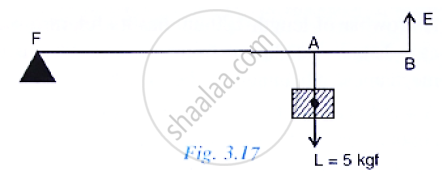
(a) To which class of lever does it belong?
(b) If FA = 80 cm, AB = 20 cm, find its mechanical advantage.
(c) Calculate the value of E.
A lever of length 9 cm has its load arm 5 cm long and the effort arm is 9 cm long.
- To which class does it belong?
- Draw a diagram of the lever showing the position of fulcrum F and directions of both the load L and effort E.
- What is the mechanical advantage and velocity ratio if the efficiency is 100%?
- What will be the mechanical advantage and velocity ratio if the efficiency becomes 50%?
Which type of levers have mechanical advantage always more than 1? Give reasons.
Give three examples for leavers of second order.
The following belong to which class of lever?
The Physical balance
The following belong to which class of lever?
A claw-hammer
The diagram below shows a lever in use.

(i) To which class of lever does it belong?
(ii) If FA = 40 cm, AB = 60 cm, then find the mechanical advantage of the lever.
A crowbar of length 100 cm is used to lift a load of 5 kgf. It has its fulcrum at a distance of 20 cm from the load. Calculate:
(i) the mechanical advantage of a crowbar and,
(ii) the effort applied at the other end.
