Advertisements
Advertisements
प्रश्न
The diagram alongside represents the structure of the human ear.
(i) Write the names of the parts labelled a to g.
(ii) State briefly the functions of the parts b, d, and g.
(iii) Name the main division of the ear.
(iv) Which is the smallest bone in the human body?
(v) What is labyrinth?

Advertisements
उत्तर
(i) (a) Bone of skull
(b) Inner ear
(c) Eardrum
(d) Bone of skull
(e) Bone of middle ear
(f) Middle ear
(g) Air filled
(ii) (b) Inner ear - It transmits the impulse to brain.
(d) Bone of skull - It helps in fixing the position of the ears to help the brain use auditory cues to judge direction and distance of sounds.
(g) Air filled - It keeps the pressure in the middle ear equalized with pressure in the outside.
(iii) The main division of the ear are: outer ear, middle ear and inner ear.
(iv) Stirrup
(v) The labyrinth is the inner ear which consists of utriculus, sacculus, cochlea and three semicircular canals.
संबंधित प्रश्न
Explain the following:
Mechanism through which a sound produces a nerve impulse in the inner ear.
the biological/technical terms for a thin membrane covering the entire front part of the eye.
Note the relationship between the first two words and suggest the suitable word for the fourth place.
sound : ear drum :: Dynamic balance : ……
Where is the oval window located? Briefly mention its function.
With reference to the human ear, answer the question that follow:
Name the part of the ear associated with
(1) static balance
(2) hearing
(3) dynamic balance.
How could you convince a small child that when you speak, it is not necessary for air to travel from you mouth to the ear of listener?
The figure below is the sectional view of a part of the skull showing a sense organ:
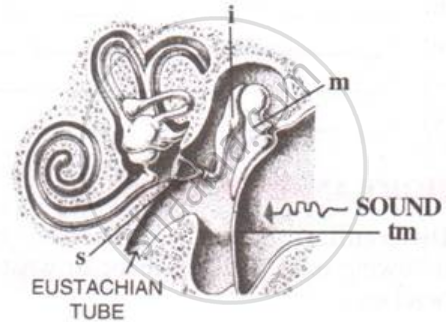
What do you call the part shown in the form of a spiral? What is its function?
Choose the Odd One Out:
Name the three ossicles of the middle ear.
The Eardrum moves inward when a rarefaction reaches it.
