Advertisements
Advertisements
प्रश्न
The correct order of increasing reactivity of C-X bond towards nucleophile in the following compounds is:
(I)

(II)

(III) (CH3)3 C-X
(IV) (CH3)2 CH-X
पर्याय
I < II < III < IV
II < I < III < IV
III < IV < II < I
IV < III < I < II
I < II < IV < III
Advertisements
उत्तर
I < II < IV < III
Explanation:
Alkyl halides are more reactive than aryl halides. This is because of the partial double bond character between the benzene ring and the halogen. Further, in alkyl halides, the greater the stability of carbocation formed, the more would be the reactivity. Thus, the tertiary halide is more reactive. Nitro group which is electron-withdrawing increases the reactivity of aryl halide.
Notes
The correct option is not given in the textbook.
APPEARS IN
संबंधित प्रश्न
\[\ce{CH3 - CH = CH2 ->[HI][Peroxide]}\]
The major product of the above reaction is,
Choose the most correct option.
The best method for the preparation of alkyl fluorides is _______.
Butanenitrile may be prepared by heating ______.

The product ‘B’ in the above reaction sequence is,
Choose the most correct option.
Which of the following is likely to undergo racemization during alkaline hydrolysis?
(I)
\[\begin{array}{cc}
\ce{CH3-CH-C2H5}\\
|\\
\ce{Cl}\end{array}\]
(II)
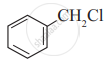
(III)

(IV)
\[\begin{array}{cc}
\ce{\phantom{.......}CH3}\\
\phantom{.....}|\\
\ce{CH3-CH}\\
\phantom{.....}|\\
\ce{\phantom{..........}CH2Cl}
\end{array}\]
Match the pairs.
| Column I | Column II |
| \[\begin{array}{cc} \ce{CH3CH - CH3}\\ |\phantom{.....}\\ \ce{X\phantom{.....}} \end{array}\] |
vinyl halide |
| \[\ce{CH2 = CH - CH2X}\] | alkyl halide |
| \[\ce{CH2 = CH - X}\] | allyl halide |
| benzyl halide | |
| aryl halide |
The bond line formula of 1-iodo-2, 3-dimethyl pentane is
When propene reacts with HCl in presence of peroxide, the product is ________.
The conversion of 2-methylpropan-1-ol to 2-methylpropan-2-ol is ______.
Identify A in the following reaction,
\[\ce{A ->[KCN (alcoholic)][\Delta] Propane nitrile +Potassium bromide}\]
Which of the following compounds is obtained when t-butyl bromide is treated with alcoholic ammonia?
The number of possible monohalogen derivatives for the alkyl halide having molecular formula C4H9X is ____________.
Identify 'B' in the following series of reactions.
\[\ce{Ethanol ->[NaBr][H2SO4, \Delta] A ->[Mg][Dry ether] B}\]
What is the IUPAC name of neopentyl chloride?
How many asymmetric carbon atoms are present in neopentyl chloride?
Identify A and B respectively in the following conversion.
\[\ce{Ethene ->[A] Bromoethane ->[B][\Delta] Ethyl propionate}\]
Identify the chiral molecule from the following.
Identify the chiral molecule from the following.
Identify A and B:
\[\ce{C6H5CH2Br ->[Alc.][KCN] A ->[Na/Ethanol] B}\]
Identify the chiral molecule from the following.
Among the following vinylic halide is ______.
Name the following halide according to IUPAC system and classify them as alkyl, allyl, benzyl (primary, secondary, tertiary), vinyl or aryl halides:
\[\ce{CH3C(C2H5)2CH2Br}\]
