Advertisements
Advertisements
प्रश्न
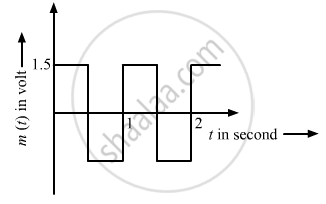
The carrier wave of a signal is given by C(t) = 3 sin (8πt) volt. The modulating signal is a square wave as shown. Find its modulation index.
Advertisements
उत्तर
Modulation index (\[\mu\]) is the ratio of the amplitude of the modulating signal to the amplitude of the carrier wave.
The generalised equation of a carrier wave is given below:
Amplitude of a modulating signal, \[A_m = 1 . 5\] V
Amplitude of a carrier wave,
APPEARS IN
संबंधित प्रश्न
Define modulation index.
Draw a sketch of a sinusoidal carrier wave along with a modulating signal and show how these are superimposed to obtain the resultant amplitude modulated wave
How are side bands produced?
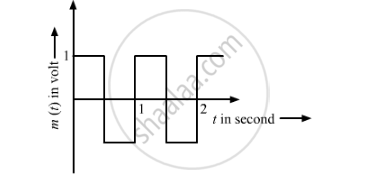
The carrier wave is given by
C(t) = 2sin(8πt) volt.
The modulating signal is a square wave as shown. Find modulation index.
Explain the need for modulation related to the size of antenna (aerial).
Why is Modulation index kept low?
In a communication system, what is meant by modulation?
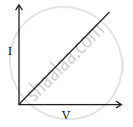
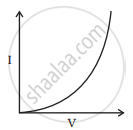
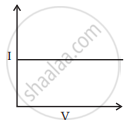
I-V characteristics of four devices are shown in Figures.
 |
 |
 |
|
| (i) | (ii) | (iii) | (iv) |
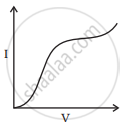
Identify devices that can be used for modulation.
A TV transmission tower antenna is at a height of 20 m. How much service area can it cover if the receiving antenna is (i) at ground level, (ii) at a height of 25 m? Calculate the percentage increase in area covered in case (ii) relative to case (i).
A carrier wave Vc(t) = 160 sin(2π × 106t) volts is made to vary between Vmax = 200 V and Vmin = 120 V by a message signal Vm(t) = Am sin(2π × 103t) volts. The peak voltage Am of the modulating signal is ______.
