Advertisements
Advertisements
प्रश्न
The audible range of frequencies of an average human ear is from 20 Hz to 20 kHz. Calculate the corresponding wavelengths. (Speed of sound in air is 344 ms–1)
Advertisements
उत्तर
We have to calculate the wavelength range of audible sound.
Given: Speed of sound ν = 344 m/s
Lower frequency of audible range fL = 20 Hz
Higher frequency of audible range fH = 20,000 Hz
We know relation of velocity, frequency, and wavelength `lambda = v/f`,
where ν is the velocity, f the frequency, and λ the wavelength.
So, wavelength corresponding to the lower frequency is
`lambda_L = 344/20`
= 17.2 m
So, wavelength corresponding to the higher frequency is
`lambda_H = 344/20000`
= 0.0172 m
Hence , the range of wavelength in audible region is 17.2 m - 0.0172 m
APPEARS IN
संबंधित प्रश्न
A person has a hearing range from 20 Hz to 20 kHz. What are the typical wavelengths of sound waves in air corresponding to these two frequencies? Take the speed of sound in air as 344 m s−1.
Can we hear (a) infrasonic waves (b) ultrasonic waves ?
What name is given to the sound waves of frequency too low for humans to hear ?
What name is given to the sound waves of frequency too high for humans to hear ?
What is the difference between infrasonic waves and ultrasonic waves ?
What is ultrasound ? What is the difference between ordinary sound and ultrasound ?
What are ultrasonic waves ? Name two animals which can produce ultrasonic waves.
One of the following can hear infrasound. This one is :
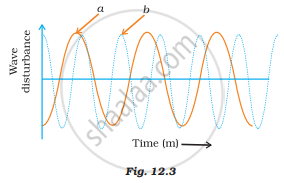
Which of the above two graphs (a) and (b) (Fig.12.3) representing the human voice is likely to be the male voice? Give a reason for your answer.
A girl is sitting in the middle of a park of dimension 12 m × 12 m. On the left side of it, there is a building adjoining the park and on the right side of the park, there is a road adjoining the park. A sound is produced on the road by a cracker. Is it possible for the girl to hear the echo of this sound? Explain your answer.
