मराठी

The area of the region bounded by the curve x = 2y + 3 and the y lines. y = 1 and y = –1 is ______. - Mathematics

Advertisements
Advertisements

प्रश्न

The area of the region bounded by the curve x = 2y + 3 and the y lines. y = 1 and y = –1 is ______.

पर्याय

  • 4 sq.units

  • `3/2` sq units

  • 6 sq.units

  • 8 sq.units

MCQ
रिकाम्या जागा भरा
Advertisements

उत्तर

The area of the region bounded by the curve x = 2y + 3 and the y lines. y = 1 and y = –1 is 6 sq.units.

Explanation:

Given equations of lines are x = 2y + 3, y = 1 and y = –1
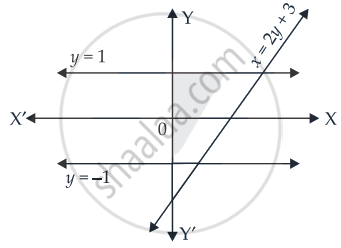

Required area = `int_-1^1 (2y + 3)  "d"y`

= `2 * 1/2 [y^2]_-1^1 + 3[y]_-1^1`

= `(1 - 1) + 3(1 + 1)`

= 6 sq.units

shaalaa.com
  या प्रश्नात किंवा उत्तरात काही त्रुटी आहे का?
पाठ 8: Application Of Integrals - Exercise [पृष्ठ १७८]

APPEARS IN

एनसीईआरटी एक्झांप्लर Mathematics [English] Class 12
पाठ 8 Application Of Integrals
Exercise | Q 34 | पृष्ठ १७८

व्हिडिओ ट्यूटोरियलVIEW ALL [1]

संबंधित प्रश्‍न

Prove that the curves y2 = 4x and x2 = 4y divide the area of square bounded by x = 0, x = 4, y = 4 and y = 0 into three equal parts.


Using integration, find the area of the region bounded by the lines y = 2 + x, y = 2 – x and x = 2.


Area bounded by the curve y = x3, the x-axis and the ordinates x = –2 and x = 1 is ______.


Find the area of ellipse `x^2/1 + y^2/4 = 1`


Using integration, find the area of the region bounded by the line y − 1 = x, the x − axis and the ordinates x= −2 and x = 3.


Sketch the graph y = | x + 3 |. Evaluate \[\int\limits_{- 6}^0 \left| x + 3 \right| dx\]. What does this integral represent on the graph?


Find the area of the region bounded by x2 + 16y = 0 and its latusrectum.


Find the area of the region \[\left\{ \left( x, y \right): \frac{x^2}{a^2} + \frac{y^2}{b^2} \leq 1 \leq \frac{x}{a} + \frac{y}{b} \right\}\]


Find the area of the region included between the parabola y2 = x and the line x + y = 2.


Find the area, lying above x-axis and included between the circle x2 + y2 = 8x and the parabola y2 = 4x.


Find the area enclosed by the curves y = | x − 1 | and y = −| x − 1 | + 1.


Find the area of the figure bounded by the curves y = | x − 1 | and y = 3 −| x |.


Find the area bounded by the parabola x = 8 + 2y − y2; the y-axis and the lines y = −1 and y = 3.


Find the area bounded by the parabola y2 = 4x and the line y = 2x − 4 By using horizontal strips.


The area bounded by the parabola y2 = 4ax and x2 = 4ay is ___________ .


The area bounded by the curve y2 = 8x and x2 = 8y is ___________ .


Find the equation of the standard ellipse, taking its axes as the coordinate axes, whose minor axis is equal to the distance between the foci and whose length of the latus rectum is 10. Also, find its eccentricity. 


Using integration, find the area of the region bounded by the parabola y= 4x and the circle 4x2 + 4y2 = 9.


Find the area of the region above the x-axis, included between the parabola y2 = ax and the circle x2 + y2 = 2ax.


The area of the region bounded by the curve x = y2, y-axis and the line y = 3 and y = 4 is ______.


Using integration, find the area of the region bounded by the line 2y = 5x + 7, x- axis and the lines x = 2 and x = 8.


Find the area bounded by the curve y = `sqrt(x)`, x = 2y + 3 in the first quadrant and x-axis.


Draw a rough sketch of the given curve y = 1 + |x +1|, x = –3, x = 3, y = 0 and find the area of the region bounded by them, using integration.


Area of the region in the first quadrant enclosed by the x-axis, the line y = x and the circle x2 + y2 = 32 is ______.


The region bounded by the curves `x = 1/2, x = 2, y = log x` and `y = 2^x`, then the area of this region, is


Area of the region bounded by the curve `y^2 = 4x`, `y`-axis and the line `y` = 3 is:


Find the area of the region bounded by `y^2 = 9x, x = 2, x = 4` and the `x`-axis in the first quadrant.


Find the area of the region bounded by the ellipse `x^2/4 + y^2/9` = 1.


The area bounded by `y`-axis, `y = cosx` and `y = sinx, 0  ≤ x - (<pi)/2` is


Using integration, find the area of the region bounded by the curves x2 + y2 = 4, x = `sqrt(3)`y and x-axis lying in the first quadrant.


Let the curve y = y(x) be the solution of the differential equation, `("dy")/("d"x) = 2(x + 1)`. If the numerical value of area bounded by the curve y = y(x) and x-axis is `(4sqrt(8))/3`, then the value of y(1) is equal to ______.


Let g(x) = cosx2, f(x) = `sqrt(x)`, and α, β (α < β) be the roots of the quadratic equation 18x2 – 9πx + π2 = 0. Then the area (in sq. units) bounded by the curve y = (gof)(x) and the lines x = α, x = β and y = 0, is ______.


Let P(x) be a real polynomial of degree 3 which vanishes at x = –3. Let P(x) have local minima at x = 1, local maxima at x = –1 and `int_-1^1 P(x)dx` = 18, then the sum of all the coefficients of the polynomial P(x) is equal to ______.


Using integration, find the area of the region bounded by line y = `sqrt(3)x`, the curve y = `sqrt(4 - x^2)` and Y-axis in first quadrant.


Find the area of the smaller region bounded by the curves `x^2/25 + y^2/16` = 1 and `x/5 + y/4` = 1, using integration.


Using integration, find the area bounded by the curve y2 = 4ax and the line x = a.


Share
Notifications

Englishहिंदीमराठी


      Forgot password?
Use app×