Advertisements
Advertisements
प्रश्न
Sunil and his parents were travelling to their village in their car. On the way his mother noticed some grey coloured panels installed on the roof of a low building. She enquired from Sunil what those panels were and Sunil told his mother that those were solar panels.
(a) What were the values displayed by Sunil and his mother? State one value for each.
(b) In what way would the use of solar panels prove to be very useful?
(c) Name the semiconductor device used in solar panels. Briefly explain with the help of a diagram, how this device works
Advertisements
उत्तर
(a) The value displayed by Sunil is awareness and the value displayed by Sunil's mother is curiosity.
(b) The use of solar panels would prove to be useful because
- It harnesses solar energy that is free from all kinds of pollution. Thus, they are eco-friendly.
- It is highly durable and, hence, requires no maintenance.
(c) Semiconductor device used in solar panels is solar cell.
It is a semiconductor device used to convert photons of solar light into electricity.
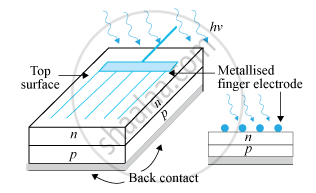
It generates emf when solar radiation fall on the p-n junction.
-
A p-type silicon wafer of about 300 μm is taken over which a thin layer of n-type silicon is grown on one side by diffusion process.
-
The generation of emf by a solar cell when light falls on it is due to following three processes:
-
The light close to the junction generates e-h pairs.
-
The electric field of the depletion region separates the electrons and holes.
-
The electrons reaching the n-side are collected by the front contact, while the holes reaching the p-side are collected by the back contact. Thus, the p-side becomes positively charged and the n-side becomes negatively charged, giving rise to photovoltage.
-
- Semiconductors with band gaps close to 1.5 eV are ideal materials for the fabrication of solar cells.
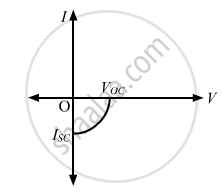
- V-I characteristic of a solar cell:
The V-I characteristic of a solar cell as follows:
Isc is the short-circuit current when the load resistance RL is zero.
Voc is the open-circuit voltage when RL is infinity.