Advertisements
Advertisements
प्रश्न
Advertisements
उत्तर १
Reflection obeys the following two laws
(a). The incident ray, the reflected ray, and the normal at the point of incidence, all lie in the same plane.
(b). The angle of incidence and the angle of reflection are always equal.
उत्तर २
- The incident ray, the reflected ray, and the normal at the point of incidence, all lie in the same plane.
- The angle of incidence and the angle of reflection are always equal.
संबंधित प्रश्न
State the laws of reflection.
Describe an activity to show that the incident ray, the reflected ray and the normal at the point of incidence lie in the same plane.
A person 1 m in front of a plane mirror seems to be ______ m away from his image.
What is the angle of incidence of a ray if the reflected ray is at an angle of 90° to the incident ray?
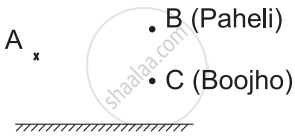
- Find out the position of the image of an object situated at A in the plane mirror.
- Can Paheli at B see this image?
- Can Boojho at C see this image?
- When Paheli moves from B to C, where does the image of A move?
Describe an experiment to verify the laws of reflection of light. Ans. Laws of reflection.
State the two laws of reflection of light.
According to the law of reflection :
A ______ reflection helps us to see the object
Reflection of light from rough surface is called ______ reflection
A student does the experiment on tracing the path of a ray of light passing through a rectangular glass slab for different angles of incidence. He can get a correct measure of the angle of incidence and the angle of emergence by following the labelling indicated in figure.
Plane mirrors are arranged parallel to each other to get ______.
The incident angle of a ray of light is 30°. The angle between the incident ray and the reflected ray is ______.
The bouncing back of light from a surface is called ______.
The incident ray, the ______ ray, and the ______ at the point of incidence, all lie in the same plane.
We can see things around us only when the light reflected by them reaches our eyes.
Why do we need a shiny surface for reflection?
Higher-Order Thinking Skills:
Are the laws of reflection true in the case of irregular reflection?
