Advertisements
Advertisements
प्रश्न
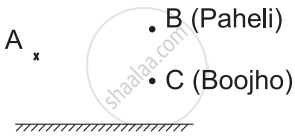
- Find out the position of the image of an object situated at A in the plane mirror.
- Can Paheli at B see this image?
- Can Boojho at C see this image?
- When Paheli moves from B to C, where does the image of A move?
लघु उत्तर
Advertisements
उत्तर

- The image of the object placed at A is formed behind the mirror. The distance of the image from the mirror is equal to the distance of A from the mirror. The image of A is shown in the given figure.
- Yes. Paheli at B can see this image.
- Yes. Boojho at C can see this image.
- The image of the object at A will not move. It will remain in the same position when Paheli moves from B to C.
shaalaa.com
या प्रश्नात किंवा उत्तरात काही त्रुटी आहे का?
संबंधित प्रश्न
A person 1 m in front of a plane mirror seems to be ______ m away from his image.
If you touch your ______ ear with your right hand in front of a plane mirror, it will be seen in the mirror that your right ear is touched with your ______.
State the two laws of reflection of light.
State the two laws of reflection of light.
State the laws of reflection and describe an experiment to verify them.
State the laws of reflection.
A ______ reflection helps us to see the object
The incident ray, the ______ ray, and the ______ at the point of incidence, all lie in the same plane.
Why do we need a shiny surface for reflection?
Which of the following is a non-mechanical wave?
