Advertisements
Advertisements
प्रश्न
State how will you use this graph to detennine the value of Planck's constant.
Advertisements
उत्तर
From the graph the slope , tan θ = `(V_s)/f`
⇒ tan `theta =h/e [∵V_s =h/ef]`
∴ h = Planck's constant = e tan θ
Thus, knowing the slope we can get the value of 'h' - Planck's constant
APPEARS IN
संबंधित प्रश्न
The photoelectric work function for a metal surface is 2.3 eV. If the light of wavelength 6800A is incident on the surface of metal, find threshold frequency and incident frequency. Will there be an emission of photoelectrons or not?
[Velocity of light c = 3 x 10⁸ m/s,
Planck’s constant, h = 6.63 * 10-34 Js ]
Write three characteristic features in photoelectric effect that cannot be explained on the basis of wave theory of light, but can be explained only using Einstein's equation.
Sketch the graphs showing variation of stopping potential with frequency of incident radiations for two photosensitive materials A and B having threshold frequencies vA > vB.
(i) In which case is the stopping potential more and why?
(ii) Does the slope of the graph depend on the nature of the material used? Explain.
Light of intensity ‘I’ and frequency ‘v’ is incident on a photosensitive surface and causes photoelectric emission. What will be the effect on anode current when (i) the intensity of light is gradually increased. In each case, all other factors remain the same. Explain, giving justification in each case.
In an experiment of the photoelectric effect, the graph of maximum kinetic energy EK of the emitted photoelectrons versus the frequency v of the incident light is a straight line AB shown in Figure 6 below:
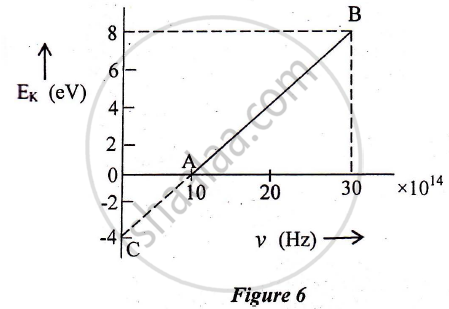
Find:
1) Threshold frequency of the metal
2) The work function of the metal.
3) Stopping potential for the photoelectrons emitted by the light of frequency `v = 30 xx 10^14 Hz`
A photosensitive surface emits photoelectrons when red light falls on it. Will the surface emit photoelectrons when blue light is incident on it? Give reason.
Draw a plot showing the variation of photoelectric current with collector potential for different frequencies but same intensity of incident radiation ?
Use Einstein's photoelectric equation to explain the observations from this graph ?
A beam of monochromatic radiation is incident on a photosensitive surface. Answer the following question giving reason :
On what factors does the number of emitted photoelectrons depend?
Consider an electron in front of metallic surface at a distance d (treated as an infinite plane surface). Assume the force of attraction by the plate is given as `1/4 q^2/(4πε_0d^2)`. Calculate work in taking the charge to an infinite distance from the plate. Taking d = 0.1 nm, find the work done in electron volts. [Such a force law is not valid for d < 0.1nm].
