Advertisements
Advertisements
प्रश्न
State four differences between – elements, compounds and mixtures with suitable examples.
Advertisements
उत्तर
- Term:
Elements – Pure substance made up of one kind of atoms only. e.g. Iron [Fe], Sulphur [S]
Compounds – Pure substance made up of two or more elements, e.g. Iron sulphide [FeS]
Mixture – Impure substance made up of two or more elements or compounds, e.g. Iron sulphur mixture. - Existence:
Elements – Elements i.e. atoms of one kind are present on their own.
e.g. Iron and sulphur exist on their own as elements iron and sulphur.
Compounds – Components in a compound present in a definite proportion.
e.g. Iron and sulphur are chemically combined in a fixed ratio in iron sulphide.
Mixture – Components in a mixture present in any proportion.
e.g. Iron and sulphur are mixed in any ratio in the mixture of iron and sulphur. - Properties:
Elements – Elements have a definite set of properties. Elements classified into metal and non-metals each with its own properties.
Compounds – Compounds have a definite set of properties.
Elements of a compound do not retain their original properties.
Mixture – Mixture does not have a definite set of properties. Components of a mixture do retain their original properties. - Separation:
Elements – Elements occur on their own or as compounds and can be separated by chemical and physical methods.
Compounds – Elements in a compound are chemically combined and can be separated by chemical methods only.
Mixture – Components in a mixture are chemically mixed and can be separated by physical methods only. - Examples:
Elements – Metals – Iron, copper, silver, gold.
Non-metals – Sulphur, chlorine.
Compounds – Iron sulphide, copper oxide, water.
Sodium chloride, copper, sulphate.
Mixture – Iron + sulphur, copper + silver, air, brass. Sodium chloride + water, copper sulphate + water.
APPEARS IN
संबंधित प्रश्न
Define: Elements
Choose the most appropriate answer
A solvent of Iodine is
Write true or false
A heterogeneous mixture has a uniform composition throughout the mixture
Differentiate between the following.
Filter Paper and Alum
Name the substance you will add to speed up sedimentation.
Give Two Examples for Each of the Following: Metalloids
Differentiate between:
Homogenous and heterogenous substances
Give two examples of non-metals.
Give two examples of the following.
Metals which are soft
What is meant by 2H and H2
State the number of atoms of CaCO3
Tick (√) the correct alternative from the choice given for the following statement.
Atoms of different kinds combine to form molecules of
Give the name of the radical - SO4
Give the name of the radical - CO3
Complete the statement given below by filling in the blank with the correct word.
The basic unit of an element is an __________.
Complete the statement given below by filling in the blanks with the correct words.
Atom contains ________ , with positively charged _____.
Select the correct answer from the choice given below.
The element which is malleable
The diagram represents fractional distillation for the separation of mixtures. Answer the following :
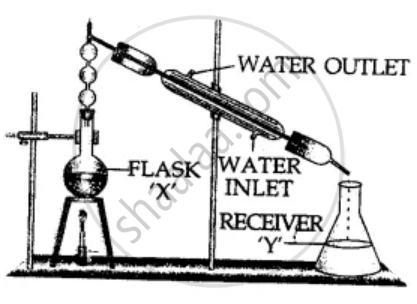
- Can two immiscible liquids be separated by this process?
- Separation of liquids by this process is based on which physical property?
- If methyl alcohol & water are to be separated, which liquid would remain in flask ‘X’ after condensation.
- Give a reason for the above answer.
- State the purpose of the fractionating column in the apparatus.
Select the correct answer from the choice given below to complete the sentence :
An example of a monoatomic molecule is ___________.
Match the following.
| 1. | Element | Made up of molecules |
| 2. | Compound | Impure substance |
| 3. | Colloid | Settles down on standing |
| 4. | Suspension | Pure substance |
| 5. | Mixture | Made up of atoms |
