Advertisements
Advertisements
प्रश्न
State and explain the law used to determine the magnetic field at a point due to a current element. Derive the expression for the magnetic field due to a circular current-carrying loop of radius r at its center.
Advertisements
उत्तर
The magnetic field at a certain point due to an element of a current-carrying conductor is given by Biot Savart's law. According to Biot-Savart’s law, the magnitude of the magnetic field dB due to a current-carrying element of length |dl| at a distance r is proportional to the current I, length of the element |dl|, and inversely proportional to the square of the distance r. Its direction is perpendicular to the plane containing dl and r.
Thus, in vector notation,
` "dB" alpha (vec("idl") xx vec("r"))/"r"^3 `
`"dB" = mu_° /(4pi) (vec("idl") xx "r")/"r"^3`
Magnetic field due to a circular current carrying loop:
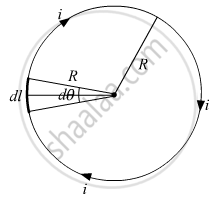
Let the current in the circular loop of radius R is i, now if take a small element of the loop, dl, making an angle dθ at the center.
The magnetic field at the center by using Biot-Savart law is, `vec"dB" = mu_°/(4pi) (vec"idl" xx vec"R")/("R"^3) = mu_°/(4pi) ("idl")/"R"^2 hat"n"` ...`(vec"dl" ⊥ vec"R", hat"n" ⊥ vec "dl"& vec"R")`
∵ dl = rdθ
⇒ `|vec"dB"| = mu_° /(4pi) ("Rd"theta)/R^2 = (mu_°"i")/(4pi"R")"d"theta`
⇒ `|vec"B"| = mu_° /(4pi"R") int_0^(2pi) "d"theta = (mu_°"i")/(2"R")`
⇒ `|vec"B"| = (mu_°"i")/(2"R")`
⇒ `vec"B" = (mu_°"i")/(2"R") hat"n"` ....(Where `hat"n"` is a vector perpendicular to the plane of loop, directed downward)
