Solve the following system of equations: sqrt(2)x – sqrt(3)y = 0 sqrt(3)x – sqrt(8)y = 0
Advertisements
प्रश्न
Solve the following system of equations:
`sqrt(2)x - sqrt(3)y = 0`
`sqrt(3)x - sqrt(8)y = 0`
Advertisements
उत्तर
`sqrt2x - sqrt3y = 0`....(i)
`sqrt3x - sqrt8y = 0` ....(ii)
From equation (i), we obtain:
`x = (-3sqrty)/sqrt2` ....(iii)
Substituting this value in equation (ii), we obtain:
`sqrt3 ((- sqrt3y)/sqrt2) - sqrt8y = 0`
`- (3y)/sqrt2 - 2sqrt2y = 0`
`y (-3/sqrt2 - 2sqrt2) = 0`
y = 0
Substituting the value of y in equation (iii), we obtain:
x = 0
`:. x = 0, y = 0`
APPEARS IN
संबंधित प्रश्न
Solve the following system of equations by cross-multiplication method.
2x + 3y + 8 = 0
4x + 5y + 14 = 0
Solve the following system of equations by cross-multiplication method.
ax + by = a – b; bx – ay = a + b
Solve the following system of equations by cross-multiplication method ax + by = 1; `bx + ay = \frac{(a+b)^{2}}{a^{2}+b^{2}-1`
For which values of a and b does the following pair of linear equations have an infinite number of solutions?
2x + 3y = 7
(a – b) x + (a + b) y = 3a + b – 2
Form the pair of linear equations in the following problems and find their solutions (if they exist) by any algebraic method:
A fraction becomes `1/3` when 1 is subtracted from the numerator and it becomes `1/4` when 8 is added to its denominator. Find the fraction.
Solve the following system of equations:
0.5x + 0.7y = 0.74
0.3x + 0.5y = 0.5
Solve each of the following systems of equations by the method of cross-multiplication :
x + 2y + 1 = 0
2x − 3y − 12 = 0
Solve the following system of equations by the method of cross-multiplication:
ax + by = a – b
bx – ay = a + b
Solve each of the following systems of equations by the method of cross-multiplication
`x/a + y/b = a + b`
Solve each of the following systems of equations by the method of cross-multiplication :
`5/(x + y) - 2/(x - y) = -1`
`15/(x + y) + 7/(x - y) = 10`
where `x != 0 and y != 0`
Solve the following system of equations by the method of cross-multiplication:
`(a - b)x + (a + b)y = 2a^2 - 2b^2`
(a + b)(x + y) = 4ab
Solve each of the following systems of equations by the method of cross-multiplication
`a^2x + b^2y = c^2`
`b^2x + a^2y = d^2`
Solve the system of equations by using the method of cross multiplication:
3x + 2y + 25 = 0, 2x + y + 10 = 0
Complete the activity to find the value of x.
3x + 2y = 11 ...(i) and 2x + 3y = 4 ...(ii)
Solution:
Multiply equation (i) by ______ and equation (ii) by ______.
`square` × (3x + 2y = 11) ∴ 9x + 6y = 33 ...(iii)
`square` × (2x + 3y = 4) ∴ 4x + 6y = 8 ...(iv)
Subtract (iv) from (iii),
`square` x = 25
∴ x = `square`
Find the values of x and y in the following rectangle [see figure].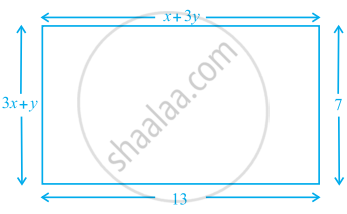
Solve the following pair of equations:
x + y = 3.3, `0.6/(3x - 2y) = -1, 3x - 2y ≠ 0`
Solve the following pair of equations:
43x + 67y = – 24, 67x + 43y = 24
A railway half ticket costs half the full fare, but the reservation charges are the same on a half ticket as on a full ticket. One reserved first class ticket from the station A to B costs Rs 2530. Also, one reserved first class ticket and one reserved first class half ticket from A to B costs Rs 3810. Find the full first class fare from station A to B, and also the reservation charges for a ticket.
A shopkeeper sells a saree at 8% profit and a sweater at 10% discount, thereby, getting a sum Rs 1008. If she had sold the saree at 10% profit and the sweater at 8% discount, she would have got Rs 1028. Find the cost price of the saree and the list price (price before discount) of the sweater.
Vijay had some bananas, and he divided them into two lots A and B. He sold the first lot at the rate of Rs 2 for 3 bananas and the second lot at the rate of Re 1 per banana, and got a total of Rs 400. If he had sold the first lot at the rate of Re 1 per banana, and the second lot at the rate of Rs 4 for 5 bananas, his total collection would have been Rs 460. Find the total number of bananas he had.
