Advertisements
Advertisements
प्रश्न
Solve each of the following systems of equations by the method of cross-multiplication
`a^2x + b^2y = c^2`
`b^2x + a^2y = d^2`
Advertisements
उत्तर
The given system of equations may be written as
`a^2x + b^2y - c^2 = 0`
`b^2x + a^2y - d^2 = 0`
Here,
`a_1 = a^2, b_1 = b^2, c_1 = -c^2`
`a_2 = b^2, b_2 = a^2, c_2 = -d^2`
By cross multiplication, we have
`=> x/(-b^2d^2 + a^2c^2) = (-y)/(-a^2d^2 + b^2c^2) = 1/(a^4 - b^4)`
Now
`x/(-b^2d^2 + a^2c^2) = 1/(a^4 - b^4)`
`=> x = (a^2c^2 - b^2d^2)/(a^4 - b^4)`
And
`(-y)/(-a^2d^2 + b^2c^2) = 1/(a^4 - b^4)`
`=> -y = (-a^2d^2 + b^2c^2)/(a^4 - b^4)`
`=> y = (a^2d^2 - b^2c^2)/(a^4 - b^4)`
Hence `x = (a^2c^2 - b^2d^2)/(a^4 - b^4), y = (a^2d^2 - b^2c^2)/(a^4-b^4)` is the solution of the given system of the equations.
संबंधित प्रश्न
A train travels at a certain average speed for a distance of 54 km and then travels a distance of 63 km at an average speed of 6 km/h more than the first speed. If it takes 3 hours to complete the total journey, what is its first speed?
A thief, after committing a theft, runs at a uniform speed of 50 m/minute. After 2 minutes, a policeman runs to catch him. He goes 60 m in first minute and increases his speed by 5 m/minute every succeeding minute. After how many minutes, the policeman will catch the thief?
Solve the following system of equations by cross-multiplication method.
2x + 3y + 8 = 0
4x + 5y + 14 = 0
Solve the following system of equations by the method of cross-multiplication.
11x + 15y = – 23; 7x – 2y = 20
Solve the following system of equations by cross-multiplication method ax + by = 1; `bx + ay = \frac{(a+b)^{2}}{a^{2}+b^{2}-1`
Form the pair of linear equations in the following problems and find their solutions (if they exist) by any algebraic method
The area of a rectangle gets reduced by 9 square units, if its length is reduced by 5 units and breadth is increased by 3 units. If we increase the length by 3 units and the breadth by 2 units, the area increases by 67 square units. Find the dimensions of the rectangle.
Solve the following system of equations:
`x/3 + y/4 =11`
`(5x)/6 - y/3 = -7`
Solve the following systems of equations:
4u + 3y = 8
`6u - 4y = -5`
Solve the following system of equations:
`3x - (y + 7)/11 + 2 = 10`
`2y + (x + 11)/7 = 10`
Solve the following system of equations:
`(7x - 2y)/(xy) = 5`
`(8x + 7y)/(xy) = 15`
Solve the following system of equations by the method of cross-multiplication:
3x + 2y + 25 = 0
2x + y + 10 = 0
Solve the following system of equations by the method of cross-multiplication:
`ax + by = (a + b)/2`
3x + 5y = 4
Solve each of the following systems of equations by the method of cross-multiplication :
2ax + 3by = a + 2b
3ax + 2by = 2a + b
Solve the following system of equations by the method of cross-multiplication:
(a + 2b)x + (2a – b)y = 2
(a – 2b)x + (2a + b)y = 3
Solve the following system of equations by the method of cross-multiplication:
`(a - b)x + (a + b)y = 2a^2 - 2b^2`
(a + b)(x + y) = 4ab
Solve the system of equations by using the method of cross multiplication:
6x – 5y – 16 = 0, 7x – 13y + 10 = 0
Solve the system of equations by using the method of cross multiplication:
3x + 2y + 25 = 0, 2x + y + 10 = 0
Find the values of x and y in the following rectangle [see figure].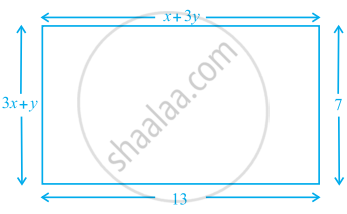
Find the solution of the pair of equations `x/10 + y/5 - 1 = 0` and `x/8 + y/6 = 15`. Hence, find λ, if y = λx + 5.
For what values of k will the following pair of linear equations have infinitely many solutions?
kx + 3y – (k – 3) = 0
12x + ky – k = 0
