Advertisements
Advertisements
प्रश्न
Solve the following equation by factorization
x (2x + 1) = 6
Advertisements
उत्तर
x (2x + 1) = 6
2x2 + x - 6 = 0
2x2 + 4x - 3x - 6 = 0
⇒ 2x (x + 2) - 3 (x + 2) = 0
⇒ (x + 2) (2x - 3) = 0
Either x + 2 = 0,
then x = -2
or
2x - 3 = 0,
then 2x = 3
⇒ x = `(3)/(2)`
Hence x = `-2, (3)/(2)`.
APPEARS IN
संबंधित प्रश्न
A passenger train takes one hour less for a journey of 150 km if its speed is increased by 5 km/hr from its usual speed. Find the usual speed of the train.
If the roots of the equations \[\left( a^2 + b^2 \right) x^2 - 2b\left( a + c \right)x + \left( b^2 + c^2 \right) = 0\] are equal, then
Solve the following quadratic equation using formula method only
x2 - 6x + 4 = 0
The area of the isosceles triangle is 60 cm2, and the length of each one of its equal side is 13cm. Find its base.
Solve equation using factorisation method:
`5/("x" -2) - 3/("x" + 6) = 4/"x"`
Solve the following equation by factorization
`(x + 2)/(x + 3) = (2x - 3)/(3x - 7)`
If x = p is a solution of the equation x(2x + 5) = 3, then find the value of p.
Solve the following equation by factorisation :
`sqrt(3)x^2 + 10x + 7sqrt(3)` = 0
The hypotenuse of a right-angled triangle is 1 m less than twice the shortest side. If the third side is 1 m more than the shortest side, find the sides of the triangle.
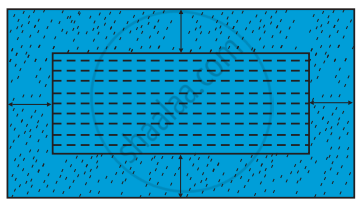
In the centre of a rectangular lawn of dimensions 50 m × 40 m, a rectangular pond has to be constructed so that the area of the grass surrounding the pond would be 1184 m2 [see figure]. Find the length and breadth of the pond.