Advertisements
Advertisements
प्रश्न
Solve the following equation by factorization
`(2)/(x^2) - (5)/x + 2 = 0, x ≠ 0`
Advertisements
उत्तर
`(2)/(x^2) - (5)/x + 2 = 0, x ≠ 0`
⇒ 2 - 5x + 2x2 = 0
⇒ 2x2 - 5x + 2 = 0 ...`{(∵ 2 xx 2 = 4),(4 = -4 xx (-1)),(-5 = -4 - 1):}}`
⇒ 2x2 - 4x - x + 2 = 0
⇒ 2x(x - 2) - 1(x - 2) = 0
⇒ (x - 2) (2x - 1) = 0
Either x - 2 = 0,
then x = 2
or
2x = 1 = 0,
then 2x = 1
⇒ x = `(1)/(2)`
∴ x = 2, `(1)/(2)`.
APPEARS IN
संबंधित प्रश्न
Find the roots of the following quadratic equation by factorisation:
100x2 – 20x + 1 = 0
Solve the following quadratic equations by factorization:
`(x + 3)/(x + 2) = (3x - 7)/(2x - 3); x ≠ -2, 3/2`
Solve the following quadratic equations by factorization:
`1/(x - 1) - 1/(x + 5) = 6/7, x ≠ 1, -5`
Solve the following quadratic equation by factorisation.
3x2 - 2√6x + 2 = 0
Write the set of values of k for which the quadratic equation has 2x2 + kx – 8 = 0 has real roots.
Show that x = –3 is a solution of x2 + 6x + 9 = 0.
Solve the following equation by factorization
`x^2/(15) - x/(3) - 10` = 0
In the centre of a rectangular lawn of dimensions 50 m × 40 m, a rectangular pond has to be constructed so that the area of the grass surrounding the pond would be 1184 m2 [see figure]. Find the length and breadth of the pond.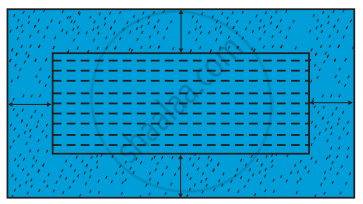
For quadratic equation `2x + 5/x = 5` :
If x4 – 5x2 + 4 = 0; the values of x are ______.
