Advertisements
Advertisements
प्रश्न
Sketch proper figure and write the answer of the following question.
If A- B - C and l(AC) = 11, l(BC) = 6.5, then l(AB) = ?
Advertisements
उत्तर
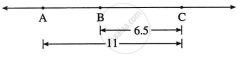
We have,
l(AC) = 11; l(BC) = 6.5
Now, l(AC) = l(AB) + l(BC) ...(A−B−C)
∴ 11 = l(AB) + 6.5
∴ l(AB) = 11 − 6.5
∴ l(AB) = 4.5
APPEARS IN
संबंधित प्रश्न
If the co-ordinate of A is x and that of B is y, find d(A, B).
x = -3, y = -6
Sketch proper figure and write the answer of the following question.
If X-Y-Z and l(XZ) = `3sqrt7`, l(XY) = `sqrt7`, then l(YZ) = ?
Find d(A, B), if co-ordinates of A and B are -2 and 5 respectively.
Co-ordinates of the pair of points are given below. Hence find the distance between the pair.
x + 3, x - 3
Co-ordinates of the pair of points are given below. Hence find the distance between the pair.
80, - 85
Find the distance between the following pair of points
(a, b) and (c, b)
Determine whether the given set of points are collinear or not
(a, −2), (a, 3), (a, 0)
Show that the following points taken in order to form an isosceles triangle
A(6, −4), B(−2, −4), C(2, 10)
Show that the following points taken in order to form the vertices of a parallelogram
A(−7, −3), B(5, 10), C(15, 8) and D(3, −5)
Verify that the following points taken in order to form the vertices of a rhombus
A(3, −2), B(7, 6), C(−1, 2) and D(−5, −6)
Verify that the following points taken in order to form the vertices of a rhombus
A(1, 1), B(2, 1), C(2, 2) and D(1, 2)
The abscissa of a point A is equal to its ordinate, and its distance from the point B(1, 3) is 10 units, What are the coordinates of A?
Let A(2, 3) and B(2, −4) be two points. If P lies on the x-axis, such that AP = `3/7` AB, find the coordinates of P.
Show that the point (11, 2) is the centre of the circle passing through the points (1, 2), (3, −4) and (5, −6)
The point whose ordinate is 4 and which lies on the y-axis is _______________
The distance between the two points (2, 3) and (1, 4) is ______
Find the distance with the help of the number line given below.

d(P, C)
Find the distance with the help of the number line given below.

d(O, E)
