Advertisements
Advertisements
प्रश्न
Show that the following points taken in order to form the vertices of a parallelogram
A(−7, −3), B(5, 10), C(15, 8) and D(3, −5)
Advertisements
उत्तर
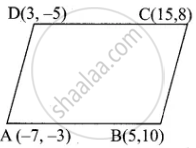
AB = `sqrt((5 + 7)^2 + (10 + 3)^2`
= `sqrt((12)^2 + (13)^2`
= `sqrt(144 + 169)`
= `sqrt(313)`
BC = `sqrt((15 - 5)^2 + (8 - 10)^2`
= `sqrt(10^2 + (-2)^2`
= `sqrt(100 + 4)`
= `sqrt(104)`
CD = `sqrt((3 - 15)^2 + (-5 - 8)^2`
= `sqrt((-12)^2 + (- 13)^2`
= `sqrt(144 + 169)`
= `sqrt(313)`
AD = `sqrt((3 + 7)^2 + (-5 + 3)^2`
= `sqrt((10)^2 + (-2)^2`
= `sqrt(100 + 4)`
= `sqrt(104)`
AB = CD = `sqrt(313)` and BC = AD = `sqrt(104)` ...(Opposite sides are equal)
∴ ABCD is a parallelogram.
APPEARS IN
संबंधित प्रश्न
If the co-ordinate of A is x and that of B is y, find d(A, B).
x = - 3, y = 7
If the co-ordinate of A is x and that of B is y, find d(A, B).
x = -3, y = -6
On a number line, co-ordinates of P, Q, R are 3, -5 and 6 respectively. State with reason whether the following statement is true or false.
d(P, Q) - d(P, R) = d(Q, R)
Show that the following points taken in order to form an equilateral triangle
`"A"(sqrt(3), 2), "B"(0, 1), "C"(0, 3)`
Show that the following points taken in order to form the vertices of a parallelogram
A(−3, 1), B(−6, −7), C(3, −9) and D(6, −1)
A(−1, 1), B(1, 3) and C(3, a) are point and if AB = BC, then find ‘a’
The abscissa of a point A is equal to its ordinate, and its distance from the point B(1, 3) is 10 units, What are the coordinates of A?
Show that the point (11, 2) is the centre of the circle passing through the points (1, 2), (3, −4) and (5, −6)
Find the distance with the help of the number line given below.

d(P, C)
Find the distance with the help of the number line given below.

d(P, J)
