Advertisements
Advertisements
प्रश्न
Show that height of the cylinder of greatest volume which can be inscribed in a right circular cone of height h and semi vertical angle α is one-third that of the cone and the greatest volume of cylinder is `4/27 pih^3` tan2α.
Advertisements
उत्तर
Let VAB be a cone.
Height of the cone = h
Semivertex angle = α
Cylinder A'B'DC is inscribed in a cone whose radius = x.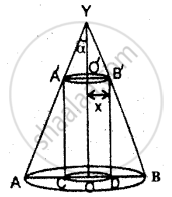
OO' = Height of cylinder = VO - VO'
= h - x cot α
V, volume of the cylinder = πx2 (h - x cot α)
On differentiating with respect to x,
`(dV)/dx = 2 pi xh - 3 pix^2 cot alpha`
For maximum and minimum, `(dV)/dx = 0`
⇒ 2πxh - 3πx2 cot α = 0
⇒ πx (2h - 3x cot α) = 0
⇒ 2h - 3 x cot α = 0
⇒ 3x cot α = 2h
`therefore x = (2h)/3 tan alpha ...[x ne 0]`
Now, `(d^2 v)/(dx^2) = 2 pih - 6 pih cot alpha`
When x = `(2h)/3 tan alpha`
`therefore (d^2V)/dx^2 = 2pih - 6pi (2h)/3 tan alpha cot alpha`
`= 2pih - 4pih`
`= pi(2h - 4h)`
`= - 2 pih < 0`
⇒ V is maximum when x = `(2h)/3 tan alpha`
Height of cylinder, OO' = VO - VO' = h - x cot α
`= h - ((2h)/3 tan alpha) cot alpha ...[because x = (2h)/3 tan alpha]`
`= h - (2h)/3 = h/3`
`= 1/3` height of the cone
Maximum volume of cylinder = πx2 (h - x cot α)
`= pi - ((2h)/3 tan alpha)^2 * (h - (2h)/3)`
`= pi((2h)/3 tan alpha)^2 xx h/3`
`= 4/27 pih^3 tan^2 alpha`
APPEARS IN
संबंधित प्रश्न
A cone is inscribed in a sphere of radius 12 cm. If the volume of the cone is maximum, find its height
Verify Rolle's theorem for the following function on the indicated interval f(x) = x2 − 4x + 3 on [1, 3] ?
Verify Rolle's theorem for the following function on the indicated interval f (x) = (x − 1) (x − 2)2 on [1, 2] ?
Verify Rolle's theorem for the following function on the indicated interval f(x) = x(x −2)2 on the interval [0, 2] ?
Verify Rolle's theorem for the following function on the indicated interval f(x) = cos 2x on [−π/4, π/4] ?
Verify Rolle's theorem for the following function on the indicated interval f (x) = log (x2 + 2) − log 3 on [−1, 1] ?
Verify Rolle's theorem for the following function on the indicated interval f(x) = sin x + cos x on [0, π/2] ?
Verify Rolle's theorem for the following function on the indicated interval f(x) = 4sin x on [0, π] ?
At what point on the following curve, is the tangent parallel to x-axis y = 12 (x + 1) (x − 2) on [−1, 2] ?
It is given that the Rolle's theorem holds for the function f(x) = x3 + bx2 + cx, x \[\in\] at the point x = \[\frac{4}{3}\] , Find the values of b and c ?
Verify Lagrange's mean value theorem for the following function on the indicated intervals. find a point 'c' in the indicated interval as stated by the Lagrange's mean value theorem f(x) = x2 − 3x + 2 on [−1, 2] ?
Verify Lagrange's mean value theorem for the following function on the indicated intervals. find a point 'c' in the indicated interval as stated by the Lagrange's mean value theore f(x) = (x − 1)(x − 2)(x − 3) on [0, 4] ?
Verify Lagrange's mean value theorem for the following function on the indicated intervals. find a point 'c' in the indicated interval as stated by the Lagrange's mean value theore f(x) = tan−1 x on [0, 1] ?
Verify Lagrange's mean value theorem for the following function on the indicated intervals. find a point 'c' in the indicated interval as stated by the Lagrange's mean value theorem f(x) = sin x − sin 2x − x on [0, π] ?
Discuss the applicability of Lagrange's mean value theorem for the function
f(x) = | x | on [−1, 1] ?
Show that the lagrange's mean value theorem is not applicable to the function
f(x) = \[\frac{1}{x}\] on [−1, 1] ?
Verify the hypothesis and conclusion of Lagrange's man value theorem for the function
f(x) = \[\frac{1}{4x - 1},\] 1≤ x ≤ 4 ?
Find a point on the parabola y = (x − 4)2, where the tangent is parallel to the chord joining (4, 0) and (5, 1) ?
When the tangent to the curve y = x log x is parallel to the chord joining the points (1, 0) and (e, e), the value of x is ______.
The value of c in Rolle's theorem for the function \[f\left( x \right) = \frac{x\left( x + 1 \right)}{e^x}\] defined on [−1, 0] is
Show that height of the cylinder of greatest volume which can be inscribed in a right circular cone of height h and semi-vertical angle α is one-third that of the cone and the greatest volume of the cylinder is `(4)/(27) pi"h"^3 tan^2 α`.
Find the area of greatest rectangle that can be inscribed in an ellipse `x^2/"a"^2 + y^2/"b"^2` = 1
An isosceles triangle of vertical angle 2θ is inscribed in a circle of radius a. Show that the area of triangle is maximum when θ = `pi/6`
If f(x) = `1/(4x^2 + 2x + 1)`, then its maximum value is ______.
Minimum value of f if f(x) = sinx in `[(-pi)/2, pi/2]` is ______.
Prove that f(x) = sinx + `sqrt(3)` cosx has maximum value at x = `pi/6`
The least value of the function f(x) = 2 cos x + x in the closed interval `[0, π/2]` is:
It is given that at x = 1, the function x4 - 62x2 + ax + 9 attains its maximum value on the interval [0, 2]. Find the value of a.
Let y = `f(x)` be the equation of a curve. Then the equation of tangent at (xo, yo) is :-
For a continuous function on the closed interval \[a,d\], what does \[f(a)\] represent?
For a continuous function on the closed interval \[a,d\], what does \[f(c)\] represent?
For a continuous function on the closed interval \[a,d\], what does \[f(d)\] represent?
Which statement about local extrema and absolute extrema is correct?
Which points must always be checked when finding absolute extrema on a closed interval \[a,b\]?
For \[f(x)=12x^{\frac{4}{3}}-6x^{\frac{1}{3}}\], which derivative is correct?
Which list contains all critical points and endpoints for \[f(x)=12x^{\frac{4}{3}}-6x^{\frac{1}{3}}\] on \[-1,1\]?
What is \[f(-1)\] for \[f(x)=12x^{\frac{4}{3}}-6x^{\frac{1}{3}}\]?
What is \[f(1)\] for \[f(x)=12x^{\frac{4}{3}}-6x^{\frac{1}{3}}\]?
