Advertisements
Advertisements
प्रश्न
Samantha is your father’s mother’s grandson’s daughter. Therefore, Samantha is your
पर्याय
niece
sister
uncle
brother
Advertisements
उत्तर
niece
Explanation:
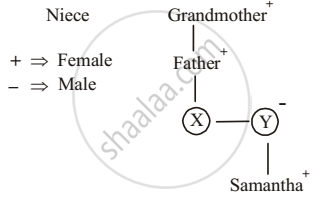
APPEARS IN
संबंधित प्रश्न
Six friends are sitting in a circle and are facing the center of the circle. Deepa is between Prakash and Pankaj. Priti is between Mukesh and Lalit. Prakash and Mukesh are opposite to each other.
Who is sitting opposite to Priti?
Six friends are sitting in a circle and are facing the center of the circle. Deepa is between Prakash and Pankaj. Priti is between Mukesh and Lalit. Prakash and Mukesh are opposite to each other.
Who is sitting right to Prakash?
Read the following information carefully and answer the question given below.
- Five friends A, B, C, D and E travelled to five different cities of Chennai, Kolkata, Delhi, Bengaluru and Hyderabad by different modes of transport viz. bus, train, aeroplane, car and boat from Mumbai.
- The person who travelled to Delhi did not travel by boat.
- C went to Bengaluru by car and B went to Kolkata by aeroplane.
- D travelled by boat whereas E travelled by train.
- Mumbai is not connected by bus to Delhi and Chennai.
Which of the following combinations of person and mode is not correct?
Read the following information carefully to answer these question
Five friends A, B, C, D and E travelled to five different cities of India from Mumbai. They went to Chennai, Kolkata, Delhi, Bengaluru and Hyderabad by different modes of transport, i.e. by bus, train, aeroplane, car and boat. Mumbai is not connected by bus to Delhi and Chennai. The person who travelled to Delhi did not make use of the boat. 'C' went to Bengaluru by car and 'B' went to Kolkata by aeroplane, 'D' travelled by boat while 'E' travelled by train.
Who among the following travelled to Delhi?
Study the following information carefully to answer the given question
Six plays are to be organized from Monday to Sunday, one play each day with one day when there is no play. 'No play' day is not Monday or Sunday.
The plays are held in sets of 3 plays each in such a way that 3 plays are held without any break, i.e. 3 plays are held in such a way that there is no 'no play' day between them but immediately before this set or immediately after this set it is 'no play' day. Play Z was held on 26th and play X was held on 31st of the same month. Play B was not held immediately after play A but was held after A and play M was held immediately before Q. All the six plays were held in the same month.
Which of the following is true?
Study the following information carefully to answer the given question
Six plays are to be organized from Monday to Sunday, one play each day with one day when there is no play. 'No play' day is not Monday or Sunday.
The plays are held in sets of 3 plays each in such a way that 3 plays are held without any break, i.e. 3 plays are held in such a way that there is no 'no play' day between them but immediately before this set or immediately after this set it is 'no play' day. Play Z was held on 26th and play X was held on 31st of the same month. Play B was not held immediately after play A but was held after A and play M was held immediately before Q. All the six plays were held in the same month.
Which day was play Q organized?
Choose the response that most accurately and completely answers the following question.
A Science student has exactly four flasks - 1, 2, 3, and 4 - originally containing a red, a blue, a green, and an orange chemical, respectively. An experiment consists of mixing exactly two of these chemicals together by completely emptying the contents of one of the flasks into another of the flasks. The following conditions apply
The product of an experiment cannot be used in further experiments.
Mixing the contents of 1 and 2 produces a red chemical.
Mixing the contents of 2 and 3 produces an orange chemical.
Mixing the contents of 3 with the contents of either 1 or 4 produces a blue chemical.
Mixing the contents of 4 with the contents of either 1 or 2 produces a green chemical.
If the student performs exactly one experiment and exactly one of the resulting three non-empty flasks contains a blue chemical, which one of the following must be the colours of the chemicals in other two flasks?
Read the following information to answer the question
From a group of six boys M, N, O, P, Q, and Rand five girls G, H, I, J, and K a team of six are to be selected. Some of the criteria for selection are as follows.
- M and J go together.
- O cannot be placed with N.
- I cannot go with J.
- No goes with H.
- P and Q have to be together.
- K and R go together.
- Unless otherwise stated these criteria are applicable to the following question.
If both K and P are members of the team and three boys in all are included in the team, the member of the team other than K and P are
Study the given pattern carefully and select the number that can replace the question mark (?) in it.
25 24 122
31 27 143
35 29 ?
Choose the set of numbers that is similar to the following set.
{25, 19, 36}
