Advertisements
Advertisements
प्रश्न
Samantha is your father’s mother’s grandson’s daughter. Therefore, Samantha is your
विकल्प
niece
sister
uncle
brother
Advertisements
उत्तर
niece
Explanation:
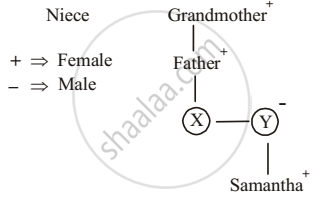
APPEARS IN
संबंधित प्रश्न
- P, Q, R, S, T, U, V and W are sitting around the circle and are facing the centre:
- P is second to the right of T who is the neighbour of R and V.
- S is not the neighbour of P.
- V is the neighbour of U.
- Q is not between S and W. W is not between U and S.
Which of the following is correct?
There are 8 houses in a line and in each house only one boy lives with the conditions as given below:
- Jack is not the neighbour Siman.
- Harry is just next to the left of Larry.
- There is at least one to the left of Larry.
- Paul lives in one of the two houses in the middle.
- Mike lives in between Paul and Larry.
If at least one lives to the right of Robert and Harry is not between Taud and Larry, then which one of the following statement is not correct?
Read the following information carefully and answer the question
Surinder, Prem, Wasim, Bishamber, and Chauhan are five players of a college cricket team and their home towns are Sikandrabad, Panipat, Waranga, Banaras, and Chennai (not in the order of their names). The five specialist slots of a spinner, pace-bowler, wicket-keeper, batsman, and captain are held by them (not in order of their names stated above). Their names, home towns, and specialties do not start with the same letter. Neither Prem nor Wasim is the captain and they do not belong to either Sik.amlrabad or Banaras. Panipat is not Bishambers home town. The player who hails from Banaras is a wicket-keeper. The captain's town in Panipat while the batsman does not hail from Warangal. Surinder is neither a wicket-keeper nor a batsman.
The Spinner's home town is
Read the following information carefully and answer the question
Surinder, Prem, Wasim, Bishamber, and Chauhan are five players of a college cricket team and their home towns are Sikandrabad, Panipat, Waranga, Banaras, and Chennai (not in the order of their names). The five specialist slots of a spinner, pace-bowler, wicket-keeper, batsman, and captain are held by them (not in order of their names stated above). Their names, home towns, and specialties do not start with the same letter. Neither Prem nor Wasim is the captain and they do not belong to either Sik.amlrabad or Banaras. Panipat is not Bishambers home town. The player who hails from Banaras is a wicket-keeper. The captain's town in Panipat while the batsman does not hail from Warangal. Surinder is neither a wicket-keeper nor a batsman.
The captain's home town is
Read the following information carefully to answer these question
Five friends A, B, C, D and E travelled to five different cities of India from Mumbai. They went to Chennai, Kolkata, Delhi, Bengaluru and Hyderabad by different modes of transport, i.e. by bus, train, aeroplane, car and boat. Mumbai is not connected by bus to Delhi and Chennai. The person who travelled to Delhi did not make use of the boat. 'C' went to Bengaluru by car and 'B' went to Kolkata by aeroplane, 'D' travelled by boat while 'E' travelled by train.
Which of the following combinations of person and mode is not correct?
Read the following information carefully to answer these question
Guest lectures on five subjects viz. Economics, History, Statistics, English, and Mathematics have to be arranged in a week from Monday to Friday. Only one lecture can be arranged on each day. Economics cannot be scheduled for Tuesday. Guest faculty for History is available only on Tuesday. Mathematics lecture has to be scheduled immediately after the day of the Economics lecture. English lecture has to be scheduled immediately before the day of Economics lecture.
Which lecture is scheduled before the Mathematics lecture?
According to the time by Rekha's watch, it is quarter past 9 and the hour-hand is pointing to the west. ln which of the given directions will the minute-hand point AFTER 75 minutes?
Study the following information carefully and answer the given questions:
L, P, Q, R, Sand Tare sitting in a straight line facing North.
- Q sits fourth to the left of T and Q does not sit at an extreme end of the line.
- R is not an immediate neighbour of Q.
- Only one person sits between R and T.
- Neither S nor L sits at the extreme end of the line.
- L is not an immediate neighbour of Q.
Four of the following five are alike in a certain way based on their seating positions in the above arrangement and so form a group. Which is the one that does not belong to that group?
Study the following information carefully and answer the given questions:
Eight friends L, M, P, Q, R, S, T and V are sitting around a circle facing the centre. L sits third to the right of M and L sits second to the left of P. R and S sit next to each other and none of them is an im- mediate neighbour of L. Q sits second to the right of T. V sits second to the right of S.
Who sits third to the left of V?
Study the following information carefully and answer the questions given below:
Nine persons – A, B, C, D, E, F, G, H and I – are sitting around a circular table facing the centre and at equal distance but not necessarily in the same order. B is immediate neighbour of neither I nor C. A is sitting third to the left of B. F is sitting third to the right of C. G is immediate neighbour of neither F nor A. D is sitting third to the left of I. H is an immediate neighbour of both A and G.
Starting from A, if all the persons are made to sit in the al- alphabetical order in clockwise direction, the position of how many (excluding A) will remain unchanged?
