Advertisements
Advertisements
प्रश्न
Direction: Read the information below and answer the question.
A neurosurgeon, an orthopaedist, a plastic surgeon, and an ophthalmologist visited the patient after surgery.
The time of each visit is mentioned below:
Neurosurgeon at 7:45
Orthopaedist 8:30
Plastic surgeon 9:15
Ophthalmologist 9:50
Each time mentioned above may be either A.M. or P.M.
Who were the doctors to visit the patient in the evening?
पर्याय
Neurosurgeon and Plastic surgeon
Plastic surgeon Ophthalmologist and Neurosurgeon
Orthopaedist and Neurosurgeon
Ophthalmologist and Orthopaedist and Plastic surgeon
Advertisements
उत्तर
Neurosurgeon and Plastic surgeon
APPEARS IN
संबंधित प्रश्न
Instructions for Question: Choose the set of three statements where the third statement can be logically derived from the preceding two.
Statements:
1. Some students love reading.
2. Some adults do not love reading.
3. Some students are not adults.
4. Some students are adults.
5. No reading lover is an adult.
6. Some men do not love reading.
The set of statements is:
Cobra: Snake :: Greyhound : ____________
Choose the pair of words from the options that best represents a similar relationship as the one expressed in the following pair of words.
Waiter: Restaurant
Choose the most appropriate option for the following question.
There were twelve dozens of chocolates with a shopkeeper. Ten chocolates were distributed by the shopkeeper to the children of his colony. The shopkeeper then added two more dozens of chocolates in his stock. If the shopkeeper divided the total chocolates equally in two different packets, then how many chocolates were there in each packet?
Ornithologist : Bird :: Archealogist : ?
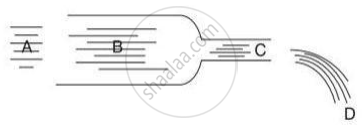
A large volume of water is gushing through a pipe which narrows at the outlet. At which point, A, B, C or D will the water flow fastest?
In the following questions find which one word cannot be formed from the letters of the given words using each letter only once:
IMPACTIENCE
College : Student :: Hospital : ?
In making a decision about an important question, it is desirable to distinguish between a 'strong' argument and a 'weak' argument. A 'strong' argument must be both important and directly related to the question. A 'weak' argument may not be directly related to the question and may be of minor importance or may be related to the trivial aspect of the question. The question below is followed by four arguments numbered I, II, Ill, and IV. You have to decide which of the arguments is 'strong' and which is 'weak'.
Statement
- Should people with educational qualifications higher than the optimum requirements be debarred from seeking jobs?
Arguments
- No, it will further aggravate the problem of educated unemployment.
- Yes, it creates complexes among employees and affects the work adversely.
- No, this goes against the basic rights of the individuals.
- Yes, this will increase productivity.
The question below is given a statement followed by two assumptions numbered I and II. An assumption is something supposed or taken for granted. You have to consider the statement and the following assumptions and decide which of the assumptions is implicit in the statement.
Statement Unless country 'X' achieves total literacy, it cannot achieve its mission of development.
Assumptions
- It is possible to achieve total literacy in the country 'X'.
- No development is possible without a proper mission.
