Advertisements
Advertisements
प्रश्न
Rs. 13500 are to be distributed among Salma, Kiran and Jenifer in such a way that Salma gets Rs. 1000 more than Kiran and Jenifer gets Rs. 500 more than Kiran. Find the money received by Jenifer.
Advertisements
उत्तर
Let the money received by Kiran be ₹ x.
Then, the money received by Salma = ₹ (x + 1000)
And the money received by Jenifer = ₹ (x + 500)
According to the question,
x + x + 1000 + x + 500 = 13500
⇒ 3x + 1500 = 13500
⇒ 3x = 13500 – 1500
⇒ 3x = 12000
⇒ x = `12000/3`
∴ x = 4000
Hence, the money received by Jenifer = ₹ 4000 + 500 = ₹ 4500
APPEARS IN
संबंधित प्रश्न
The number of boys and girls in a class are in the ratio 7:5. The number of boys is 8 more than the number of girls. What is the total class strength?
The perimeter of a rectangle is 13 cm and its width is `2 3/4` cm. Find its length.
The present age of Sahil's mother is three times the present age of Sahil. After 5 years their ages will add to 66 years. Find their present ages.
The sum of three consecutive multiples of 7 is 357. Find the smallest multiple.
After 18 years, Swarnim will be 4 times as old as he is now. His present age is ______.
If the sum of two consecutive numbers is 93 and one of them is x, then the other number is 93 – x.
The sum of three consecutive odd natural numbers is 69. Find the prime number out of these numbers.
The sum of three consecutive numbers is 156. Find the number which is a multiple of 13 out of these numbers.
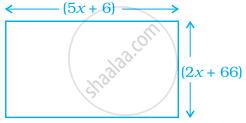
For what value of x is the perimeter of shape 186 cm?
On dividing Rs. 200 between A and B such that twice of A’s share is less than 3 times B’s share by 200, B’s share is?
