Advertisements
Advertisements
प्रश्न
Redraw the flow-chart with corrections. Explain in brief the process of obtaining energy through oxidation of carbohydrates, lipids & proteins.

How energy is formed from oxidation of carbohydrates, fats and proteins? Correct the diagram given below.
Advertisements
उत्तर १
Corrected flow-chart:
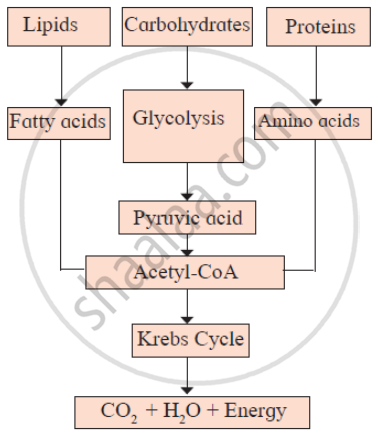
Process of obtaining the energy:
- Carbohydrates: Carbohydrates such as glucose are broken down into pyruvic acid through glycolysis. Pyruvic acid is then converted into acetyl-Coenzyme A (Acetyl-CoA), which enters the Krebs cycle and is oxidised. The NADH2 and FADH2 produced during this process are oxidised in the electron transport chain, releasing energy as ATP.
- Proteins: Proteins are digested into amino acids. These amino acids are converted into intermediates that enter the Krebs cycle, often through acetyl-CoA. During the Krebs cycle, NADH2 and FADH2 are formed, which are oxidised in the electron transport chain to produce ATP.
- Lipids: Lipids are broken down into fatty acids and glycerol. Fatty acids are converted into acetyl-CoA, which enters the Krebs cycle and is oxidised. The NADH2 and FADH2 produced are then oxidised through the electron transport chain, resulting in the release of energy as ATP.
उत्तर २
- Dietary carbohydrates are digested by enzymes and transformed into glucose. Proteins and lipids are metabolised into amino acids and glycerol, respectively.
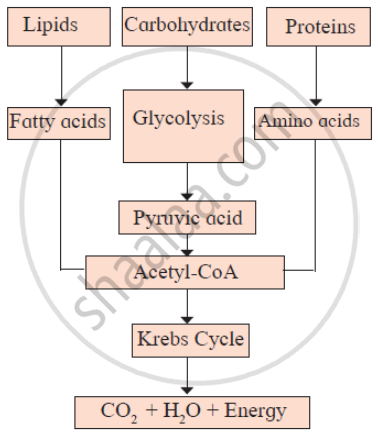
- Carbohydrates are oxidised during cellular respiration. Aerobic respiration involves three processes for glucose oxidation: glycolysis, the tricarboxylic acid cycle (Krebs cycle), and the electron transfer chain.
- During glycolysis, one molecule of glucose yields two molecules of pyruvic acid, ATP, NADH2, and water. The process converts pyruvic acid into Acetyl-Coenzyme-A, releasing two molecules of NADH2 and CO2.
- In the TCA cycle, molecules of Acetyl-CoA enter mitochondria and undergo a series of cyclic events. The acetyl portion of Acetyl-CoA is totally oxidised throughout this cyclical phase. This reaction releases chemicals such as CO2, H2O, NADH2, and FADH2.
- In the third step of the ETC reaction, NADH2 and FADH2 from the first two steps are used to produce ATP molecules. Each NADH2 molecule yields 3 ATP molecules, while FADH2 yields 2 ATP molecules.
- When one molecule of glucose is completely oxidised in the presence of oxygen, it produces 38 molecules of ATP, which is how carbohydrates are converted into energy.
- Insufficient carbohydrates in the diet might lead to the use of protein or lipids for energy. Acetyl-CoA is produced by the conversion of fatty acids from lipids and amino acids from proteins. Acetyl-CoA can be oxidised through the TCA cycle to produce energy.
APPEARS IN
संबंधित प्रश्न
Give a scientific reason.
Cell division is one of the very important properties of cells and living organisms.
Write the correct option from the given multiple options.
Which of the following vitamin is necessary for synthesis of NADH2?
Choose the correct option.
Which step of Kreb's cycle operates substrate-level phosphorylation?
Fill in the blank with a suitable word.
In the prokaryotes ______ molecules of ATP are formed per molecule of glucose oxidised.
Fill in the blank with a suitable word.
F1- F0 particles participate in the synthesis of _______.
Answer the following question.
Why is less energy produced during anaerobic respiration than in aerobic respiration?
Answer the following question.
Where is the respiration electron transport system located in a cell?
Give scientific reason.
We feel tired after exercising.
Which molecules are formed during the glycolysis process?
Explain the use of fatty acids.
State two groups/types of vitamins.
Identify the given reaction and explain it.

What are the main steps of anaerobic respiration?
Why is water an essential nutrient?
Identify the statement that correctly describes phosphorylation.
Identify the CORRECT way/s of Phosphorylation.
Oxidative phosphorylation refers to ______
In glycolysis,____________ ATP molecules are formed directly.
Give three uses of fatty acids.
