Advertisements
Advertisements
प्रश्न
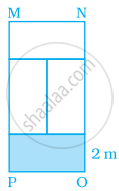
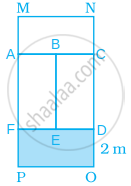
Rectangle MNOP is made up of four congruent rectangles (see figure). If the area of one of the rectangles is 8 m2 and breadth is 2 m, then find the perimeter of MNOP.
Advertisements
उत्तर
We have, area of one rectangle = 8 m2
And breadth = 2 m
We know that,
Area of rectangle = l × b
⇒ l × b = 8
⇒ l × 2 = 8
⇒ l = 4 m
Now, we have to find the perimeter of MNOP, which contains four congruent rectangles, it means they have same length and breadth.
∴ Perimeter of rectangle MNOP = MN + NC + CD + DO + PO + PF + FA + MA
= 4 + 2 + 4 + 2 + 4 + 2 + 4 + 2
= 24 m
Hence, the perimeter of MNOP is 24 m.
APPEARS IN
संबंधित प्रश्न
A regular pentagon of each side 12 cm has same perimeter as that of a regular hexagon. Find the length of each side of the hexagon.
If A denotes area of a rectangle, l represents its length and b represents its breadth, find:
l, if A = 48 cm² and b = 6 cm
If A denotes area of a rectangle, l represents its length and b represents its breadth, find:
b, if A = 88 m² and l = 8m
Find the perimeter of a rectangle whose area = 2600 m² and breadth = 50 m.
Each side of a square tile is 60 cm. How many tiles will be required to cover the floor of a hall with length = 50 m and breadth = 36 m.
The perimeter of a rectangular field is 500 m and its length = 150 m. Find:
(i) its breadth,
(ii) its area.
(iii) cost of ploughing the field at the rate of ₹1.20 per square meter.
Sanju completes 12 rounds around a square park every day. If one side of the park is 120 m, find out in kilometres and metres the distance that Sanju covers daily.

Each rectangle is made out of 12 equal squares, so all have the same area, but the length of the boundary will be different.
Which of these rectangles has the smallest perimeter?
Length of a rectangular field is 250 m and width is 150 m. Anuradha runs around this field 3 times. How far did she run? How many times she should run around the field to cover a distance of 4 km?
Why is the perimeter of a rectangle calculated as 2 × (length + breadth)?
