Advertisements
Advertisements
प्रश्न
Read the following extract and answer the questions given below :
I was 33 at the time, a doctor in the West End of London. I had been lucky)' in advancing through severed arduous Welsh mining assistantships to my own practice- acquired on the installment plan from a dear old family physician who, at our first interview, gazed at my cracked boots and frayed cuffs and trusted me.
I think I wasn't a bad doctor. My patients seemed to like me not only 1he nice old ladies with nothing wrong with them, who lived near the Park and paid handsomely for my cheerful bedside manner but the cabbies, porters, and deadbeats in the mews and back streets of Bayswater, who paid nothing and often had a great deal wrong with them. Yet there was something- though I treated everything that came my way, read all Ille medical journals, attended scientific meetings, and even found time to take complex postgraduate diplomas - I wasn't quite sure of myself. I didn't stick at anything for long. I had successive ideas of specializing in dermatology, in aural surgery, in pediatrics, but discarded them all. While I worked all day and half of most nights, I really lacked perseverance, stability. One day I developed indigestion. After resisting my wife's entreaties for several weeks, I went casually to consult a friendly colleague. I expected a bottle of bismuth and an invitation to a bridge. I received instead of the shock of my life: a sentence to six months' complete rest in the country on a milk diet. I had a gastric ulcer.
(I) What does the doctor tell us about his profession?
(2) What sort of patients did the doctor handle?
(3) What shock of life did the doctor receive when he visited his doctor colleague?
(4) What qualities of the doctor appeal you the most?
(5) Rewrite the following sentences in the ways instructed:
(i) I read all the medical journals.
(Rewrite it using the past perfect continuous tense.)
(ii) I treated everything that came n1y way.
(Rewrite the sentence beginning with "Everything ... ")
(iii) I received the shock of my life.
(Make it a Rhetorical question.)
(6) Find out the words from the extract which mean :
(i) involving a lot of effort and energy.
(ii) serious requests
Advertisements
उत्तर
(1) The doctor tells us that he was not a bad doctor, all his patients seemed to like him. However, he felt he lacked presence and stability.
(2) The doctor treated all kinds of patients, the rich old ladies had nothing wrong with them and the poor cabbies, porters and deadbeats, who paid nothing and often had a great deal of wrong with them.
(3) The doctor was troubled with indigestion, so he consulted a friendly colleague who told him he had a gastric ulcer and take complete rest in the country on a milk diet.
(4) The doctor was kind and therefore the old ladies liked to visit him, he probably didn’t overcharge his patients so the poor could approach him. Overall he was honest and was able to realize his own drawbacks. He was a simple man and lived a simple life.
(5)
(i) I had been reading all the medical journals.
(ii) Everything that came my way was treated by me.
(iii) Didn’t I receive the shock of my life?
(6)
APPEARS IN
संबंधित प्रश्न
 During the devastating July 2005 floods that hit Mumbai, Rajen Dutia received an urgent call from a relative, Lopa Vyas late in the evening. “A friend’s mother is stranded near your home, Rajen. Can you please take her home? Her name is Rashmi,” Vyas told him.
Mumbai had come to a halt and people were trapped everywhere. Despite power failure and raging rain, Dutia stepped out and made his way to the spot, where he found Rashmi as well as a dozen other people. They were stranded in the dark, shivering in the rain. They all lived far away and had no place to go for the night.
Rajen took all of them to his one-bedroom flat, where he served them dinner and invited them to spend the night.
"By doing so," says Rajen, "I was simply fulfilling my karma, paying the universe back for the good it had done for me."
"God is kind. My daughter had just started her new job that day, and had gone for her training. She was stranded too. While she was trying to get to our relatives, she almost drowned, but a young stranger saved her. He and his friends even dropped her to my relative's place and phoned me to say she was safe. One good turn deserves another."
A2. Order
Look at the following sentences from the passage and put them in the correct sequence: (2)
(a) He took them to his one-bedroom flat.
(b) Rajen found Rashmi as well as a dozen other people shivering in the rain.
(c) Mumbai had come to a halt and people were trapped everywhere.
(d) Rajen Dutia received an urgent call.
A3
During the devastating July 2005 floods that hit Mumbai, Rajen Dutia received an urgent call from a relative, Lopa Vyas late in the evening. “A friend’s mother is stranded near your home, Rajen. Can you please take her home? Her name is Rashmi,” Vyas told him.
Mumbai had come to a halt and people were trapped everywhere. Despite power failure and raging rain, Dutia stepped out and made his way to the spot, where he found Rashmi as well as a dozen other people. They were stranded in the dark, shivering in the rain. They all lived far away and had no place to go for the night.
Rajen took all of them to his one-bedroom flat, where he served them dinner and invited them to spend the night.
"By doing so," says Rajen, "I was simply fulfilling my karma, paying the universe back for the good it had done for me."
"God is kind. My daughter had just started her new job that day, and had gone for her training. She was stranded too. While she was trying to get to our relatives, she almost drowned, but a young stranger saved her. He and his friends even dropped her to my relative's place and phoned me to say she was safe. One good turn deserves another."
A2. Order
Look at the following sentences from the passage and put them in the correct sequence: (2)
(a) He took them to his one-bedroom flat.
(b) Rajen found Rashmi as well as a dozen other people shivering in the rain.
(c) Mumbai had come to a halt and people were trapped everywhere.
(d) Rajen Dutia received an urgent call.
A3(i). Fill in the blanks :
Select the words given in the passage (1)
(i) Thousands Of pilgrims were …………….. due to the cloud burst in Uttarakhand.
(ii) The tiger was ……………… by the hunter.
(ii). Antonyms:
Select the correct antonyms for the given words from the alternatives :
(1) Please :
(a) unplease (b) displease (c) misplease
(2) Safe: '
(a) insafe (b) safeless (c) unsafe
A4(i) Tags :
Select the correct tag for the alternatives given below :
One good turn deserves another.
(a) Doesn’t it? (b) don’t it (c) does it?
(ii). Guess:
Choose the correct answer : (1)
Rajen can you please take her home? ‘Can’ indicates :
(a) Obligation (b) ability (c) permission
A5. Personal Response :
‘ one good turn
Deserves another.’
Explain with an
example of your own.
The natural life span of a domesticated horse is about 25 – 30 years, 10 years down from what it was in the wild. You can tell a horse’s age from the number of teeth he has. They get all their teeth by the age of 5, after which those teeth just get longer. Horses have close to 360 degree all round vision. The only place they cannot see is directly behind or right in front of themselves, which is why it’s dangerous to stand behind a horse. If they later I it also means that they cannot see a jump once they are about four feet from it, and have to rely on memory as to its height and shape! Each of the horse’s two eyes work independently wherever a horse’s ear points is where the horse is looking. A horse is able to sleep standing up as he is able to lock his leg muscles so that he dosen’t fall asleep. Nor do all horses in the same field ever lie down at once – one animal always stands “on look out” duty.
1) What is the life span of a wild horse?
(2) Why do the horse owners cover their horse’s eyes with blinkers?
(3) What prevents a horse from falling while asleep?
(4)
(a) Falls /shorter/ the mane/ on the/ side/ legged.[Rearrange the words to make a meaningful sentence]
(b) Form antonyms by adding a prefix :
(i) able
(ii) direct
(5)
(a) They get all their teeth by the age of five. [Pick out the prepositions]
(b) If they feel something behind them they may kick. [Rewrite using ‘unless’]
(6) How have horses helped man through the ages?
The hopping kangaroo is a familiar sight in every snapshot relating to Australia. Members of the kangaroo family can be as small as a rat or as big as a man. Kangaroos are found mainly in Australia, Tasmania and New Guinea. Kangaroos, which are big-footed marsupials that evolved in Australia, use their short front legs like arms. The man-sized kangaroos of Australia are capable of speeding up to 88 km/hr for short distances, their means of locomotion being their powerful hind legs, which carry them over the ground in jumps of 9 m or more at a time.
Weighing around 70 kg, they have an average lifespan of around six to eight years and a maximum lifetime of 20 years. When bothered by predators, kangaroos often head for the water, standing submerged to the chest and attempting to drown the attacker by holding him under water. Another defensive technique is to get their back to a tree and kick at their adversary with their clawed hind feet, sometimes with sufficient force to kill a man. Normally shy animals, they alert other kangaroos to danger by beating on the ground with their hind feet. This loud alarm signal carries over a long distance.
The tail is important for kangaroos. It holds them in balance and supports them when they sit or fight against other kangaroos. The kangaroo uses its short legs as arms. With them it scratches itself, cleans its fur and holds branches when it eats leaves. Kangaroos are marsupials and the females carry newborns in a pouch in front of their abdomens. The babies are born small and climb up into safety of the pouch. There, for the next 225 days or so, they eat, sleep and grow. Once they reach full development, they leave the pouch. A young kangaroo that leaves the pouch is called a ‘joey’. To keep from getting too hot, the kangaroos take naps in the afternoon and do most of their grazing at night. But the best stay-cool secret of these creatures is the spit bath! Kangaroos drool and lick saliva all over their faces and bodies to cool down.
On the basis of your reading of the above passage, complete the following sentences with appropriate words/phrases:
(a) When followed by predators, kangaroos submerge ____________ and _________________.
(b) The powerful hind legs help kangaroos to __________________.
(c) Kangaroos are mainly found in Australia and are ____________________.
(d) They use their front legs to ___________________.
(e) Kangaroos warn others of danger by _______________________.
(f) The secret of kangaroos to stay cool is ______________________.
(g) They use their tails to _________________________.
(h) Before becoming ‘joeys’, the young ones stay in the ______________ and ________________.
It is rare to find someone with good technical and communication skills. You can get far ahead of your colleagues if you combine the two early in your career. People will judge, evaluate, promote or block you based on your communication skills. Since habits form by repeating both good and bad forms of communication, learn to observe great communicators and adopt their styles and traits — in written and verbal forms. The art of listening and learning from each and every interaction is another secret recipe. Develop the subconscious habit of listening to yourself as you speak and know when to pause.
Learning what not to say is probably more important than learning what to say. As your career develops, you will realize that the wise speak less. Speak when you have value to add, else refrain. Poorly constructed emails with grammatical errors are acceptable between friends, but they should be seriously avoided while communicating formally with your seniors. Avoid any communication in an emotional state when might say things you will regret later. One unnecessary word uttered at the wrong time or place can ruin a relationship, career or even your life. Such is the power of words. If such a thing happens, you should immediately apologise, else it may haunt you for life.
Another problem to overcome is speaking too fast. Since our minds are working faster than our speech, we are inclined to speak fast. This does not necessarily mean that the person hearing it will get it any faster. On the contrary, it is always the reverse. So slow down and think before you speak. “When I get ready to speak to people,” Abraham Lincoln said, “I spend two-thirds of the time thinking what they want to hear and one-thirds of the time thinking what they want to hear and one-third thinking what I want to say.” Adding humour and wit is also essential. But realize that not all jokes are funny and observe certain boundaries. Never say anything that could offend. Remember you are not a comedian who must offend as many people as you can to be witty.
2.1 Answer the following questions briefly:
(a) Why is it necessary to have good communication skills?
(b) How can communication skills be developed?
(c) What, according to the writer, should be avoided while communicating?
(d) Why should you be careful when you tend to be humorous?
2.2 Choose the most appropriate meanings of the given words from the options provided:
(a) evaluate (para 1)
(i) estimate
(ii) assume
(iii) punish
(iv) evolve
(b) trait (para 1)
(i) treaty
(ii) trail
(iii) quality
(iv) liberty
(c) utter (para 2)
(i) flatter
(ii) speak
(iii) rot
(iv) unique
(d) haunt (para 2)
(i) hunt
(ii) chant
(iii) trouble
(iv) avoid
Q1 Read the following passage and answer the questions that follow:
1. Too many parents these days can't say no, As a result, they find themselves raising 'children' who respond greedily to the advertisements aimed right at them. Even getting what they want doesn't satisfy some kids; they only want more. Now, a growing number of psychologists, educators, and parents think it's time to stop the madness and start teaching kids about what's really important: values like hard work, contentment, honesty, and compassion. The struggle to set limits has never been tougher ‒ and the stakes have never been higher. One recent study of adults who were overindulged as children paints a discouraging picture of their future: when given too much too soon, they grow up to be adults who have difficulty coping with life's disappointments. They also have a distorted sense of entitlement that gets in the way of success in the workplace and in relationships.
2. Psychologists say that parents who overindulge their kids set them up to be more vulnerable to future anxiety and depression. Today's parents themselves raised on values of thrift and self-sacrifice, grew up in a culture where no was a household word. Today's kids want much more, partly because there is so much more to want. The oldest members of this generation were born in the late 1980s, just as PCs and video games were making their assault on the family room. They think of MP3 players and flat-screen TV as essential utilities, and they have developed strategies to get them. One survey of teenagers found that when they crave something new, most expect to ask nine times before their parents give in. By every measure, parents are shelling out record amounts. In the heat of this buying blitz, even parents who desperately need to say no find themselves reaching for their credit cards.
3. Today's parents aren't equipped to deal with the problem. Many of them, raised in the 1960s and '70s, swore they'd act differently from their parents and have closer relationships with their own children. Many even wear the same designer clothes as their kids and listen to the same music. And they work more hours; at the end of a long week, it's tempting to buy peace with 'yes' and not mar precious family time with conflict. Anxiety about the future is another factor. How do well-intentioned parents say no to all the sports gear and arts and language lessons they believe will help their kids thrive in an increasingly competitive world? Experts agree: too much love won't spoil a child. Too few limits will.
4. What parents need to find, is a balance between the advantages of an affluent society and the critical life lessons that come from waiting, saving, and working hard to achieve goals. That search for balance has to start early. Children need limits on their behaviour because they feel better and more secure when they live within a secure structure. Older children learn self-control by watching how others, especially parents act. Learning how to overcome challenges is essential to becoming a successful adult. Few parents ask kids to do chores. They think their kids are already overburdened by social and academic pressures. Every individual can be of service to others, and life has meaning beyond one's own immediate happiness. That means parents eager to teach values have to take a long, hard look at their own.
(a) Answer the following:
- What values do parents and teachers want children to learn?
- What are the results of giving the children too much too soon?
- Why do today's children want more?
- What is the balance which the parents need to have in today's world?
- What is the necessity to set limits for children?
(b) Pick out words from the passage that mean the same as the following:
- a feeling of satisfaction (para 1)
- valuable (para 3)
- important (para 4)
1. Why does a person become overconfident? The reason lies in over assessment of his capabilities. Sometimes people over assess their competence and jump into situations that are beyond their control.
2. Napoleon Bonaparte who became Emperor of France would say that the word 'impossible' was common only amongst fools. The overconfident Napoleon invaded Russia in the winter of 1812. This proved to be a big disaster.
3. Overconfidence generally leads people into misadventures, endangering their chances in life. It is wisely said that any achievement is a result of two factorsone's personal planning and support from the external world. People, take into account only their planning, generally ignoring external factors. As a result they are unable to foresee future developments. Hence, a great risk of failure.
4. Then there is the question: how can one manage overconfidence? The formula is very simple. Before taking a decision discuss the matter with other informed people with an objective mind and when it is proved that you are about to go off the path, accept reality and say without delay, "I was wrong'.
5. Overconfidence is a flaw characterizing people who lack the virtue of modesty. Modesty makes you a realist; you become a person who is cut down to size. People of this kind become very cautious; before taking an action they assess the whole situation. They adopt a realistic approach.
6. Overconfident people live within their own thoughts. They know themselves but they are unaware of others. Living inside their own cell they are unable to make use of the experiences of others. This kind of habit is highly damaging to all concerned
7. There is a saying that the young man sees the rule and the old man sees the exception, with a slight change, I would like to say that the overconfident person sees the rule and the confident person sees the exception. Overconfident people are always at risk. It is said that taking risk is good but it must be well calculated otherwise it becomes very dangerous.
1) Answer the following :(8)
a. Why does a person become overconfident?
b. What does overconfidence generally lead people into?
c. How can one manage overconfidence?
d. What kind of person does 'modesty' make you?
2)Find meanings of the words given below with the help of the options that follow :(4)
a. Misadventure (Para 3)
(i) Mishap (ii) Unlucky (iii) Unhappy (iv) Unpleasant
b. Endangering (Para 3)
(i) Reckless (ii) Imperil (iii) Risky (iv) Threatening
c. Assess (Para 5)
(i) Assemble (ii) Acquire (iii) Evaluate (iv) Accept
d. Objective (Para 4)
(i) Obedient (ii) Servile (iii) Honest (iv) Impartial
Read the passage given below and answer the questions that follow:
If you are addicted to coffee, and doctors warn you to quit the habit, don’t worry and just keep relishing the beverage, because it’s not that bad after all! In fact, according to a new study, the steaming cup of Java can beat fruits and vegetables as the primary source of antioxidants. Some studies state that coffee is the number one source of antioxidants in American diet, and both caffeinated and decaf versions appear to provide similar antioxidant levels.
Antioxidants in general have been linked to a number of potential health benefits, including protection against heart diseases and cancer, but Vinson, a dietitian said that their benefits ultimately depend on how they are absorbed and utilized in the body. The research says that coffee outranks popular antioxidant sources like tea, milk, chocolate and cranberries. Of all the foods and beverages studied, dates actually have the most antioxidants based solely on serving size, but since dates are not consumed anywhere near the level of coffee, the drink comes as the top source of antioxidants, Vinson said.
Besides keeping you alert and awake, coffee has been linked to an increasing number of potential health benefits, including protection against liver and colon cancer, type 2 diabetes, and Parkinson’s disease, according to some recently published studies. The researchers, however, advise that one should consume coffee in moderation, because it can make you jittery and cause stomach pains
(a) What do doctors advise us about the habit of drinking coffee?
(b) What are the two versions of coffee that are drunk in America?
(c) State any two benefits of antioxidants.
(d) What does Vinson say about the consumption of antioxidants?
(e) Name any two popular sources of antioxidants.
(f) How does coffee outrank dates in the level of antioxidants?
(g) Mention any two benefits of coffee.
(h) What do researchers warn us about the excessive use of coffee?
Read the passage given below :
Kausani is situated at a height of 6,075 feet in the Central Himalayas. It is an unusally attractive little town. It covers just about 5.2 sq. kms. It lies to the north of Almora in Uttarakhand's picturesque kumaon region.
Kausani provides the 300-km wide breathtaking view of the Himalayas. It is the most striking aspect of the place. Snow-capped peaks are spread in a stately row. They stare at you in silvery white majesty. The most famous peak on view is Nanda Devi, the second highest mountain in India. It is situated at a height of 25.645 feet and 36 miles away as the crow files. The other famous peaks on view are choukhamba (23,420 feet) and Trishul (23,360 feet). Then there are also Nilkanth, Nandaghunti, Nandaghat and Nandakot. On a clear day, the blue of the sky makes a splendid background to these peaks. At sunrise and at sunset, when the colour changes to a golden orange, the scene gets etched in your memory.
When Gandhiji visited this place in 1929, its scenic beauty held him spellbound. He named it the 'Switzerland of Indian'. He prolonged his two-day stay to fourteen days, making time to write a book, 'Anashakti Yoga'. The place where he was staying was originally a guest-house of the tea estate. It was renamed 'Anashakti Ashram' after the book.
Kausani is the birthplace of Sumitranandan Pant, India's poet laureate. Its natural surroundings inspired many of his poems. Its tea gardens mingle with dense pine forests and fruit orchards. The area is also host to many fairs and religious caremonies. If Uttaranchal is the abode of gods, Kausani is God's own backyard. There is no traffic, no one is in a hurry. If serenity could be put on a canvas, the picture would resemble Kausani.
On the basis of your reading of the above passage, answer the following questions :
(a) Where is Kausani situated ?
(b) What is the most striking aspect of Kausani ?
(c) Which is the most famous peak on view from Kausani ?
(d) How did Kausani influence Sumitranandan Pant ?
(e) When does the view of peaks become so memorable ?
(f) How can we say that Gandhiji was greatly charmed by the natural beauty of Kausani ?
(g) What makes Kausani a calm and quiet place ?
(h) Why, do you think, is Kausani known as 'God' s own backyard' ?
Read the passage given below:
1. Every morning Ravi gives his brain an extra boost. We're not talking about drinking strong cups of coffee or playing one of those mind-training video games advertised all over Facebook. "I jump onto my stationary bike and cycle for 45 minutes to work," says Ravi. "When I get to my desk, my brain is at peak activity for a few hours." After his mental focus comes to a halt later in the day, he starts it with another short spell of cycling to be able to run errands.
2. Ride, work, ride, repeat. It's scientifically proven system that describes some unexpected benefits of cycling. In a recent study in the Journal of Clinical and Diagnostic Research, scientists found that people scored higher on tests of memory, reasoning, and planning after 30 minutes of spinning on a stationary bike than they did before they rode the bike. They also completed the tests faster after pedalling.
3. Exercise is like fertilizer for your brain. All those hours spent on exercising your muscles, create rich capillary beds not only in leg and hip muscles, but also in your brain. More blood vessels in your brain and muscles mean more oxygen and nutrients to help them work. When you pedal, you also force more nerve cells to fire. The result: you double or triple the production of these cells – literally building your brain. You also release neurotransmitters (the messengers between your brain cells) so all those cells, new and old, can communicate with each other for better, faster functioning. 'That's a pretty profound benefit to cyclists.
4. This kind of growth is especially important with each passing birthday, because as we age, our brains shrink and those connections weaken. Exercise restores and protects the brain cells. Neuroscientists say, "Adults who exercise display sharper memory skills, higher concentration levels, more fluid thinking, and greater problem-solving ability than those who are sedentary."
5. Cycling also elevates your mood, relieves anxiety, increases stress resistance, and even banishes the blues. "Exercise works in the same way as psychotherapy and antidepressants in the treatment of depression, maybe better," says Dr. Manjari. A recent study analyzing 26 years of research finds that even some exercise – as little as 20 to 30 minutes a day – can prevent depression over the long term.
6. Remember: although it's healthy, exercise itself is a stress, especially when you're just getting started or getting back into riding. When you first begin to exert yourself, your body releases a particular hormone to raise your heart rate, blood pressure, and blood glucose levels, says Meher Ahluwalia, PhD, a professor of integrative physiology. As you get fitter, it takes a longer, harder ride to trigger that same response.
On the basis of your understanding of the passage, complete the statements given below with the help of the options that follow:
(a) Ravi gets his brain to work at peak level by
(ii) playing games that need brain activity.
(iii) cycling on a stationary bike.
(iv) taking tablets to pump up his brain.
(b) When nerve cells work during exercise then
(ii) the brain is strengthened by multiplying them.
(iii) you start to lose your temper.
(iv) your stationary cycle starts to beep.
Answer the following questions briefly:
(c) How does exercise help the brain?
(d) Why does Ravi do a circuit of 'ride, work, ride'?
(e) What is the work of neurotransmitters?
(f) What benefits other than greater brain activity does one get from cycling?
(g) Why is exercise so important for adults?
(h) How is exercise itself a stress?
(ii) inactive (para 4)
Read the passage given below and answer the questions that follow:
The most alarming of man’s assaults upon the environment is the contamination of air, earth, rivers, and sea with lethal materials. This pollution is for the most part irrevocable; the chain of evil it initiates is for the most part irreversible. In this contamination of the environment, chemicals are the sinister partners of radiation in changing the very nature of the world; radiation released through nuclear explosions into the air, comes to the earth in rain, lodges into the soil, enters the grass or corn, or wheat grown there and reaches the bones of a human being, there to remain until his death. Similarly, chemicals sprayed on crops lie long in soil, entering living organisms, passing from one to another in a chain of poisoning and death. Or they pass by underground streams until they emerge and combine into new forms that kill vegetation, sicken cattle, and harm those who drink from once pure wells.
It took hundreds of millions of years to produce the life that now inhabits the earth and reached a stage of adjustment and balance with its surroundings. The environment contained elements that were hostile as well as supporting. Even within the light of the sun, there were short wave radiations with power to injure. Given time, life has adjusted and a balance reached. For time is the essential ingredient, but in the modern world is no time.
The rapidity of change and the speed with which new situations are created follow the heedless pace of man rather than the deliberate pace of nature. Radiation is no longer the bombardment of cosmic rays; it is now the unnatural creation of man’s tampering with the atom. The chemicals to which life is asked to make adjustments are no longer merely calcium and silica and copper and all the rest of the minerals washed out of the rocks and carried in the rivers to the sea; they are the synthetic creations of man’s inventive mind, brewed in his laboratories, and having no counterparts in nature.
(a) On the basis of your understanding of the above passage make notes on it using headings and sub-headings. Use recognizable abbreviations (wherever necessary-minimum four) and a format you consider suitable. Also supply a title to it.
(b) Write a summary of the passage in about 80 words.
(A) Read the fo llowing extract and answer the questions given below :
Kalpana Chawla was extremely proud other birth-place and made every effort to bring it into the lime-light. During space flights she vit, (mid prondk point it out to her Fellow-astronauts. Once, during the second Hight she remembered her closest friend, Dais Chawla, who died in a road accident. In fact, despite her celebrity status, she took pains to track down her former teachers, classmates and friends in India and showed a keen desire to stay in touch with them.
Her affectionate and humble nature won the hearts of all who came in contact with her. Although Kalpana had a strong desire to go to Mars, fly over its canyons she was equally concerned about the well-being of the earth. She always urged young people to listen to the sounds of nature and take care of our fragile planet. During, her space trips, she took many breatlitakilig photographs of the earth for various terrestrial studies later on the ground. When she was in space, she always felt a sense of connection with everyone on the earth.
It was Kalpana's cherished desire to visit India again. But that was not to be. A few months after her tragic death, Harrison visited India. He went to her school and college, met her family, teachers and friends and scattered her ashes over the Himalayas.
(1) What is the extract about? (1)
(2) How was Kalpana connected with India and Indians? (2)
(3) How was Kalpana concerned about the well-being of the earth? (2)
(4) What would you like to do For India? (2)
(5) Rewrite the following sentences in the ways instructed:
(i) She took many breathtaking photographs of the earth.
(Rewrite it using the Present Perfect Continuous tense.) (1)
(ii) He scattered her ashes over the Himalayas.
(Rewrite it beginning with 'Her ashes ...... ')(1)
(iii) Kalpana was extremely proud of her birth-place and made every effort to bring it into limelight.
(Rewrite it using 'not only ...... but also'.)(1)
( 6) Give the antonyms from the extract for -
(i) collected (1/2)
(ii) forgot (1/2)
(B) Summary :
Write a summary of the above extract with the help of the following
points and suggest a suitable title :
Points : Kalpana's affection towards India and Indians her humble - nature her love for the earth Harrison's visit to India. (4)
Read the following extract and answer the questions given below:
There are some glimmers of hope. I met up young Navdeep. Ahuja who along with another colleague began the innocuously named Graduates Welfare Association, Fazilka. They are bringing about change with the mandate of citizens' participation in governance and are facilitating the creation of physical and social infrastructure across 22 cities in Punjab. They have put in place a network of cycle rickshaws called Eco-cabs which can be booked through a mobile phone. They are also developing car tree zones, food and culture streets in these cities. All this is being done very efficiently and at a low cost. We need many such organizations. However, my idea of a city in 2020 is not a utopian dream. It is achievable. It has streets where people walk on wide footpaths shaded by leafy trees. Streets are usually one-third of a city's area and its most democratic segment. Public space dedicated to pedestrians reduces inequality and should be accorded priority when developing cities. Adjoining the streets should be cycle lanes where bicycles and, rickshaws can sail past smoothly. It'll have a great public transport system with buses, metro and taxis. Parking will be difficult and expensive so people will use public transport rather than cars. There will be parks and gardens and the air will be clean, as pollution levels will have dropped dramatically. And then cities will become areas of graceful living and a charmed way of life.
(1) What is the extract about?
(2) What will happen when parking becomes difficult and expensive?
(3) How has Graduates Welfare Association brought about changes in some cities?
(4) What efforts will you take to make your city a livable place?
(5) Rewrite the following sentences in the ways instructed :
(i) We need many such organizations.
(Frame a ' Wh-question' to get the underlined part as an answer.)
(ii) It reduces inequality.
(Rewrite it using the Present Perfect Tense.)
(iii) The air will be clean, as pollution levels will. have dropped dramatically.
(Rewrite it using 'unless')
(6) Find out the words from the extract which mean:
(i) co-worker
(ii) small signs
Read the following extract and answer the questions given below :
Early risers clearly have the edge in life. By the time most of us wake up, they've been through their morning rituals, enjoyed their walk, had their tea and read the daily news. They're also likely to have made long-distance calls before dawn to those similarly inclined. Thus, by the time the sun warms up they're likely to have discussed all varieties of 'men, matters, and affairs' with a dozen people.
The upshot of these varying tendencies is that such extreme contrasts often exist in the same household. Weeks pass before the younger lot (typically late risers) and the older lot (normally early birds) come face to face. It's almost as if they live in different time zones and different countries.
All over the country, things are likely to be pretty much the same in this respect, one would think. If the man of the house, any house, decides to take a day off from work, he'd probably find his son emerging from his room at about I0 a.m. and that too in a 'rubbing-eyes' mode. After fooling around for a while the lad would probably dash off to college in a rush whilst simultaneously zipping up his jeans and sending text messages on his phone. His father would undoubtedly be left shaking his head and burying himself deeper into his newspaper.
(1) What is the extract about?
(2) How do the early risers get a headstart in life?
(3) What kind of lifestyle of the young son is reflected in the extract?
(4) According to you, why do the youngsters rise up late?
(5) Rewrite the following sentences in the ways instructed:
(i) He goes for his morning walk at 1 p.m.
(Rewrite it in the Present Perfect Continuous Tense.)
(ii) They live in different time zones.
(Make it a complex sentence.)
(iii) The man decides to take a day off from work.
(Rewrite it using the noun form of the underlined word.)
(6) Find out the words from the extract which mean:
(i) have a slight advantage over
(ii) coming out
(A) Read the following extract and answer the questions given below:
Chronic floods during the monsoon, on average, affect more than 30 million Indians annually Ironically, 60% of India's farmland, 66% of its livestock and its entire forest area depend on rains for survival.
According to a recently released Central Water Commission (CWC) report, on an average, 7·21 million hectares (roughly 72,000 sq. km.) go under floodwater. This water typically ravages 3·78 million hectares of agricultural land, damaging crops worth Rs. 1, 118 crores annually.
Heavy rains and floods account for nearly 1,700 lives lost annually. Apart from this, I ·25 lakh houses are annually damaged by torrential rains that also wipe out nearly 96,000 livestock.
Floods are the most recurrent natural calamity, hitting India almost every year. According to the CWC's report on financial aspects of flood control, anti-sea erosion and drainage projects, it is not possible to provide absolute protection instantly to all flood-prone areas. It says that such an attempt will neither be practical nor economically viable.
The CWC's analysis of floods in India from 1953 to 2011 shows a marginal decline in flood-affected areas over the years, the data shows 1977 1978 and 1979 were the worst-hit. The 1977 floods killed over 11,000 people, six-time the average for the 59 years, between 1953 and 2011. In terms of area and population affected, the floods of 1978 were the most destructive.
In terms off the financial loss, recent floods have been far more destructive. The total loss of crops, houses and public utilities in 2009 was Rs. 32541 crores, the highest for any year.
Question
(1) What is the above extract about?
(2) How do floods adversely affect India?
(3) Why is it not possible to provide absolute protection to all flood-prone areas?
(4) How would you help the flood-affected people?
(5) Rewrite the following sentences in the ways instructed :
(i) The floods of 1978 were the most destructive.
(Change the sentence into the 'positive degree'.)
(ii) Floods are the most recurrent natural calamity hitting India almost every year.
(Make it a complex sentence.)
(iii) Floods have been far more destructive.
(Rewrite the sentence using the Simple Present tense.)
(6) Give the meanings of:
(i) entire
(ii) calamity
(B) Write a brief summary of the above extract with the help of the points given below and suggest a suitable title.
Floods - natural, recurrent calamity in India - destroy life and property - no absolute protection - neither practical nor economically viable- floods in 1977 and 1978.
Read the following extract and answer the questions given below:
|
We often hear this statement that “many of our young people spend more time before their T.V. sets, than they do in their classrooms or with their textbooks. “A bit exaggerated though it may sound, it is nearly true and our teenagers are being considerably influenced by the electronic media, particularly the T.V. The television has become the single most powerful influence in the lives of many of our youngsters today. Too often this happens to us much before we realise it ourselves. I am in no way trying to deny the many advantages of T.V. or minimise its manifold contributions to our world. On the other hand, I consider T.V. as one of the greatest scientific achievements of our times, bringing people closer than ever before. Television’s use of the modern satellite technology brings today even the remotest regions of the world to us in seconds, making the world a small (global) village. As we know, television also provides us with a fuller and more impressive coverage of current events than any other media. The T.V. does serve. In addition, as medium of education as well as entertainment. Besides, helping us to learn subjects taught in schools, college in greater depth, it enables us (National Geographic, Discovery channel etc.) to see and appreciate from close quarters (without having to go there, which is very expensive or even impossible for most of us) the wonders of God’s creation in any part of the world. |
- Our young people spend more time before their T.V. set than in their classrooms. (1)
(Rewrite it using positive degree) - The T.V. does serve as medium of education as well as an entertainment. (1)
(Rewrite it using ‘not only ..... but also’) - I consider T.V. as one of the greatest scientific achievements of our times. (1)
(Rewrite it using the noun form of the underlined word.)
Read the following extract and answer the questions given
below :
In 1945 in Bay Roberts, Canada, a 12-year-old boy saw something in a shop window that set his heart racing. But the price -five dollars-was far beyond Reuben Earle's means. Five dollars would buy almost a week's groceries for his family.
Reuben couldn't ask his father for the money. Everything Mark Earle made by fishing, Reuben's mother, Dora, stretched like elastic to feed and clothe their five children.
Nevertheless, he opened the shop's weathered door and went inside. Standing proud and straight in his flour-sack shirt and washed out trousers, he told the shopkeeper what he wanted, adding, "but I don't have the money now. Can you please hold it for me?" ·
"I will try," the shopkeeper smiled. ''Folks around here don't usually have that kind of money to spend on things. It should keep for a while.,.
Reuben respectfully touched his worn cap and walked out into the May sunlight. The bay rippled in a freshening wind that ruffled his short hair. There was purpose in his loping stride. He
would raise the five dollars and not tell anybody.
Hearing the sound of hammering from a side street, Reuben had an idea.
He ran towards the sound and stopped at a construction site. People built their own homes in Bay Roberts, using nails purchased in burlap sack from a local factory. Sometimes the sacks were discarded in the flurry of buildings, and Reuben knew he could sell them back to the factory for five cents a piece.
(1) What did Reuben decide to do to raise the required amount?
(2) How much money did Reuben need? Why?
(3) Why couldn't Reuben ask his father for the money?
(4) What is special about the gifts which are given on special occasions?
(5) Rewrite the following sentences as directed :
(i) Reuben couldn't ask his father for the money.
(Rewrite the sentence using ' be able to'.)
(ii) Hearing the sound of hammering from a side street, Reuben had an idea.
(Rewrite the sentence using 'and'.)
(iii) He could sell them back to the factory.
·(Rewrite the sentence beginning with: 'They ..... ')
(6) Match the words in column 'A' with their meanings in
column 'B':
| column 'A' | column 'B' |
| folk | natural harbour |
| bay | sticks |
| people |
Read the following passage and do the activities.
The Delhi Metro is a metro system serving Delhi and its satellite cities of Bahadurgarh, Ballabhgarh, Faridabad, Ghaziabad, Gurgaon and Noida in the National Capital Region of India. Delhi Metro Rail Corporation Limited
(DMRC), a State-owned company with equal equity participation from the Government of India and the Government of Delhi, built and operates the Delhi
Metro. It is the second oldest metro in India after the Kolkata Metro.
The Delhi Metro is the largest and busiest metro in India, and the world’s 9th longest metro system in length and 16th largest in ridership. A member of CoMET, the network consists of eight colour-coded regular lines, with a total
length of 317 kilometres, serving 231 stations including 6 on Airport Express line and interchange stations. The system has a mix of underground, at-grade, and elevated stations using both broad-gauge and standard-gauge. DMRC operates over 2,700 trips daily. In the financial year 2016–17, the Delhi Metro had an average daily ridership of 2.76 million passengers and served 100 crore (1.0 billion) riders.
The Delhi Metro Rail Corporation was certified by the United Nations in 2011 as the first metro rail and rail-based system in the world to get “carbon credits for reducing greenhouse gas emissions” and helping in reducing pollution levels in the city by 630,000 tonnes every year. Planning for the metro started in 1984 when the Delhi Development Authority and the Urban Arts Commission came up with a proposal for developing a multi-modal transport system for the city. Delhi Metro Rail Corporation (DMRC) was incorporated in May 1995, construction started in 1998, and the first section, on the Red Line, opened in 2002. The development of the network was divided into phases, Phase I containing 3 lines was completed by 2006, and Phase II in 2011. Phase III is scheduled to be mostly complete by 2018.
(A1) Name the following.
(a) The Government authority which built and operates the Delhi Metro -
(b) The first and the oldest Metro in India -
(c) The satellite cities nearby Delhi -
(d) The largest and busiest metro in India -
(A2) The salient features of Delhi Metro are -
(A3) Find out antonyms from the passage for the following.
(i) shortest ´ (ii) increasing ´
(iii) irregular ´ (iv) ended ´
(A4) The Delhi Metro is the largest and busiest metro in India.
(Complete the following sentences with the help of the given sentence.)
(i) No other metro................................
(ii) The Delhi Metro is larger.......................
(A5) “Transportation is the backbone of Indian economy’’ - Elaborate
(B) Read the passage given in Q. 4 (A) and write the summary of it. Suggest a suitable title to your summary.
Read the following passage and do the activities.
Galaxies are vast clusters of thousands of millions of stars, planets, gases and dust, which are held together by gravity. There are over one thousand million galaxies, and each is a very long way from its nearest neighbour.
Galaxies were formed during the Big Bang explosion about 15,000 million years ago. When this phenomenon occurred, everything that was in the universe flew out in different directions. Scientists believe that the galaxies were formed from lumps of matter that resulted. However, the process is nowhere near complete. The universe is still expanding, galaxies are still moving away from each other, new stars are still being created.
Galaxies are classified according to their shapes. There are three main types. The most common type of galaxy is The Spiral. This has several spiral arms radiating out from the center. Spiral galaxies have a large cluster of stars in their nucleus. The second type is the Barred spiral. In this type of galaxy, the spiral arms curve away from the opposite ends of a sort of bar going through the middle of the nucleus. These contain large amounts of gas and dust as well stars. The third type of galaxy is electrical. These consist almost entirely of stars and contain very little gas or dust. Some galaxies have irregular, uneven shapes and cannot be classified.
(A1) State whether the following statements are true or false. 02
(1) The most common type of galaxy is the barred spiral.
(2) Galaxies are clusters, held by gravity.
(3) Scientists do not believe in the Big Bang explosion.
(4) Galaxies are moving from each other.
(A2) Complete the web chart. 02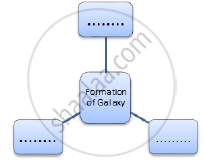
(A3)
(a) Find out similar words from the passage. 01
(i) mass (ii) happenings
(b) Give the verb form of the given words. 01
(i) classified (ii) directions
(A4) Identify and name the clause. 02
Scientists believe that the galaxies were formed from the lumps of matter.
(A5) Can there be life in another galaxy? Give reasons for your answer. 02
(B) Read the passage given in Q. 4 (A) and write the summary of it. Suggest a suitable title to your summary. (05)
On this historic moment, I stand here to thank Pandit Jawaharlal Nehru. India’s present epoch maker has come over here to bless the state of Maharashtra which is definitely going to last forever. On behalf of thousands of common people, I express my deep sense of gratitude to him for blessing us. We Maharashtrians love him, worship him. And once again, I wish to declare that this state of Maharashtra, recently formed, will work for the betterment of the common people of Maharashtra, but if it comes to sacrifice, whatever best and grand we have, it will be done primarily for India. This is so, because, we believe from the beginning, that Maharashtra depends on India; its greatness depends on the greatness of India. All Maharashtrians believe that both India and Maharashtra can progress only when there is oneness of interest. And, therefore, I have made this clear by bringing to your notice the significance of certain symbols, for example, the Himalayas stand for lndia and the Sahyadri, for Maharashtra. The snowy Himalayas with the highest mountain ranges symbolise India and the Sahyadri with the blackest rock structure and with 200-300 inches rainfall symbolise Maharashtra. I promise you that if the Himalayas are in jeopardy, the Sahyadri of Maharashtra will use its black rock structure like a shield to protect the Himalayas.
‘Hard labour’ is the watch word of our times. And, Panditji, you have given us the message of building Maharashtra and our nation by hard labour. We are going to inscribe this valuable message on our minds and try our best to look at your blessings and your guidance, as the blessings and guidance of an epoch maker.
A1 . Read the following statements. Find out the correct statements and write them down : (2)
(i) Both India and Maharashtra can progress if they have different interests.
(ii) Hard work is the only way to build the future of India and Maharashtra.
(iii) The sacrifice of the best and grand in Maharashtra will be made for the state of Maharashtra.
(iv) In times of great calamity the Sahyadri will protect the Himalayas, like a shield.
A2. Complete the following statements : (2)
(i) The interest of Maharashtra and that of India should be one for the progress of Maharashtra state, because ................
(ii) Maharashtra depends on India, because ................
A3.Complete the table : (2)
| The name of the mountain | Stands for | The reason |
| The Himalayas The Sahyadri |
A4. Vocabulary - (2)
Give antonyms of the following words by adding prefixes :
(i) gratitude
(ii) clear
(iii) believe
(iv) significance
A5. Personal response - (2)
Give your suggestions that will help the people to make Maharashtra prosperous.
A6. Grammar - (2)
Rewrite the following sentences in the ways instructed :
(i) India and Maharashtra can progress only when there is oneness of interest.
(Rewrite it using ‘unless’)
(ii) This state of Maharashtra will work for the betterment of the common people of Maharashtra.
(Rewrite it using modal auxiliary showing ‘obligation’)
(A) Read the extract and do the activities that follows :
“Pluck the flowers off”, said the other boy and the daisy trembled for fear, for to be pulled off meant death
to it; and it wished so much to live, as it was to go with the square of turf into the poor captive lark’s cage.
“No, let it stay,” said the other boy, “it looks so pretty.” And so it stayed, and was brought into the lark’s cage. The poor bird was lamenting its lost liberty, and beating its wings against the wires; and the little daisy could not speak or utter a consoling word, much as it would liked to do so. So the forenoon passed. “I have no water,” said the captive lark, “they have all gone out and forgotten to give me anything to drink. My throat is dry and burning. I feel as if I had fire and ice within me and the air is so oppressive. Alas! I must die, and part with the warm sunshine, the fresh green meadows, and all the beauty that God has created.” And it thrust its beak into the piece of grass, to refresh itself a little. Then it noticed the little daisy, and nodded to it, and kissed it with its beak and said : “You must also fade in here, poor little flower. You and the piece of grass are all they have given me in exchange for the whole world, which I enjoyed outside. Each little blade of grass shall be a green tree for me, each of your white petals a fragrant flower. Alas! You only
remind me of what I have lost .
A1. True / False -
State whether the following statements are true or false :
(i) The boys had kept water in the cage for the lark.
(ii) The daisy had a desire to console the poor lark.
(iii) The lark was reminded of its lost liberty.
(iv) The daisy did not want to go into the lark’s cage.
A2. Write an imaginary ending :
Write an imaginary paragraph in about 50 words to give a different ending to the above extract.
Read the extract and do the activities that follow:
My mother was still managing Green's, even though its days were numbered. The day after my return I joined her in the small office, where she sat behind her over-large desk, telephone on her right and the latest paperback western before her, ready to be taken up when noting much was happening – which was fairly often. My mother enjoyed reading westerns-particularly Luke Short, Max Brand, and Clarence E Mulfordmuch in the same way that I enjoyed detective fiction. Both genres were freely available in cheap collins ‘White Circle’, edition published during and just after the War.
We discussed the affair of the skeleton in the cupboard, but as there was no longer any mystery about it, there was nothing for me to investigate. However, armed with the key to the store room, I went down to the basement on my own and made a thorough search of all the old furniture, on the offchance that another skeleton moght tumble out of a cupboard or be found jammed into a drawer or trunk. I did find some old tennis rackets, back numbers of Punch, a cracked china chamber-pot, some old postcards of Darjeeling and Simla, and a framed photograph of King Edward the Seventh. I took the copies of ‘Punch’ to my room and read the reviews of all the plays that had been running in London between 1926 and 1930, thus becoming an authority on the theatre in England of that period.
A1. True/False
State whether the following statements are true or false:
(i) The narrator found one skeleton jammed into a drawer
(ii) The narrator did not like to read detective fiction
(iii) The narrator's mother was managing the Green's hotel
(iv) The narrator wanted to be an authority on the English theatre of that period
A2. Write a gist :
Write a gist of the above given extract in about 50 words.
Read the passage given below and answer the questions that follow:
| 1 | Even before the independence of India, father of the nation, Mahatma Gandhi had said that, “Sanitation is more important than Independence.” He had emphasized the importance of cleanliness and sanitation in daily lives. However, he failed in his aim because of the incomplete participation of the people. After many years of independence of India, a most effective campaign of cleanliness has been launched to call people for their active participation and complete the mission of cleanliness. The President of India, Pranab Mukherjee while addressing the Parliament in June 2014 said, “For ensuring hygiene, waste management and sanitation across the nation, a Swachh Bharat Mission will be launched. This will be our tribute to Mahatma Ghandhi on his 150 birth anniversary to be celebrated in the year 2019.” In order to fulfil the vision of Mahatma Gandhi and make India an ideal country in the world, the Government of India initiated a campaign called ‘Swachh Bharat Abhiyan’ on the birthday of Mahatma Gandhi (2" of October). This campaign aims at completing the mission by 2019. |
| 2 | Through this campaign the Government of India would solve the problem of lack of sanitation by improving the waste management techniques. Clean India movement is completely linked with the economic strength of the country. The basic goal behind the launch of the ‘Swachh Bharat Abhiyan’ is to provide the country with enough sanitation facilities as well as to eliminate all the unhealthy practices of people in their daily routine. The completion of this mission would indirectly draw the attention of business investors to India, enhance the GDP growth, draw tourists from all over the world, create a variety of avenues of employment, reduce health costs, reduce death rate, and reduce fatal disease rate and many more. It has been requested that every Indian devote at least 100 hours per year to cleanliness in India which is sufficient to make this country a clean country by 2019. The cleanliness drive also ensures cleanliness in the official buildings. Spitting paan, gutka and other tobacco products in the government offices has been banned. |
On the basis of your understanding of the above passage, answer any eight of the following questions:
- What is the passage about?
- What was the result of incomplete participation of the people in the mission?
- Why has 2019 been kept as the target year of completion?
- What did Gandhiji say about sanitation?
- How can the problem of lack of sanitation be solved?
- How will it impact our economy?
- What has been banned in the offices?
- What request has been made to Indians to accomplish it?
- What does ‘Swachh Bharat Abhiyan’ aim at?
Read the following extract and answer the questions given below:
But being named an 'AdarshGaon' is far from easy. Villages had to give a proposal after which a committee headed by Mr. Pawar inspected the villages. "The Villages had to show dedication in the struggle to fight mediocrity. They had to follow all the conditions of becoming an 'AdarshGaon'. We chose villages with a revolutionary spark, "Mr. Pawar says.
Villages need to follow strict rules. The process begins with effective water management through the watershed technique and water auditing. taking responsibility for the village's natural resources-planting trees and stopping grazing. contributing labour for the village work, and then expanding to bring about behavioral changes in the people for harboring social change. Hiware Bazaar is free of any kind of addiction and there are no liquor or tobacco shops in the village. Vasectomy has been made compulsory, as is the pre-marital HIV test.
The 'AdarshGaon' model prides itself on being based on the joint decisions made by the Gram Sabha, where all the villagers are present. Even while selecting the new villages under the scheme, Mr. Pawar made sure that the decision to become an ideal village was taken by the entire village together.
The greatest victory for Hiware Bazaar so far has been the reverse migration that the village has witnessed since 1989. As many as 93 families have come back to the village," from the slums in Mumbai and Pune," Mr. Pawar says.
Questions:
(1) What features of 'Adarsh Gaon' are given in this extract?
(2) What is the procedure for selecting 'Adarsh Gaon'?
(3) What is the greatest victory for Hiware Bazaar?
(4) Do you think all villages in Maharashtra should follow the ideals of Hiware Bazaar? why?
(5) Rewrite the following sentences in the ways instructed :
i. Mr. Pawar inspected the villages.
(Rewrite it using the noun form of the word underlined.)
ii. Vasectomy has been made compulsory by the villagers.
(Rewrite it beginning with-"The villagers........".)
iii. There are no liquor or tobacco shops in the village.
(Rewrite it using 'neither......nor'.)
(6) Find out the words from the extract which mean:
(i) causing a great change
(ii) the quality of being average
Read the following extract and answer the questions given below:
To read a lot is essential. It is stupid not to venture outside the examination 'set books' or the textbooks you have chosen for intensive study. Read as many books in English as you can., not as a duty but for pleasure. Do not close the most difficult books you find, with the idea of listing and learning as many new words as possible. choose what is likely to interest you and be sure in advance, that it is not too hard. You should not have to be constantly looking up new words in the dictionary, for that deadens interest and checks real learning. Lookup a word here and there, but as a general policy try to push ahead. guessing what words mean from the context. It is extensive and not intensive reading that normally helps you to get interested in extra reading and thereby improve your English. You should enjoy the feeling which extensive reading gives. As you read, you will become more and more familiar with words and sentence patterns you already know, understanding them better and better as you meet them in more and more contexts, some of which may differ only slightly from others.
Some people say that we cannot learn to speak a language better with the help of a book. To believe that the spoken language and written language are quite different things. This is not so.
Questions:
(1) What does the author tell us about the importance of reading English?
(2) What different steps are suggested to improve reading?
(3) What do some people say about learning the spoken form of a language?
(4) What will you do to improve your English?
(5) Rewrite the following sentences in the ways instructed:
i. To read a lot is essential.
(Rewrite using gerund form of the words underlined.)
ii. Some people say that we cannot learn to speak a language better with the help of a book.
(Rewrite it using 'be able to'.)
iii. It is extensive.
(Make it a Rhetorical question.)
(6) You should not have to be constantly looking up new words in the dictionary, for that deadens interest and checks real learning.
The underlined word here means:
(i) develops
(ii) deprives of
(iii) creates
(B) Write a summary of the above extract with the help of the outline given below and suggest a suitable title.
Read a lot --- outside the textbooks --- for pleasure --- avoid difficult books ---read interesting ones --- avoid dictionary --- guess meanings --- extensive and not intensive reading --- different opinions.
Read the following extract and answer the questions given below :
Reuben arrived at the factory. The sack buyer was about to lock up.
"Mister! Please don't close up yet." The man turned and saw Reuben, dirty and sweat-stained.
"Come back tomorrow, boy."
"Please, Mister. I have to sell the sacks now-please." The man heard a tremor in Reuben's voice and could tell he was close to tears.
"Why do you need this money so badly?"
"It's a secret."
The man took the sacks, reached into his pocket and put four nickels into Reuben's hand. Reuben murmured a quiet thank-you and ran home.
Then, clutching the tin can, he headed for the store.
"I have the money" he solemnly told the owner, pouring his coins onto the counter.
The man went to the window and retrieved Reuben's treasure. He wiped the dust off and gently wrapped it in brown paper. Then he placed the parcel in Reuben's hands.
Racing home, Reuben burst through the front door. His mother was scrubbing the kitchen range. "Here Mum!Here!" Reuben exclaimed as he ran to her side. He placed a small box in her work-roughened hand.
She unwrapped it carefully, to save the paper. A blue-velvet jewel box appeared. Dora lifted the did, tears beginning to blur her vision.
In gold tettering on a small, almond-shaped brooch was the word 'Mother'
It was Mother's Day, 1946
Dora had never received such a gift; she had no finery except her wedding ring. Speechless, she smiled radiantly and gathered her son into her arms.
(1) Why did Reuben insist on the sack buyer to buy his sacks that day only?
(2) How did the mother react when Reuben gave her the gift?
(3) In what way was Reuben's gift special to his mother?
(4) What do you plan to do on Mother's Day?
(5) Rewrite the following sentences in the ways instructed :
(i) I have to sell the sacks.
(Rewrite it replacing the underlined part with the modal auxiliary showing 'compulsion'.)
(ii) She smiled radiantly and gathered her son into her arms. (Use 'As soon as'.)
(iii) She unwrapped it carefully.
(Rewrite the sentences using the noun form of the underlined word.)
(6) Find out the words/phrases from the extract which mean:
(i) showing joy (ii) got back
Read the following extract and complete the table given below:
Children are perpetually asking questions. As adults, we are awkward with questions. We link the act of asking questions to ignorance. It indicates that we do not know; hence, we may look stupid while asking questions.
Children have no shame, whereas adults suffer from layers and layers of shame. Because children have no shame, they are more capable of failing at something and moving on from it. Our sense of shame makes us inhibited. So we do not try new things at work.
Children quickly make friends with strangers. Put two small kids alongside a few toys and they will start playing before they care to know about each other’s antecedents. As adults, we seek the false comfort of known relationships before we agree to play with each other.
Children freely express their emotions; adults learn to suppress their emotional side. We come to the workplace and are frequently counselled, “Do not get emotional.”
Children play. They find play in everything. Adults shun play and consider it the opposite of “serious work”. To a child, every act is an act of play.
Traits Delinking Childhood and Adulthood:
| Traits | Children | Adults | |
| 1 |
Asking Questions |
Perpetually ask questions freely |
(1) Feet awkward with questions (2) ___________ |
| 2 |
Feeling Shame |
(1) Feel no shame (2) ____________ |
(1) Suffer from shame (2) Inhibited to try new things at work |
| 3 |
Making friends |
(1) Quick in making friendship without knowing each other |
(1) ____________ |
| 4 |
Expressing emotions |
(1) ____________ |
(1) Suppress emotions. |
Read the following extract and answer the questions given below :
But being named an 'AdarshGaon · is far from easy. Villages had to give a proposal after Which a committee headed by Mr. Pawar inspected the villages. "The villages had to show dedication in the struggle to fight mediocrity. They had to follow all the conditions of becoming an 'AdarshGaon '. We chose villages with a revolutionary spark." Mr. Pawar says.
Villages need to follow strict rules. The process begins with effective water managc1nent through the watershed technique and Water auditing. taking responsibility for the village's natural resources -phmting trees and stopping grazing, contributing labour for the village Work, and then expanding to bring about behavioral changes in the people for harbouring social change. Hiware Bazaar is free of any kind of addiction and there are no liquor or tobacco shops in the village. Vasectomy has been made co1npulsory. as is the pre-marital HIV test.
The 'AdarshGaon · n1odcl prides itself of being based on the joint decisions made by the (Gram Sabha, Where all the villagers are present. Even while selecting the new villages under the scheme, Mr. Pawar made sure that the decision to become an ideal village was taken by the entire village together.
The greatest victory for Hiware Bazaar so far has been the reverse migration that the village has witnessed since 1989. As many as 93 families have come back to the village, "from the slums in Mumbai and Pune." Mr. Pawar says.
(1) What features of 'AdarshGaon' are given in this extract?
(2) What is the procedure for selecting 'AdarshGaon'?
(3) What is the greatest victory for Hiware Bazaar?
(4) Do you think all villages in Maharashtra should follow the ideals of Hiware Bazaar? Why?
(5) Rewrite the following sentences in the Ways instructed :
(i) Mr. Pawar inspected the villages.
(Rewrite it using the noun form of the word underlined.)
(ii) Vasectomy has been made compulsory by the villagers.
(Rewrite it beginning with -"The villagers ........ ".)
(iii) There are no liquor or tobacco shops in the village.
(Rewrite it using 'neither ........ nor'.)
(6) Find out the words from the extract which mean :
(i) causing a great change
(ii) the quality of being average
Read the following extract and answer the questions given
below:
So what is a city? It's a dense amalgamation of buildings and people. A city must provide equity and also be sustainable. As an architect who has been closely connected with Delhi and its planning, my wish list is more about the direction we need to take
so that future generations don't end up living in chaotic dysfunctional cities.
The first requirement for a city is a pragmatic plan. Many of our cities such as Delhi and Bhubaneshwar and even Port Blair in the Andamans have reasonably good master plans. Many also have City Development Plans which have been made an essential
requirement to draw funds from the government's Urban Renewal Programme (JNNURM). But they should be updated frequently based on the changing needs of its people.
And let's not forget its citizens-they need to be more proactively involved when evolving master plans. But often, there's a lack of planning and inadequate implementation systems. This applies to all essential components of city-streets, public transport system, traffic management, affordable housing, cars and parking, drainage, water supply, sewerage, and garbage. Any deficiency in these will lead to poor quality cities which won't be able to handle the pressure of increased population and changing needs.
The second requirement of a good city is good social infrastructure such as parks and places for leisure such as river and sea fronts. It needs to preserve and protect its heritage.
(1) What does a city require to emerge as a good city?
(2) What is the second requirement of a good city?
(3) What are the basic requirements to draw funds from the government's-Urban Renewal programme (JNNURM)?
(4) What suggestions will you give to make your city ideal?
(5) Rewrite the following sentences in the ways instructed:
(i) It's a dense amalgamation of buildings and people.
(Rewrite it using 'as well as'.)
(ii) A city must provide equity and also be sustainable.
(Rewrite it using another modal auxiliary showing "advice".)
(iii) The first requirement for a city is a pragmatic plan.
(Frame a 'Wh' ·question to get the underlined part as an answer.)
(6) Match the words in column 'A' with their meaning in 'B':
| Column A | Column B |
| 1 pragmatic | 1 blend |
| 2 amalgamation | 2 fantastic |
| 3 realistic | |
| 4 ancient |
Read the following passage carefully:
|
On the basis of your reading of the above passage, answer the following question:
- The Dancing Girl belongs to:
- Mohenjo-Daro
- Greek culture
- Homo sapiens
- Tibet
- In the museum she’s kept among:
- dancing figures
- bronze statues
- terracotta animals
- books
- Which information is not given in the passage?
- The girl is caged behind glass.
- She is a rare artefact.
- School books communicate the wealth of our heritage.
- She cannot be rediscovered as she’s bronze.
- ‘Great Art’ has power because:
- It appeals to us despite the passage of time.
- It is small and can be understood.
- It’s seen in pictures and sketches.
- It’s magnified a million times.
- The jewellery she wears:
- consists of only bangles of shell or ivory or thin metal.
- is a necklace with two pendants.
- both (i) and (ii) are correct.
- neither (i) nor (ii) is correct.
- She reminds us:
- of the never-say-die attitude of humans.
- why museums in our country are exciting.
- why she will make us come into money.
- of dancing figures.
- The synonym of the word “among” in para 1 is ______.
- The size of the dancing girl is equal to the length of the human palm. (True/False)
Read the following passage carefully.
1. Few guessed that this quiet, parentless girl growing up in New York City would one day become the First Lady of the United States. Even fewer thought she would become an author and lecturer and a woman much admired and loved by people throughout the world.
2. Born Anna Eleanor Roosevelt in 1884 to wealthy, but troubled parents who both died while she was young, Roosevelt was cared for by her grandmother and sent to school in England. In 1905, she married her distant cousin, Franklin Delano Roosevelt. She and her husband had six children. Although they were wealthy, her life was not easy and she suffered several personal tragedies. Her second son died when he was a baby. In 1921, her strong athletic husband was stricken with polio, which left him physically disabled for life.
3. Eleanor Roosevelt was a remarkable woman who had great intelligence and tremendous strength of character. She never let things get her down. She nursed her husband back to good health and encouraged him to remain in politics. She then helped him to become Governor of New York, and in 1933, President of the United States.
4. While her husband was President, she took a great interest in all the affairs of the country. She became her husband's legs and eyes; she visited prisons and hospitals; she went down into mines, up scaffoldings, and into factories. Roosevelt was tireless and daring. During the depression, she travelled all over the country bringing goodwill, reassurance, and help to people without food and jobs. During World War II she visited American soldiers in camps all over the world. The United States had never known a First Lady like her.
5. Roosevelt also kept in touch with the American people through a daily newspaper column called 'My Day'. She broadcast on the radio and delivered lectures, all first for a First Lady.
1.1 On the basis of your understanding of the above passage answer the following questions: (any eight)
(a) How was Eleanor Roosevelt's personality in contrast to what she became?
(b) Apart from being the First Lady what else did she have to her credit?
(c) What challenges did she face in her personal life but remained unfazed?
(d) Eleanor was a strong woman who helped her husband become the President of America. How?
(e) What does the statement: 'she became her husband's legs and eyes' mean?
(f) What was her special contribution during the depression?
(g) How did she motivate soldiers during World War II?
(h) What did she do for the first time for a First Lady?
(i) What side of her personality is reflected in this passage?
Read the passage given below carefully and answer the questions that follow.
1. Overpowering prey is a challenge for creatures that do not have limbs. Some species like Russell's viper inject poison. Some others opt for an alternative non-chemical method – rat snakes, for instance, catch and push their prey against the ground, while pythons use their muscle power to crush their prey to death. But snakes can't be neatly divided into poisonous and non-poisonous categories.
2. Even species listed as non-poisonous aren't completely free of poison. The common Sand Boa, for instance, produces secretions particularly poisonous to birds. So the species doesn't take any chance – it crushes its prey) and injects poison as an extra step.
3. Do vipers need poison powerful enough to kill hundreds of rats with just one drop? After all, they eat only one or two at a time.
4. While hunting animals try their worst to kill most efficiently, their prey uses any trick to avoid becoming a meal, such as developing immunity to poison.) For instance, Californian ground squirrels are resistant to Northern Pacific rattlesnake poison.
5. Competition with prey is not the only thing driving snakes to evolve more and more deadly poison. Snakes also struggle to avoid becoming prey themselves.
6. Some snake killers have partial immunity to poison. Famously, mongooses are highly resistant to cobra poison, and with their speed and agility, kill snakes fearlessly. It would be the death of cobras as a species if they didn't evolve a more deadly poison to stop mongooses.
7. Poison has another important role. It's an extreme meat softener, specific enzymes break up the insides of the prey. Normally, a reptile depends on the sun's warm rays to aid digestion.
8. But I wonder if we cannot use venom in our favour. In remote parts of India, local hospitality often involves leather tough meat. I chew and chew until my jaws ache. If I spit it out or refuse, our hosts would be offended, I swallow like a python stuffing a deer down its throat and hope I don't choke. If only I had poison.
(b) How does Sand Boa kill its prey?
(c) There is a constant tussle between the hunting animal and its prey? Why?
(e) What difficulty does the writer face when he is entertained in the remote parts of India?
2.2 On the basis of your reading of the above passage fill in any two of the following blanks.
b. humans
c. a python
d. prey
b. hardens
c. softens
d. breaks down
iii. Californian squirrels are ______________ rattlesnake poison.
a. afraid of
b. helpless against
c. resistant to
d. indifferent to
a. Liquid substances released from glands (para 2)
c. Particular (para 7)
Read the passage given below:
During our growing up years we as children were taught both at home and school-to worship the photos and idols of the gods of our respective religions. When we grow a little older, we were to read holy books like The Bhagwad Gita, Bible, and Quran; we were told that there are a lot of life lessons to be learned from these holy books. We were then introduced to stories from our mythologies which taught us about ethics and morality-what is good and what is bad I also learned to be respectful towards my parents who made my life comfortable with their hard work and love and care, and my teachers who guided me to become a good student and a responsible citizen.
Much later in life, I realised that though we learn much from our respective holy books, there is a lot to learn from our surroundings. This realization dawned upon me when I learned to enquire and explore. Everything around us- the sun, the moon, the stars, rain, rivers, stones, rocks, birds, plants, and animals-teach us many valuable life lessons.
No wonder that besides the scriptures in many cultures nature is also worshipped. The message that we get is to save our environment and maintain ecological balance. People are taught to live in harmony with nature and recognize that there is God in all aspects of nature.
Nature is a great teacher. A river never stops flowing. If it finds an obstacle in its way in the form of heavy rock, the river water fights to remove it from its path or finds an alternative path to move ahead. This teaches us to be progressive in life, and keep the fighting spirit alive.
Snakes are worshipped as they eat insects in the field that can hurt our crops, thus protecting the grains for us. In fact, whatever we worship is our helper and makes our lives easy for us. There are many such examples in nature, but we are not ready to learn a lesson, Overcome with greed, we are destroying nature. As a result, we face natural disasters like drought, floods, and landslides. We don't know that nature is angry with us.
However, it is never too late to learn. If we learn to respect nature the quality of our life will improve.
2.1 Answer briefly the following questions:
(a) What are we taught in our childhood and growing up years?
(b) Why should we respect our parents and teachers?
(c) What message do we get when we worship nature?
(d) How does a river face an obstacle that comes in its way?
2.2 Choose meanings of the words given below with the help of options that follow:
(e) guided
(i) answered
(ii) advised
(iii) fought
(iv) polished
(f) explore
(i) search
(ii) frequent
(iii) describe
(iv) request
(g) valuable
(i) proper
(ii) desirable
(iii) available
(iv) useful
(ii) friendship
(iii) discomfort
(iv) honesty
Read the passage given below and answer the questions that follow:
| 1. | A fisherman, enfeebled with age, could no longer go out to sea so he began fishing in the river. Every morning he would go down to the river and sit there fishing the whole day long. In the evening he would sell whatever he had caught, buy food for himself and go home. It was a hard life for an old man. One hot afternoon while he was trying to keep awake and bemoaning his fate, a large bird with silvery feathers alighted on a rock near him. It was Kaha, the heavenly bird. “Have you no one to care for you, grandpa?” asked the bird. “Not a soul.” “You should not be doing such work at your age,” said the bird. “From now on I will bring you a big fish every evening. You can sell it and live in comfort.” True to her word, the bird began to drop a large fish at his doorstep every evening. All that the fisherman had to do was take it to the market and sell it. As big fish were in great demand, he was soon rolling in money. He bought a cottage near the sea, with a garden around it and engaged a servant to cook for him. His wife had died some years earlier. He had decided to marry again and began to look for a suitable woman. |
| 2. | One day he heard the royal courtier make an announcement. Our king has news of a great bird called Kaha,” said the courtier. “Whoever can give information about this bird and help catch it, will be rewarded with half the gold in the royal treasury and half the kingdom!” The fisherman was sorely tempted by the reward. Half the kingdom would make him a prince! |
| 3. | “Why does the king want the bird,” he asked. “He has lost his sight,” explained the courtier. “A wise man has advised him to bathe his eyes with the blood of Kaha. Do you know where she can be found?” “No…I mean …no, no…” Torn between greed and his sense of gratitude to the bird, the fisherman could not give a coherent reply. The courtier, sensing that he knew something about the bird, informed the king. The king had him brought to the palace. |
| 4. | “If you have information about the bird, tell me”, urged the king. “I will reward you handsomely and if you help catch her, I will personally crown you king of half my domain.” “I will get the bird for you,” cried the fisherman, suddenly making up his mind. “But Kaha is strong. I will need help. The king sent a dozen soldiers with him. That evening when the bird came with the fish, the fisherman called out to her to wait. “You drop the fish and go and I never get a chance to thank you for all that you‘ve done for me," he said. “Today I have laid out a feast for you inside. Please alight and come in. Kaha was reluctant to accept the invitation but the fisherman pleaded so earnestly that she finally gave in, and alighted. The moment she was on the ground, the fisherman grabbed one of her legs and shouted to the soldiers hiding in his house to come out. They rushed to his aid but their combined effort could not keep Kaha down. |
| 5. | She rose into the air with the fisherman still clinging to her leg. By the time he realised he was being carried away, the fisherman was too high in the air to let go. He hung on grimly, and neither he nor Kaha was ever seen again. |
Based on your understanding of the above passage, answer the questions.
- Why did the fisherman start fishing in the river?
- How did the fisherman spend the day before he met Kaha?
- How did the fisherman betray Kaha?
- Why was the fisherman doubtful about revealing information about Kaha to the courtier?
Read the given case-based passage carefully and answer the questions that follow.
|
Case study of museums |
|
| 1. |
We don’t go to museums. We prefer malls, cinema halls, and restaurants. Visiting a museum is best left to schools which makes it mandatory. After all, it is an academic exercise. And what entertainment can these places possibly offer? India doesn’t boast the greatest of museums, but one can’t doubt the collection of artefacts in these repositories of heritage, even for a second. Our eventful history has handed down us numerous masterpieces, but unfortunately, we don’t find them compelling enough. A cultural historian and museologist Jyotindra Jain says that the habit of going to museums has just not been inculcated in us. One of the best museums in the country, the National Museum in Delhi charges a mere Rs. 20. According to Joyoti Roy, outreach consultant, National Museum, it receives between 6,00,000 to 7,00,000 visitors each year and anything between 2,500 and 3,000 per day. The mix includes Indians, foreigners, and school students. For an Indian museum, it is an astounding figure, but still nowhere close to the footfalls museums, we consider the finest, get. |
| 2. | It has not been many days since the National Gallery of Modern Art, Bangalore, hosted A. Ramachandran’s expansive retrospective covering five decades of his artistic journey. As we sat outside the first-floor gallery after Ramachandran walked me through his sketches, sculptures, and paintings, the senior artist, a bit disappointed said, “Had an exhibition of this scale taken place abroad, people would have come in thousands.” There were about three-five visitors inside the gallery at that time. Jain, who has also helmed institutions like the Crafts Museum and Indira Gandhi National Centre for the Arts in Delhi, puts the onus on museums. “We developed the museums but didn’t evolve the infrastructure around it. And it is the museum’s responsibility to do it. When you know, people are not going to come to you, you must go to them. Crafts Museum shares its wall with India Trade Promotion Organisation. It receives lakhs of people during the trade fair. I fought tooth and nail to get that door opened during my tenure (1984-89) so that the visitors spill over to the Crafts Museum as well. Museums need to rethink their strategies and outreach should be a major point of concern for them.” |
| 3. | In 2010, UNESCO brought out a report on the terrible conditions at India’s top eight museums, citing substandard maintenance, lighting, and signage, among other issues. The Ministry of Culture put together a 14 - point museum reforms agenda and things have moved forward since then. Dr Bhau Daji Lad Museum, the oldest museum in Mumbai has received 3,00,000 visitors over the past year. On average, the museum witnesses 500 visitors every day, with an average of 2,000 visitors over weekends. Not big numbers again, but impressive enough in the Indian context. And this is when the museum re-emerged after a revamp in 2008 with an extensive exhibition programme. Collaborations, screenings of movies of different genres, and workshops for adults and children contributed to the increase in the number of footfalls. The public-private partnership model of the museum is unique and can be replicated in other cases as well. |
| 4. | Robust publicity of exhibitions and creating links between different art spaces can also fetch the audience. Different art institutions located in proximity can host a series of events to be held in each one of them simultaneously. Museums also need to transform their cafes, upgrade their museum shops, and most importantly, invest in their human resource. So, what do we do until then? Let’s go and explore these storehouses of history, culture, and knowledge because unless and until we claim them, they will remain indifferent to our needs. |
After studying the case study of museums, answer the following questions.
- What according to the author is the reason for fewer footfalls in the museums in India?
- What measures are suggested in the passage to multiply the visitors to the museums?
- What was the proposition given by A. Ramachandran during his tenure at Crafts Museum?
- Between the National Museum of Delhi and Dr. Bhau Daji Lad Museum, which museum has more footfall on daily basis? Justify using statistics provided in the study.
Read the following excerpt from a case study.
| Impacts of Festivities on Ecology | |||||||||||||||||||||||||||||
| 5 | Festivals are synonymous with celebration, ceremony and joy. However, festivals bring to the fore the flip side of celebrations – pollution – air, water, soil and noise. This led to the need of assessing the awareness level among people about ecological pollution during festivals. So, a study was conducted by scholars of an esteemed university in India. This study was titled Awareness Towards Impact of Festivals on Ecology. | ||||||||||||||||||||||||||||
| 10 | There were two main objectives of the study. The first one was to assess the awareness level among people about ecological protection during festivities. Exploring solutions to bring awareness about celebrating festivals without harming ecology was the second objective. The method used to collect data was a simple questionnaire containing 6 questions, shared with 50 respondents across four selected districts of a state in the southern region of India. | ||||||||||||||||||||||||||||
| 15 |
The research began by understanding the socio-economic conditions of the respondents before sharing the questionnaire. Once the responses were received, the data collected were tabulated (Table 1), for analysis. Table-1: Awareness level among respondents
|
||||||||||||||||||||||||||||
| 20 | The study recommended the imposition of strict rules and regulations as opposed to a total ban on all festive activities which have a drastic impact on our environment. The researchers believed that such measures would help in harnessing some ill-effects that add to the growing pollution and suggested further studies be taken up across the country to assess awareness about ecological degradation. | ||||||||||||||||||||||||||||
| 25 | The observations made in the study pointed to the environmental groups and eco-clubs fighting a losing battle due to city traffic issues, disposal of plastics, garbage dumping and all sorts of ecological degradation. The researchers stressed that the need of the hour is increasing awareness among people to reduce environmental pollution which can be facilitated by celebrating all festivals in an eco-friendly manner. | ||||||||||||||||||||||||||||
On the basis of your understanding of the passage, answer the questions given below.
- Why do the researchers call pollution the ‘flip side’ of festivals?
- Comment on the significance of the second objective of the study with reference to lines 7-12.
- Justify the researchers’ recommendation for limiting the drastic impact of festival pollution on the environment with reference to lines 16-21.
- Why do the researchers feel that environmental groups and eco-clubs are fighting a losing battle in the given scenario?
- Even though a larger number of people say ‘no’ to bursting crackers than those who say ‘yes’, festival pollution persists. How does evidence from table 1 support this statement?
- What purpose does the ‘Can’t Say’ column serve in the questionnaire (table 1)?
Read the following passage and complete the activities:
A1. Complete the chart on the life stages of fireflies: (2)

|
Fireflies are beetles and go through several life stages, starting out as an egg, then hatching into larvae. At the juvenile stage, they turn into pupae and then, finally adults. Fireflies spend most of their lives in a larval stage, hidden away. There are 2000 different species of fireflies. But they all go through a long juvenile stage and a short adult life, which is mainly about courtship, mating and reproduction. The juveniles living underground or underwater, are very different though-they're hunters, they eat snails and soft-bodied insects and they have very different habitats. Conserving them is essential for human life as fireflies are a key part of the food web. They are predators of agricultural pests. In turn, they are prey for spiders and other insects. They are completely enmeshed in the web of life. In addition, about 70 years ago, scientists unravelled the mystery of fireflies' light-producing talents. Since then, the bio-chemical reactions that fireflies experience have been used in detecting bacterial contamination in foods, testing drugs against cancer, developing drought-resistant crops. They have been used in space exploration. So fireflies give us beauty and inventions. Fireflies carry oxygen, calcium, magnesium and a natural chemical called luciferin. These react together to produce the photons. This is how the fireflies glow. Firefly tourism is growing across the world. In Maharashtra, for example, a particular species monsoon fireflies, emerge before the rains. They're beautiful and a festival is held in Purushwadi, encouraging firefly tourism. Its wonderful that people around the world go to see fireflies in their natural habitat. We need to be cautious. Too many people can disturb adult and larval habitats. Fireflies need darkness to communicate with each other and we need fireflies because they are harbingers of hope. |
A2. Write two reasons for the conservation of fireflies. (2)
A3. Make antonyms of the following words using prefix: (2)
- different × ______
- experience × ______
- bacterial × ______
- natural × ______
A4. Do as directed: (2)
(i) Too many people can disturb adult and larval habitat.
(Rewrite using 'as well as')
(ii) These react together to produce photons.
(Pick out the infinitive from the given sentence)
A5. Can you think of any other insect that teaches us some values of life? Explain with examples. (2)
Read the following passage and do the activities.
A1. Complete the following sentences.
- Vegetarianism has not spread as desired because ______.
- Vegetarians are of various types ______.
|
Vegetarianism promotes a natural way of life. But despite its implicit message of universal love and nonviolence, it has not spread as it should have. This may be because it usually is an inward looking habit and is best cultivated in the mind. Leading a vegetarian way of life helps the animal kingdom to coexist with man. The animals supply milk, manure and energy. This has been central to Indian culture for thousands of years. A vegetarian lifestyle is natural, multifaceted and helps preservation in a healthy way. Food and health are closely related. Vegetarians are of various types. There are lacto-vegetarians who consume dairy products; Lacto-ovo-vegetarians include eggs in addition to dairy products. Vegans are pure vegetarians who do not consume any food derived from animals. The Western science of food considers food as something to sustain only the human body, whereas Indian science considers food as something which sustains not only the body, but also maintains the purity of heart, mind and soul. Thus, an item of food which is injurious to the mind is not considered to be fit for consumption, even if it is otherwise beneficial to the body or satisfies the taste. Indian food science does not give so much importance to protein or even to a balanced diet but it gives importance to food that increases the strength of the body and its vitality. Vegetarian foods provide an infinite variety of flavours whereas non-vegetarian foods have hardly any taste of their own. In fact, non-vegetarian foods have to be seasoned with ingredients from the vegetable kingdom to make them palatable. |
A2. What is the importance of eating vegetarian food?
A3.
- Pick out two adjectives from the given passage.
- Find words in the passage which mean the following:
- Indirect
- Tasty
A4. Convert the following sentence to negative without changing the meaning.
Leading a vegetarian way of life helps the animal kingdom to coexist with man.
A5. Why do you think vegetarianism is being promoted on a global level? Justify with your response.
Read the passage and write a summary of it in a paragraph. Suggest a suitable title.
|
Vegetarianism promotes a natural way of life. But despite its implicit message of universal love and nonviolence, it has not spread as it should have. This may be because it usually is an inward looking habit and is best cultivated in the mind. Leading a vegetarian way of life helps the animal kingdom to coexist with man. The animals supply milk, manure and energy. This has been central to Indian culture for thousands of years. A vegetarian lifestyle is natural, multifaceted and helps preservation in a healthy way. Food and health are closely related. Vegetarians are of various types. There are lacto-vegetarians who consume dairy products; Lacto-ovo-vegetarians include eggs in addition to dairy products. Vegans are pure vegetarians who do not consume any food derived from animals. The Western science of food considers food as something to sustain only the human body, whereas Indian science considers food as something which sustains not only the body but also maintains the purity of heart, mind and the soul. Thus, an item of food that is injurious to the mind is not considered to be fit for consumption, even if it is otherwise beneficial to the body or satisfies the taste. Indian food science does not give so much importance to protein or even to a balanced diet but it gives importance to food that increases the strength of the body and its vitality. Vegetarian foods provide an infinite variety of flavours whereas non-vegetarian foods have hardly any taste of their own. In fact, non-vegetarian foods have to be seasoned with ingredients from the vegetable kingdom to make them palatable. |
Read the following passage and do the activities.
A1. Fill in the blanks.
- ______ is the effect of excessive humour.
- ______ and ______ are the qualities of a humorous person.
|
You are endowed with certain naughtiness as a child. Keep it alive. Humour will lighten all tough situations. One who has humour can sail through any conflict. Humour is buffer that saves you from humiliation. Humour brings everyone together, while humiliation tears them apart. In a society tom with humiliation and inSult, humour is like a breath of fresh air. Humour should be coupled with care and concern. Humour can keep the spirit high, yet if overdone, it leaves a bad taste. Humour without wisdom is shallow. Humour without sensitivity is satire-it comes back to you with more problems. The wise use humour to bring wisdom and to lighten situations. The intelligent use humour as a sword to insult others. The irresponsible use humour to escape from responsibility. And fools take humour too seriously! How does one cultivate a sense of humour? Humour is not just words, it is the lightness of your being. You do not have to read and repeat jokes. Humour can be cultivated by taking life not too seriously (because you will never come out of it alive), having a sense of belonging with everybody, including those who are not friendly, practising Yoga and meditation, having unshakable faith in the Divine and in the laws of Karma, being in the company of those who live in knowledge and have a sense of humour. |
A2. How does humour help in building harmony in society?
A3. State the meaning of the following:
- Satire
- To be shallow
A4. Add a question tag to the following sentences.
- You are endowed with certain naughtiness as a child.
- Humour can be cultivated by taking life not too seriously.
A5. How do you think can humour help you to develop a better personality?
II. Read the passage given below.
| 1 | The North-East of India is a melting pot of variegated cultural mosaic of people and races, an ethnic tapestry of many hues and shades. Yet, these states are lesser explored as compared to the rest of the country. The new generations of travellers who are ‘money rich and time poor’ are increasingly looking for unique experiences --a phenomenon being called the emergence of the ‘experience economy’. For this new and growing breed of tourists, the North-East with its variety and uniqueness holds immense attraction. |
| 2 | A study conducted in 2020 by Dr. Sherap Bhutia, revealed that the foreign tourist arrival in the North-East increased from 37,380 persons in 2005 to 118,552 in 2014. The overall growth rate of tourists (both domestic and foreign) in the North-East was as high as 26.44% during 2005-06. High and positive growth of 12.53% was registered in foreign tourist visits to North-East States of India during 2012 from 2011, which further rose to register a growth of 27.93% during 2013 from 2012. Foreign tourist arrivals in the North-East witnessed a growth of 39.77% during 2014 from 2013, according to data provided from the Ministry of Tourism, Government of India. |
| 3 | The study recommendations for tourism planners included the need to concentrate on some key areas like enhancement of tourist facilities, tourism financing, focus on community involvement and others for the formulation of a sustainable tourism strategy in the North-East States of India. |
i. Infer one reason for the following, based on information in paragraph 1. (1)
The rate of tourism in the North-East of India puzzles tourism officials.
ii. Select the appropriate option to fill in the blanks. (1)
From paragraph 1, we can infer that the ______ and ______ of the North-Eastern states aid attracting the ‘money rich and time poor’ tourists.
1. distinctiveness
2. conventionality
3. diversity
4. uniformity
5. modernity
- 1 & 3
- 2 & 4
- 2 & 5
- 1 & 4
iii. Complete the following analogy correctly with a word/ phrase from paragraph 1: (1)
aroma : cooking : : ______ : painting
(Clue: Just like aroma is integral to cooking, similarly, ______ is/ are integral to painting)
iv. Select the correct option to complete the following sentence: (1)
Travellers advocating the ‘experience economy’ seek a holiday package with ______ (Paragraph 1)
- grand facilities, expensive hotels and excellent services to pamper them.
- a wholesome experience within the budget they have planned for.
- places and cities to buy things from and opportunities to spend money.
- cost-effective services, affordable accommodation and many days of touring.
v. Select the chart that appropriately represents the trend of foreign tourist travels in the North-East, from 2011-2014, as per paragraph 2. (1)
 |
 |
 |
 |
| (1) | (2) | (3) | (4) |
- Option 1
- Option 2
- Option 3
- Option 4
vi. Fill in the blank by selecting the correct option. (1)
The study of tourist travel statistics in the North-East, from 2005 to 2014 showed ______ results.
- expected
- encouraging
- inconsistent
- questionable
vii. Substitute the word ‘witnessed’ with one word similar in meaning, in the following, sentence from paragraph 2: (1)
Foreign tourist arrivals in the North-East witnessed a growth of...
viii. List any 2 examples of ‘tourist facilities’ as referred to, in Paragraph 3. (1)
ix. List one reason why the researchers recommend that the formulation of a tourism strategy in the North-Eastern States of India be sustainable. (1)
x. Select the option that titles paragraphs 1-3 appropriately, with reference to information in the text. (1)
- 1. Full Speed Ahead!
2. Ups and Downs
3. Cause for Concern - 1. Winds of Change
2. Numbers Don't Lie
3. Time for Action - 1. Inspecting Trends
2. Statistically Speaking
3. Let's Investigate - 1. Cause and Effect
2. Dynamic Data
3. Dependable Facts
Read the passage given below-
| (1) | Milkha Singh, also known as The Flying Sikh, was an Indian track and field sprinter who was introduced to the sport while serving in the Indian Army. He is the only athlete to win gold in 400 metres at the Asian Games as well as the Commonwealth Games. He also won gold medals in the 1958 and 1962 Asian Games. He represented India in the 1956 Summer Olympics in Melbourne, the 1960 Summer Olympics in Rome and the 1964 Summer Olympics in Tokyo. He was awarded the Padma Shri, India's fourth-highest civilian honour, in recognition of his sporting achievements. |
| (2) | The race for which Singh is best remembered is his fourth-place finish in the 400 metres final at the 1960 Olympic Games. He led the race till the 200 m mark before easing off, allowing others to pass him. Singh's fourth-place time of 45.73 seconds was the Indian national record for almost 40 years. |
| (3) | From beginning that saw him orphaned and displaced during the partition of India, Singh became a sporting icon in the country. In 2008, journalist Rohit Brijnath described Singh as "the finest athlete India has ever produced". |
| (4) | He was disappointed with his debut performance at the 1956 Melbourne Olympics. "I returned to India, chastened by my poor performance in Melbourne. I had been so excited by the prospects of being part of the Indian Olympics team, but, hadn't realized how strong and professional the competition would be. My success in India had filled me with a false sense of pride and it was only when I was on the track that I saw how inconsequential my talents were when pitted against superbly fit and seasoned athletes. It was then that I understood what competition actually meant, and that if I wanted to succeed on the international arena, I must be prepared to test my mettle against the best athletes in the world." |
| (5) | Then he decided to make sprinting the sole focus of his life. "Running had thus become my God, my religion and my beloved". "My life during those two years was governed by strict rules and regulations and a self-imposed penance. Every morning I would rise at the crack of dawn, get into my sports kit and dash off to the track, where I would run two or three miles cross-country in the company of my coach." |
| (6) | On how he pushed himself through the tough days of vigorous training. "I practiced so strenuously that often I was drained of all energy, and there were times when I would increase my speed to such an extent that after my rounds, I would vomit blood or drop down unconscious through sheer exercise. My doctors and coaches warned me, asked me to slow down to maintain my health and equilibrium but my determination was too strong to give up. My only focus was to become the best athlete in the world. But then images of a packed stadium filled with cheering spectators, wildly applauding me as I crossed the finishing line, would flash across my mind and I would start again, encouraged by visions of victory." |
Based on your reading answer any five questions from the six given below: (5)
- What is Milkha Singh known as? What realization did Milkha Singh have when he was on the track during the Melbourne Olympics?
- List any two of Milkha Singh's achievements.
- What strict rules and regulations did Milkha Singh follow?
- State two consequences of his hard and strenuous practice.
- What motivated Milkha Singh to become the best athlete in the world?
- Explain the phrase 'I would start again' in the last sentence.
Read the following excerpt from a Case Study. J.K. Rowling - A Journey.
|
The story of Joanne Kathleen Rowling's near magical rise to fame is almost as well known as the characters she creates. Rowling was constantly writing and telling stories to her younger sister Dianne. "The first story I ever wrote down was about a rabbit called Rabbit." Rowling said in an interview. "He got measles and was visited by his friends including a giant bee called Miss Bee. And ever since Rabbit and Miss Bee, I have always wanted to be a writer, though I rarely told anyone so. However, my parents, both of whom come from impoverished backgrounds and neither of whom had been to college, took the view that my overactive imagination was an amusing personal quirk that would never pay a mortgage or secure a pension. A writer from the age of six, with two unpublished novels in the drawer, she was stuck on a train when Harry walked into her mind fully formed. She spent the next five years constructing the plots of seven books, one for every year of his secondary school life. Rowling says she started writing the first book, Harry Potter and the Sorcerer's Stone, in Portugal, where she was teaching English. At first nobody wanted to publish Harry Potter. She was told that plot was too complex. Refusing to compromise, she found a publisher. In 1997 Rowling received her first royalty cheque. By book three, she had sky rocketed to the top of the publishing world. A row of zeroes appeared on the author's bank balance and her life was turned upside down. Day and night she had journalists knocking on the unanswered door of her flat. Rowling's quality control has become legendary, as her obsession with accuracy. She's thrilled with Stephen Fry's taped version of the books and outraged that an Italian dust jacket showed Harry minus his glasses. "Don't they understand that the glasses are the clue to his vulnerability." Annual earnings of J.K. Rowlin from 2010 to 2019
|

On the basis of your understanding of the passage answer any five of the six questions given below. (5)
- Explain J. K. Rowling's 'near magical rise to fame'.
- What reason did the publishers give for rejecting Rowling's book?
- What was the drawback of achieving fame?
- Why was Rowling outraged with the Italian dust jacket?
- Find a word in the last para that means the same as 'insecure/helpless'.
- According to the graph, how many years did it take Rowling to become very successful?
Read the following passage and answer the questions that follow:
| 1. |
Too many parents these days can't say no, As a result, they find themselves raising 'children' who respond greedily to the advertisements aimed right at them. Even getting what they want doesn't satisfy some kids; they only want more. Now, a growing number of psychologists, educators, and parents think it's time to stop the madness and start teaching kids about what's really important: values like hard work, contentment, honesty, and compassion. The struggle to set limits has never been tougher and the stakes have never been higher. One recent study of adults who were overindulged as children paints a discouraging picture of their future: when given too much too soon, they grow up to be adults who have difficulty coping with life's disappointments. They also have a distorted sense of entitlement that gets in the way of success in the workplace and in relationships. |
| 2. |
Psychologists say that parents who overindulge their kids set them up to be more vulnerable to future anxiety and depression. Today's parents themselves raised on values of thrift and self-sacrifice, grew up in a culture where no was a household word. Today's kids want much more, partly because there is so much more to want. The oldest members of this generation were born in the late 1980s, just as PCs and video games were making their assaults on the family room. They think of MP3 players and flat-screen TV as essential utilities, and they have developed strategies to get them. One survey of teenagers found that when they crave something new, most expect to ask nine times before their parents give in. By every measure, parents are shelling out record amounts. In the heat of this buying blitz, even parents who desperately need to say no find themselves reaching for their credit cards. |
| 3. |
What parents need to find, is a balance between the advantages of an affluent society and the critical life lessons that come from waiting, saving, and working hard to achieve goals. That search for balance has to start early. Children need limits on their behaviour because they feel better and more secure when they live within a secure structure. |
| 4. |
Older children learn self-control by watching how others, especially parents act. Learning how to overcome challenges is essential to becoming a successful adult. Few parents ask kids to do chores. They think their kids are already overburdened by social and academic pressures. Every individual can be of service to others, and life has meaning beyond one's own immediate happiness. That means parents eager to teach values have to take a long, hard look at their own. |
Based on your understanding of the passage, answer any eight questions from the nine given below:
- What is challenging for today's parents?
- What will be the consequence of over indulging children?
- Why do parents get caught in the buying blitz?
- How do children learn critical life lessons?
- What is the impact of advertisements on children?
- Why do children need limits on their behaviour?
- How do older children learn self-control?
- Find a word in the passage which means 'research'. (Paragraph 2)
- Find a word in the passage which means 'wealthy'. (Paragraph 3)
Read the following table displaying the details of five House Captains.
| Name | Motto | Participation in activities | Achievements | Awards | Personal Qualities | Drawbacks | Other notable things |
| Rohit | "Together we can achieve greatness" | Debate club, Quiz club | 1st prize in Science Olympiad | Best Student | Diligent, confident, empathetic | Sometimes tends to be overly competitive | Volunteer at a local NGO |
| Sanya | "Service before self" | Social service club, Drama club | 1st prize in Debate competition | Best Orator | Compassionate, organized, responsible | Can be overly self critical at times | Participated in a Model United Nations conference |
| Rajat | "Never give up, always rise up" | Sports club, Music club | 2nd position in Chess competition | Best Sportsperson | Perseverant, team player, adaptable | Can sometimes be indecisive | Plays in a local band |
| Aryan | "Success through hard work" | Photography club, Science club | 1st prize in a Photography competition | Budding Innovator | Creative, curious, detail oriented | Can sometimes procrastinate | Built a working model of a wind turbine for a science fair |
| Ananya | "Strive for excellence" | "Dance club, Art club | 1st prize in Art competition | Creative Mind | Confident, hardworking, imaginative | Tends to overthink things | Published her own poetry collection |
Answer the following questions, based on the table above.
(i) Identify the person who is likely to ask many "why" questions, and support your choice with one reason. (2)
(ii) Which house captain is most likely to struggle the most with handling stress during the school's annual inter-house sports tournament? (1)
- Rohit
- Sanya
- Rajat
- Ananya
(iii) Give two justifications for Sanya being the best fit to lead a school-wide initiative to promote mental health and well-being among students. (2)
(iv) Select the correct option to fill the blank and complete the analogy. (1)
______ : paint brush :: Rajat : tabla
- Rohit
- Sanya
- Aryan
- Ananya
(v) Based on the personal qualities of the House Captains, why is Rajat the most likely to be a collaborative worker? (1)
(vi) Complete the given sentence with the appropriate reason, with reference to the information in the table. (1)
We can infer that Aryan’s overall performance may be negatively impacted by his weakness in time management because ______.
(vii) Explain briefly why situation (b), from the three situations given below, showcases Ananya's motto, "Lead by example"? (1)
- During a group project, Ananya assigns each team member specific tasks and sets a high standard for the project's quality. She tells them to actively participate in the project and take it to fruition.
- During a house debate competition, Ananya notices that a few of her house members are struggling to articulate their arguments effectively. Ananya takes the time to listen to their concerns and provides constructive feedback and support.
- During a fundraising event, Ananya volunteers to be in charge of organizing and coordinating the event but she frequently delegates tasks to others and attends to her school assignment while her team completes the task successfully.
(viii) Select the option that correctly matches the House Captains (a) -(c), to the trophies (i)-(v). (1)
| House Captains | (a) Rajat | (b) Ananya | (c) Aryan |
 |
 |
 |
 |
 |
| (i) | (ii) | (iii) | (iv) | (v) |
- (a) - (ii) , (b) - (i) , (c) - (iii)
- (a) - (i) , (b) - (v) , (c) - (iv)
- (a) - (v) , (b) - (iii) , (c) - (ii)
- (a) - (iii) , (b) - (iv) , (c) - (i)
Read the following text.
| (1) | As a high school student, studying poetry can be a rollercoaster ride. This journey is punctuated by moments of profound appreciation for simpler pieces and intermittent frustration with more complex works. Let's be real here -some poems are just plain confusing and no amount of re-reading seems to help decipher the intended meaning. The puzzlement that results from such instances can be both vexing and demotivating. If solving a riddle is what was intended, then playing Sudoku is a better option. One is led to ponder if obscurity was the goal. |
| (2) | Conversely, some pieces resonate with the reader's soul. Stirring feelings of warmth, happiness, and connection to the world. Often, these compositions centre on themes that are universally understood, such as love, nature, or faith. Being able to actually understand what the poet is trying to say can feel like a little victory and is a welcome relief after grappling with more perplexing poetry. |
| (3) | Then there are poems that are emotionally charged; the ones that make the reader curl up in a ball and cry or jump up and down with joy. One is left in awe of the poet's ability to convey emotion through words. Let’s not forget the downright weird poems. These are the ones that defy categorization and leave the reader to their own devices in attempting to interpret meaning. The author's use of figurative language and unconventional imagery can create a sense of bewilderment that is either intriguing or off-putting. Regardless, the reader can appreciate the uniqueness of the work. |
| (4) | Despite the wide range of emotions and reactions that come with studying poetry, it can be a rewarding pursuit. Not only does reading poetry allow one to appreciate the artistic beauty of the written word but also enables one to develop crucial critical thinking and analytical skills. The process of unlocking a poem's meaning can feel like cracking a code or solving a puzzle but the sense of accomplishment derived from mastering a challenging piece can be deeply gratifying. Finally, impressing an English teacher with a well-analysed poem can be a source of pride and validation. |
| (5) | Overall, studying poetry is like a box of mixed chocolates, you never know what you're going to get. But whether it's complex, emotional, simple, or just downright weird, there's always something to be gained from the experience. So, let's applaud all the poets out there, for making us laugh, cry, scratch our heads, and occasionally feel like a genius. |
Answer the following questions based on the passage above.
i. Which of the following statements best describes the author's attitude towards studying poetry? (1)
-
- Finds poetry to be a frustrating and meaningless endeavor.
- Believes that the emotional rollercoaster of studying poetry is not worth the effort.
- Recognizes the challenges of studying poetry but also acknowledges the rewards it offers.
- Feels that poetry is too obscure and abstract for the average person to appreciate.
ii. What is the tone of the writer in the given lines from paragraph (1)? Rationalise your response in about 40 words. (2)
If solving a riddle is what was intended, then playing Sudoku is a better option. One is led to ponder if obscurity was the goal.
iii. Complete the sentence appropriately. (1)
The author's use of vivid imagery in the paragraph (3), such as "curl up in a ball and cry" and "jump up and down with joy", greatly affects the reader because ______.
iv. The passage includes some words that are opposites of each other. From the sets (a) - (e) below, identify two sets of antonyms: (1)
| (a) intriguing and off-putting | (b) deciphering and interpreting |
| (c) appreciate and applaud | (d) simple and challenging |
| (e) emotions and feelings | |
v. Complete the sentence appropriately. (1)
We can say that the author's tone becomes more neutral and objective when discussing weird poems, compared to other types of poetry because ______.
vi. Based on the reading of the passage, examine, in about 40 words, how studying poetry can be like exploring a new city. (2)
vii. What is the message conveyed by Hina’s experience, in the following case? (1)
Hina spends hours trying to analyze a poem for her assignment and finally feels a sense of accomplishment and pride, once she understands.
- Only those with natural talent for poetry should engage with it.
- Persistence makes studying poetry a rewarding pursuit.
- Study of poetry is guaranteed to impress others.
- The efforts of studying poetry is inversely proportional to the rewards gained.
viii. State whether the following lines display an example of a simple/complex/emotionally charged/downright weird poem. (1)
| The sun rises in the east, A new day begins, a fresh start. Birds chirp, nature wakes up, A peaceful feeling in my heart. |
Read the passage given below:
|
- Infer one reason for the following based on information in paragraph 1. (1)
The 'blackout' phase is significant ______. - Choose the appropriate option to fill in the blank. (1)
From paragraph 1 & 2, we can infer that there will be ______.
1. no communication with the people.
2. blackout phase.
3. satellite will get no communication.
4. the moon will block the earth.
5. the communication break will be for 15 days.- 1, 2 & 3
- 1, 3 & 4
- 2, 3 & 5
- 3, 4 & 5
- The communication with the satellite will break for approximately ______ days. (1)
- 10
- 15
- 20
- 25
- Complete the following analogy correctly with a word/phrase from paragraph 2: (1)
aroma : cooking : : ______ : space research
(Clue - just like aroma is integral to cooking, similarly __ is/are integral to space research.) - According to ISRO official till 8th July, when Sun will block Mars, ______ signal/signals per day will be sent to the spacecraft. (1)
- no
- considerable
- indefinite
- only for few
- Select the correct option to complete the following sentence: (1)
The ISRO officials are ______ about their control over the spacecraft after the blackout phase.
- doubtful
- apprehensive
- confident
- jittery
- The spacecraft's life was extended by six months because of ______. (1)
- extra fuel
- incomplete work
- lack of communication amongst ISRO officials
- technical problems in its landing
- Read the following sentences: (1)
(A) The blackout was a sudden development.
(B) Because of this, the officials are very nervous about the success of the spacecraft.
- Both (A) & (B) are true.
- Both (A) & (B) are false.
- (A) is true and (B) is false.
- (A) is false and (B) is true.
- Substitute the word 'nonpareil' with one word similar in meaning in the following sentence from paragraph 5. (1)
India managed to get into the nonpareil club of Mars spacecraft in orbit. - The word scarcity in the passage means the opposite of: (1)
- excess
- plenty
- inadequacy
- surplus
Read the passage given below and answer the questions that follow:
| 1. | The man with the white face entered the carriage at Rugby. He moved slowly in spite of the urgency of his porter, and even while he was still on the platform I noted how ill he seemed. He dropped into the corner over against me with a sigh, made an incomplete attempt to arrange his travelling shawl and became motionless, with his eyes staring vacantly. Presently he was moved by a sense of my observation, looked up at me, and put out a spiritless hand for his newspaper. Then he glanced again in my direction. I feigned to read. I feared I had unwittingly embarrassed him, and in a moment I was surprised to find him speaking. |
| 2. | "I beg your pardon?" said I. "That book," he repeated, pointing a lean finger, "is about dreams." "Obviously," I answered, for it was Fortnum Roscoe's Dream States, and the title was on the cover. He hung silent for a space as if he sought words. "Yes," he said at last, "but they tell you nothing." I did not catch his meaning for a second. "They don't know," he added. I looked a little more attentively at his face. "There are dreams," he said, "and dreams." That sort of proposition I never dispute. "I suppose--" he hesitated. "Do you ever dream? I mean vividly." "I dream very little," I answered. "I doubt if I have three vivid dreams in a year." "Ah!" he said and seemed for a moment to collect his thoughts. "Your dreams don't mix with your memories?" he asked abruptly. "You don't find yourself in doubt; did this happen or did it not?" "Hardly ever. Except just for a momentary hesitation now and then. I suppose few people do." "Does he say--?" He indicated the book. "Says it happens at times and gives the usual explanation about intensity of impression and the like to account for its not happening as a rule. I suppose you know something of these theories--" "Very little--except that they are wrong." |
| 3. | His emaciated hand played with the strap of the window for a time. I prepared to resume reading, and that seemed to precipitate his next remark. He leant forward almost as though he would touch me. "Isn't there something called consecutive dreaming--that goes on night after night?" "I believe there is. There are cases given in most books on mental trouble." "Mental trouble! Yes. I daresay there are. It's the right place for them. But what I mean--" He looked at his bony knuckles. "Is that sort of thing always dreaming? Is it dreaming? Or is it something else? Mightn't it be something else?" |
| 4. | I should have snubbed his persistent conversation but for the drawn anxiety of his face. I remember now the look of his faded eyes and the lids red stained--perhaps you know that look. "I'm not just arguing about a matter of opinion," he said. "The thing's killing me." "Dreams?" "If you call them dreams. Night after night. Vivid!—so vivid . . . this--" (he indicated the landscape that went streaming by the window) "seems unreal in comparison! I can scarcely remember who I am, what business I am on . . . ."He paused. "Even now--" "The dream is always the same--do you mean?" I asked. "It's over." "You mean?" "I died." "Died?" |
| 5. | "Smashed and killed, and now, so much of me as that dream was, is dead. Dead forever. I dreamt I was another man, you know, living in a different part of the world and in a different time. I dreamt that night after night. Night after night I woke into that other life. Fresh scenes and fresh happenings--until I came upon the last--" "When you died?" "When I died." "And since then--" "No," he said. "Thank God! That was the end of the dream.. . " |
| 6. | It was clear I was in for this dream. And after all, I had an hour before me, the light was fading fast, and Fortnum Roscoe has a dreary way with him. "Living in a different time," I said: "do you mean in some different age?" "Yes." "Past?" "No, to come--to come." "The year three thousand, for example?" "I don't know what year it was. I did when I was asleep, when I was dreaming, that is, but not now--not now that I am awake. There's a lot of things I have forgotten since I woke out of these dreams, though I knew them at the time when I was--I suppose it was dreaming. They called the year differently from our way of calling the year . . . What did they call it?" He put his hand to his forehead. "No," said he, "I forget." He sat smiling weakly. For a moment I feared he did not mean to tell me his dream. As a rule, I hate people who tell their dreams, but this struck me differently. I proffered assistance even. "It began--" I suggested. |
| 7. | "It was vivid from the first. I seemed to wake up in it suddenly. And it's curious that in these dreams I am speaking of I never remembered this life I am living now. It seemed as if the dream life was enough while it lasted. Perhaps--But I will tell you how I find myself when I do my best to recall it all. I don't remember anything clearly until I found myself sitting in a sort of loggia looking out over the sea. I had been dozing, and suddenly I woke up--fresh and vivid--not a bit dreamlike—because the girl had stopped fanning me." |
On the basis of your reading of the above excerpt, choose the correct option to answer the following questions:
- How did the man with the white face behave as he entered the carriage? (1)
- Excited and enthusiastic
- Scared
- Excited and nervous
- showed no enthusiasm
- What was the name of the book which the narrator was reading? (1)
- Fortnum Roscoe's Dream States
- Dream States
- Dreams of the States
- State of the Dream
- What was the man’s opinion about the theory of dreams given in the narrator’s book? (1)
- He felt that it was all correct.
- He felt the book painted a wrong picture.
- He felt that the book explained nothing.
- He felt that the book was confusing.
- Statement 1: The narrator couldn’t snub the man’s conversation.
Statement 2: The man with the white face looked anxious. (1)
- Both 1 & 2 are correct and 2 is the reason for 1.
- Both 1 & 2 are correct and 2 is not the reason for 1.
- 1 is correct and 2 is incorrect.
- Both 1 & 2 are incorrect.
- What is NOT the reason for narrator being interested in listening to the man’s description of his last dream? (1)
- The man’s dream was about an alien.
- It was getting dark.
- The narrator had still an hour’s journey left.
- His book was getting boring.
- What did the man NOT say about the last dream which he had? (1)
- It was a dream which wasn’t clear.
- He was sitting in the loggia.
- His last dream was very clear.
- He would wake up in these dreams suddenly.
- Which of the following is NOT true for the Man with the white face? (1)
- He moved around slowly.
- He looked sickly.
- He didn’t want to talk about his dream.
- He didn’t believe in theories of Fortnum Roscoe's Dream States.
- "I dream very little," I answered. "I doubt if I have three vivid dreams in a year. This line highlights that the narrator did not – (1)
- Have normal dreams.
- Good sleep pattern.
- Give much importance to the science behind dreams.
- like talking to the man with the white face.
- How does the use of vivid and descriptive language in the passage enhance the reader's understanding of the man's experience? (1)
- Complete the sentence appropriately. (1)
It is fair to say that the man's experience of consecutive dreaming is similar with being lost in a maze because ______. - Choose the right answer which explains the phrase: (1)
He hung silent for a space as if he sought words.
- he was at a loss of words.
- he was indecisive.
- he was left hanging because of his indecisiveness.
- he stayed silent for some time as if he searched for words.
- State whether the following opinion is TRUE or FALSE. (1)
The author implies that memory and consciousness are not objective, but rather are shaped by our subjective experiences and perceptions. - What does the man with the white face, most likely mean by "there are dreams, and dreams"? (Reference - paragraph 2) (1)
- What do the man's "vacant" stare and "spiritless" hand suggest about his condition? (1)
- In paragraph 2, the narrator says, “I did not catch his meaning for a second.”
Which of the following expressions correctly display the usage of “catch”? (1)- catch a glimpse
- catch a hunger
- catch an anger
- catch a skill
Read the passage given below:
| (1) | Fast-Moving Consumer Goods (FMCG) are products that sell quickly at relatively low cost. FMCG is the fourth-largest sector in the Indian economy. There are three main segments in the sector – food and beverages, which accounts for 19% of the sector; healthcare, which accounts for 31% of the share; and household and personal care, which accounts for the remaining 50% share. The urban segment contributes to about 55% of the revenue share, while the rural segment accounts for 45%. Rise in rural consumption will drive the FMCG market. The Indian processed food market is projected to expand to US\[\$\] 470 billion by 2025, up from US\[\$\] 263 billion in 2019-20. |
| (2) | The Indian FMCG industry grew by 16% in 2021, a 9-year high, despite nationwide lockdowns, supported by consumption-led growth and value expansion from higher product prices, particularly for staples. Real household spending is projected to increase 9.1% after 2021, after a decrease of 9.3% in 2020 due to the economic impact of the pandemic. Price increases across product categories will offset the impact of rising raw material prices, along with volume growth and a resurgence of demand for discretionary items. |
| (3) | The FMCG sector has received good investments and support from the Government in the recent past. The sector witnessed healthy FDI inflows from April 2000-March 2022. Furthermore, as per the Union Budget 2022-23, a substantial amount has been allocated to the Department of Consumer Affairs, and an increased amount has been allocated to the Department of Food and Public Distribution. In 2021-22, the Government approved the Production-Linked Incentive Scheme for the Food Processing Industry (PLISFPI) with an outlay of a larger amount to help Indian brands of food products in the international markets. |
| (4) | The Government's Production-Linked Incentive (PLI) Scheme gives companies a major opportunity to boost exports. The future outlook of the FMCG rural sector looks on track now. Rural consumption has increased, led by a combination of increasing income and higher aspiration levels. There is an increased demand for branded products in rural India. The growth of the organised sector in FMCG is expected to rise with an increased level of brand consciousness, augmented by the growth in modem retail. |
 |
|
| Table. FMCG Products | |
| 1. Processed foods: | Cheese products, cereals |
| 2. Prepared meals: | Ready-to-eat meals |
| 3. Beverages: | Bottled water, aerated drinks, and juices |
| 4. Baked goods: | Biscuits, bread |
| 5. Fresh foods, frozen foods, and dry goods: | Fruits, vegetables, milk, butter, frozen food, and nuts |
| 6. Medicines: | Aspirin, pain relievers, and over-the-counter medication that can be purchased without a prescription |
| 7. Cleaning products: | Baking soda, washing powder |
| 8. Cosmetics and toiletries: | Beauty products, soaps, toothpaste |
| 9. Office supplies: | Pens, pencils |
Based on your understanding of the passage, answer the questions given below:
- Does the following statement agree with the information given in para 1? (1)
Food and beverages segment dominates the Global FMCG market and is expected to retain its dominance.
Select from the following:- True - If the statement agrees with the information.
- False - If the statement contradicts the information.
- Not Given - If there is no information on this.
- What do you think gives opportunities to boost exports? (1)
- Select the option that displays the most likely reason for FMCG rural sector being on track. (1)
- FMCG sector has been unable to get investments from the government.
- PLI schemes don't reach the rural sector.
- Gross Merchandise Value (GMV) of the online grocery segment in India is expected to double in the next five years.
- There is a desire to buy branded products in the villages too.
- Complete the sentence based on the following statement: (1)
The Indian FMCG industry grew by 16% in 2021, a 9-year high, despite nationwide lockdowns because ______. - From the given pie chart, which segment of FMCG accounts for the maximum percentage of the sector? (1)
- Complete the given sentence by selecting the most appropriate option: (1)
The combination of increasing income and higher aspiration levels in the rural areas has led to ______.- the Government taking a direct interest
- the demand for branded products
- price increases across product categories
- the fall of supply in urban areas
- How is the Government trying to help Indian brands of food products in the international markets? (1)
- Complete the given sentence by selecting the most appropriate option: (1)
The concluding paragraph of the passage makes a clear case ______.- that the rural people also want branded products
- that the FMCG industry will not focus on brand consciousness
- for the role of data analytics in the FMCG industry
- for the Government's role by providing incentives
- What will be the impact of the increased level of brand consciousness? (1)
- Based on the reading of the passage, correct the following statement: (1)
The urban segment contributes to about 45% of the revenue share, while the rural segment accounts for 55%.
Read the following passage carefully:
|
(1) Plastic pollution has become one of the most pressing environmental issues, as rapidly increasing production of disposable plastic products overwhelms the world’s ability to deal with them. Plastic pollution is most visible in developing Asian and African nations, where garbage collection systems are often inefficient or nonexistent. But the developed world, especially in countries with low recycling rates, also has trouble properly collecting discarded plastics. Plastic trash has become so ubiquitous that it has prompted efforts to write a global treaty negotiated by the United Nations. (2) Plastics made from fossil fuels are just over a century old. Production and development of thousands of new plastic products accelerated after World War II. It transformed the modern age so much that life without plastics is unrecognizable today. Plastics revolutionized medicine with life-saving devices, made space travel possible, lightened cars and jets-saving fuel and pollution- and saved lives with helmets, incubators, and equipment for clean drinking water. (3) The conveniences plastics offer, however, led to a throw-away culture that reveals the material’s dark side: today, single-use plastics account for 40 percent of the plastic produced every year. Many of these products, such as plastic bags and food wrappers, have a lifespan of mere minutes to hours, yet they may persist in the environment for hundreds of years. (4) Most of the plastic trash in the oceans, Earth’s last sink, flows from land. Trash is also carried to sea by major rivers, which act as conveyor belts, picking up more and more trash as they move downstream. Once at sea, much of the plastic trash remains in coastal waters. But once caught up in ocean currents, it can be transported around the world. (5) Millions of animals are killed by plastics every year, from birds to fish to other marine organisms. Nearly 700 species, including endangered ones, are known to have been affected by plastics. Nearly every species of seabirds eats plastics. Most of the deaths of animals are caused by entanglement or starvation. Seals, whales, turtles, and other animals are strangled by abandoned fishing gear or discarded six-pack rings. (6) The solution is to prevent plastic waste from entering rivers and seas in the first place, many scientists and conservationists – including the National Geographic Society – say. This could be accomplished with improved waste management systems and recycling, better product design that takes into account the short life of disposable packaging, and reduction in manufacturing of unnecessary single-use plastics. |
Answer the following questions, based on the above passage:
- Which of the following statements best describes the reason why plastic pollution has become one of the most pressing environmental issues?
- Plastic trash collection systems have become inefficient or nonexistent.
- Rapidly increasing production of disposable plastic products overwhelms the world’s ability to deal with them.
- Some plastics have a lifespan of mere minutes to hours, yet they may persist in the environment for hundreds of years.
- The developed world, especially in countries with low recycling rates, has trouble properly collecting plastics.
- What is the tone of the writer in the given lines from paragraph 2? Rationalise your response in about 40 words.
‘It transformed the modern age so much that life without plastics is unrecognizable today.' - The passage includes some words that are opposites of each other. From the sets (A) – (E) below, identify two sets of synonyms.
- garbage and trash
- starvation and strangled
- disposable and reductio
- persist and downstream
- transformed and revolutionized
- Complete the sentence appropriately:
The writer says that most of the plastic trash is found in the Earth’s last sink and the reason it is transported around the world is _______. - Based on the reading of the passage, examine, in about 40 words, the downside of the convenience that plastic offers.
- Complete the sentence appropriately:
According to conservationists, the two ways in which most of the deaths of animals are caused are _______. - Based on the passage, how can we contribute to the reduction of plastic waste?
- by internationalising the waste management system
- by minimizing the use of single-use plastics
- by not abandoning fishing gear
- by not using helmets made of plastic
- State one reason why plastic pollution is most visible in developing Asian and African nations.
Read the following passage carefully:
|
(1) Rotation of crops is a universal phenomenon which is practised by most of the farmers of the tropical and temperate countries. The main objective of rotation of crops is to obtain higher agricultural returns on the one hand, and to maintain the soil fertility on the other. (2) In other words, the rotation of crops helps in making agriculture more sustainable. The importance of crop rotation is more in the areas where farmers grow two, or more than two crops in the same field in a year. Irrigation facilities have also been appreciably developed in the country during the last three decades. The availability of water to the arable land has helped in the intensification of agriculture. (3) In the areas such as Punjab and Haryana, where the Green Revolution is a big success, one soil exhaustive crop (rice) is followed by another soil exhaustive crop (wheat). Subsequently, the field vacated by wheat is devoted to either rice or maize or cotton. Thus, in one year, the farmers are harvesting three soil exhaustive crops from the same field. Such a rotation of crops may fetch more income to the farmers, but depletes the soil fertility at a faster pace. (4) A number of field studies were conducted to assess the traditional crop rotation pattern. One such field study about the changes in the rotation of crops was conducted in the village Banhera (Tanda), Haridwar district. The main rotation of crops of the village is shown in the table below. |
| Traditional Rotation of Crops (1960-65) in Banhera (Tanda) | ||||
| Year | Kharif (mid-June to mid-October) | Rabi (mid-October mid-April) | Zaid (April to June) | No. of days land left fallow |
| 1960 | Millet/fodder/rice | Gram | Fallow | 90 |
| 1961 | Fallow | Wheat | Fallow | 210 |
| 1962 | Millet/fodder/rice | Gram | Fallow | 90 |
| 1963 | Fallow | Wheat | Fallow | 210 |
| 1964 | Millet mixed with urad/fodder/rice | Gram | Fallow | 90 |
| 1965 | Fallow | Wheat | Fallow | 210 |
Answer the following questions, based on the above passage:
- Fill in the blanks with the appropriate option from those given in brackets, based on your understanding of para 2.
One of the reasons that there has been an intensification of agriculture in the country is the development of irrigation facilities is a/an ______ (fact/opinion) because it is a/an ______ (subjective judgement/objective detail). - Based on your understanding of paras 1 and 2, state whether the following statement is true or false.
If proper irrigation facility is provided, higher agricultural returns can be obtained by making crop rotation more sustainable. - Justify the following in about 40 words.
Crop rotation may fetch more income to the farmers, but depletes the soil fertility at a faster pace. - Based on the table, mention the years when the land was left fallow for maximum number of days.
- The study conducted in village Banhera (Tanda) reflects that during the years 1960 to 1965, from April to June, the land was left fallow or uncultivated throughout. State any one inference that can be drawn from this.
- Select the option that correctly states the significance of crop rotation as given below:
- Crop rotation is done to obtain higher agricultural returns.
- Higher agricultural returns can be obtained by harvesting soil-exhaustive crops.
- Crop rotation demands that land should be left fallow for a few months to increase the fertility of soil.
- Better irrigation facility to the arable land has helped in the intensification of agriculture.
- If crops to be harvested are chosen wisely, crop rotation can help in maintaining fertility of soil.
- (1), (2) and (4)
- (1) only
- (3) and (5)
- (1) and (5)
- Crop rotation is helping in making agriculture more sustainable. Mention one benefit and one drawback of crop rotation. (Answer in about 40 words)
- Which of the following is the main takeaway from the study mentioned in the passage?
- The study needs to include more valid data to support the practice of crop rotation
- Crop rotation is a sustainable practice that can transform the agricultural sector.
- The impact of crop rotation on farmer’s upliftment has been thoroughly explained.
- Crop rotation is independent of the type of crops harvested and availability of water for irrigation.
