Advertisements
Advertisements
प्रश्न
Re-word the lines from the story:
I had heard a great deal about Miss Beam’s school.
Advertisements
उत्तर
I had come to know a lot about the school run by Miss Beam.
संबंधित प्रश्न
If your friends get here before 7 o’clock we can take them out for dinner.
(Rewrite: Using ‘unless’)
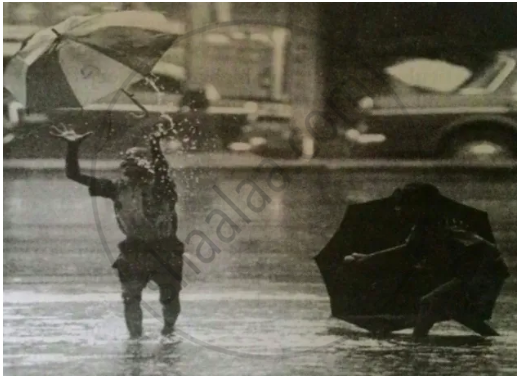
Study the picture given below. Write a story or a description or an account of what it suggests to you. Your composition may be about the subject of the picture or you may take suggestions from it; however, there must be a clear connection between the picture and your composition.
With close reference to the novel Ivanhoe discuss how the central plot revolves around the conflicts and tensions between the Normans and the Saxons.
Answer the following questions with reference to Ray Douglas Bradbury’s short story, ‘All Summer in a Day’:
Why was there so much excitement in the schoolroom that morning? What sets Margot apart from the other children?
Explain the statement, “King Tut is one of the first mummies to be scanned — in death, as in life...”
Notice these expressions in the text. Infer their meaning from the context.
-
Remove
-
slackers
-
muck
-
kept in
-
got carried away
-
cut
-
sadist
-
shrivelled up
Discuss the following with your partner and complete the following sentence.
Organic fertilizer means ______________.
Imagine that Revathi’s father is abroad on business and she wishes to convey the news of her prize - winning plants. Draft an email for the above subject.
(Use an email format.)
Compose two lines of your own on any sensory organ.
From the passage, find and write any two examples of the following:
Sentences containing
- 'must'
- 'can'
Write what you think about the following thoughts and actions of Mathilde:
Mathilde despaired over the loss of her necklace.
Form pairs. Discuss how ‘Part II’ of the story could have been different. Write your storyline in the form of bullets showing the main events.
Listen carefully and write the word in the appropriate column.
| Positive Feelings | Negative Feelings |
Teacher: hopeful, lonely, happy, jealous, surprised, shy, loving, proud, cheerful, anxious, nervous, excited, embarrassed, scared, silly, comfortable, peaceful, depressed, enthusiastic, motivated, inspired, threatened, crushed, angry.
Read the following and draw a tree diagram to show this information.
| Things in our surroundings form two groups - living things and non-living things. Living things are of two kinds, plants and animals. There are two types of plants - flowering plants and non-flowering plants. If we consider animals, we see that some animals lay eggs. They are oviparous animals. Some animals give birth to their young ones. They are viviparous animals. |
Create a poster for the following.
You are Raja/ Ranjani. Draft a poster to create awareness about the harmful effects of using plastics, in not more than 50 words.
Draft Letter for the following.
You are Ajeet, living in a remote village in Tirunelveli. You participated in a health camp organized by your school. You were surprised to observe that most of the residents were unaware of health and hygiene. As a concerned citizen, write a letter to the editor stating the need to organize such camps focusing on the importance of health and hygiene.
Why was Mary Kom named the ‘Queen of Boxing’ and ‘Magnificent Mary'?
Installing a computer
The description of installing a computer in your study room is given in the form of jumbled sentences. Rearrange the sentences in the right order and form a coherent paragraph.
| 1. | Once you connect the CPU, connect the keyboard and mouse. |
| 2. | Before turning on the power, check that all parts are connected to the CPU. |
| 3. | First, open the box and take out the computer parts. |
| 4. | Plug both the computer and the monitor with a power cord. |
| 5. | Set the computer on a table or flat surface. |
| 6. | Finally, turn on the power. |
Answer the following question as briefly as possible and with close reference to the relevant text.
Referring closely to the poem, We are the Music Makers, refer to any two examples given by the poet which identify poets and singers as “movers and shakers.”
