Advertisements
Advertisements
प्रश्न
Prove the following identities:
`(sec A - 1)/(sec A + 1) = (1 - cos A)/(1 + cos A)`
Advertisements
उत्तर
L.H.S. = `(sec A - 1)/(sec A + 1)`
= `(1/(cosA) - 1/1)/(1/(cosA) + 1/1`
= `((1 - cos A)/cos A)/((1 + cos A)/cos A)`
= `(1 - cos A)/cos A xx cos A/(1 + cos A)`
= `(1 - cosA)/(1 + cosA)`
= R.H.S.
संबंधित प्रश्न
Prove that `(sin theta)/(1-cottheta) + (cos theta)/(1 - tan theta) = cos theta + sin theta`
Prove the following identities:
`(cosecA - 1)/(cosecA + 1) = (cosA/(1 + sinA))^2`
If `sin theta = 1/2 , " write the value of" ( 3 cot^2 theta + 3).`
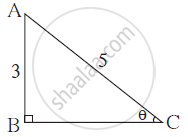
From the figure find the value of sinθ.
If sec θ + tan θ = x, write the value of sec θ − tan θ in terms of x.
If cosec θ = 2x and \[5\left( x^2 - \frac{1}{x^2} \right)\] \[2\left( x^2 - \frac{1}{x^2} \right)\]
Without using trigonometric table , evaluate :
`(sin47^circ/cos43^circ)^2 - 4cos^2 45^circ + (cos43^circ/sin47^circ)^2`
Prove that `"cosec" θ xx sqrt(1 - cos^2θ) = 1`.
If tan θ + cot θ = 2, then tan2θ + cot2θ = ?
Given that sinθ + 2cosθ = 1, then prove that 2sinθ – cosθ = 2.
