Advertisements
Advertisements
प्रश्न
Prove the result that the velocity v of translation of a rolling body (like a ring, disc, cylinder or sphere) at the bottom of an inclined plane of a height h is given by `v^2 = (2gh)/((1+k^2"/"R^2))`.
Using dynamical consideration (i.e. by consideration of forces and torques). Note k is the radius of gyration of the body about its symmetry axis, and R is the radius of the body. The body starts from rest at the top of the plane.
Advertisements
उत्तर १
A body rolling on an inclined plane of height h is shown in the following figure:
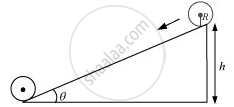
m = Mass of the body
R = Radius of the body
K = Radius of gyration of the body
v = Translational velocity of the body
h =Height of the inclined plane
g = Acceleration due to gravity
Total energy at the top of the plane, E1= mgh
Total energy at the bottom of the plane, `E_b = KE_rot + KE_trans`
`=1/2 Iomega^2 + 1/2 mv^2`
But `I = mk^2 " and " omega = v/r`
`:.E_b = 1/2 (mk^2)(v^2/R_2) + 1/2 mv^2`
`=1/2 mv^2 k^2/R^2 + 1/2mv^2`
`= 1/2 mv^2(1+ k^2/R^2)`
From the law of conservation of energy, we have:
`E_T = E_b`
`mgh = 1/2mv^2(1+k^2/R^2)`
`:.v = (2gh)/(1+k^2"/"R^2)`
Hence, the given result is proved.
उत्तर २
Let a rolling body (I = Mk2) rolls down an inclined plane with an initial velocity u = 0; When it reaches the bottom of the inclined plane, let its linear velocity be v. Then from conservation of mechanical energy, we have Loss in P.E. = Gain in translational K.E. + Gain in rotational K.E.
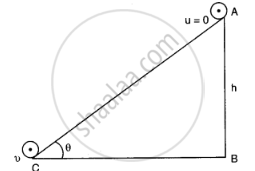
`Mgh = 1/2mv^2 + 1/2 Iomega^2`
`= 1/2mv^2 + 1/2(mk^2)(v^2/R^2)`
`Mgh = 1/2mv^2 (1+k^2/R^2)`
`v^2 = (2gh)/(1+k^2/R^2)`
संबंधित प्रश्न
Read each statement below carefully, and state, with reasons, if it is true or false;
The instantaneous speed of the point of contact during rolling is zero.
Read each statement below carefully, and state, with reasons, if it is true or false;
A wheel moving down a perfectly frictionless inclined plane will undergo slipping (not rolling) motion
Two uniform solid spheres having unequal masses and unequal radii are released from rest from the same height on a rough incline. If the spheres roll without slipping, ___________ .
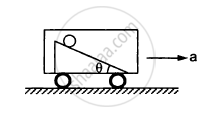
The following figure shows a smooth inclined plane fixed in a car accelerating on a horizontal road. The angle of incline θ is related to the acceleration a of the car as a = g tanθ. If the sphere is set in pure rolling on the incline, _____________.
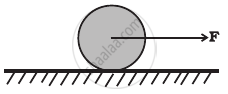
A solid sphere of mass 0⋅50 kg is kept on a horizontal surface. The coefficient of static friction between the surfaces in contact is 2/7. What maximum force can be applied at the highest point in the horizontal direction so that the sphere does not slip on the surface?
Discuss the interlink between translational, rotational and total kinetic energies of a rigid object rolls without slipping.
Answer in Brief:
A rigid object is rolling down an inclined plane derive the expression for the acceleration along the track and the speed after falling through a certain vertical distance.
A pendulum consisting of a massless string of length 20 cm and a tiny bob of mass 100 g is set up as a conical pendulum. Its bob now performs 75 rpm. Calculate kinetic energy and increase in the gravitational potential energy of the bob. (Use π2 = 10)
What is the difference between sliding and slipping?
A uniform disc of mass 100g has a diameter of 10 cm. Calculate the total energy of the disc when rolling along with a horizontal table with a velocity of 20 cms-1. (take the surface of the table as reference)
A solid sphere of mass 1 kg and radius 10 cm rolls without slipping on a horizontal surface, with velocity of 10 emfs. The total kinetic energy of sphere is ______.
A man is supported on a frictionless horizontal surface. It is attached to a string and rotates about a fixed centre at an angular velocity `omega`. The tension in the strings is F. If the length of string and angular velocity are doubled, the tension in string is now ____________.
An object is rolling without slipping on a horizontal surface and its rotational kinetic energy is two-thirds of translational kinetic energy. The body is ______.
A uniform disc of radius R, is resting on a table on its rim.The coefficient of friction between disc and table is µ (Figure). Now the disc is pulled with a force F as shown in the figure. What is the maximum value of F for which the disc rolls without slipping?
The least coefficient of friction for an inclined plane inclined at angle α with horizontal in order that a solid cylinder will roll down without slipping is ______.
If x = at + bt2, where x is the distance travelled by the body in kilometers while t is the time in seconds, then the unit of b is ______.
The kinetic energy and angular momentum of a body rotating with constant angular velocity are E and L. What does `(2E)/L` represent?
An inclined plane makes an angle 30° with the horizontal. A solid sphere rolling down an inclined plane from rest without slipping has linear acceleration ______. (g = acceleration due gravity) (sin 30° = 0.5)
